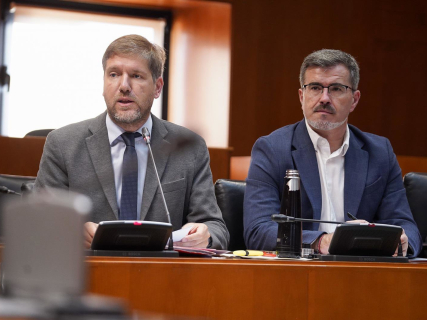

The Agriculture, Livestock, and Food Commission of the Cortes of Aragón has rejected this Monday, with the votes against from PP and Vox, a non-legislative proposal from PSOE that sought to urge the Government of Aragón to "rectify the elimination of aid for local sales in 2025 and to call in this year 2026 a line of aid for the promotion and encouragement of local sales of agri-food products that improves the old aids to make them attractive for small producers."
In his intervention, Marcel Iglesias (PSOE) defended that "aid for local sales of agri-food products should be restarted" because "we are talking about meat producers, for example, who have their own livestock, process their production, and attend fairs, selling directly at their farms or in local stores," with "environmental responsibility" and to "try to maximize their yield."
PP deputy José María Giménez recalled that "the law on local sales of agri-food products regulates the marketing of small volumes of product to improve the economic outcome for the producer and bring the primary consumer closer to the product." However, in light of the data, he pointed out that "we believe that the producer is not interested in this type of subsidies."
On behalf of Vox, David Arranz stated that "this initiative is an example of how PSOE understands agricultural policy." He specified that "in 2021 and 2022, when they were in power, this line had more than one hundred and fifty thousand euros and in the end, only seventeen percent was paid, and in 2023, out of forty thousand euros, just over twenty-five thousand ended up being paid."
CHA deputy Miguel Jaime has expressed his support for the socialist proposal, considering that "it is necessary to recover aid for local sales of agri-food products, as we are talking about maintaining agricultural operations, generating activity in our towns, and ensuring that part of the value of the productions remains in the territory."
From Teruel Existe, Pilar Buj emphasized that "proximity commerce is not a minor issue, it eliminates intermediaries, diversifies benefits, and for a family operation, it can be the difference between continuing and closing." Furthermore, she highlighted that "this commerce is the best ally of quality and trust is what gives value to the ecological and artisanal."