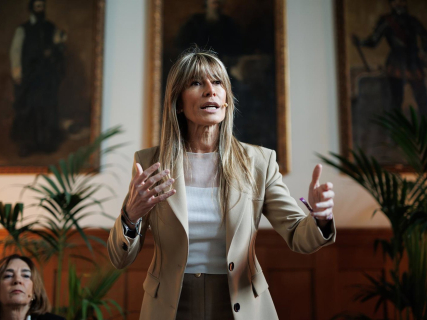
Hairstyle claims explanations from Begoña Gómez about the use of her passport after traveling to the United Kingdom for her daughter's graduation

The magistrate demands that Pedro Sánchez's wife prove that the document was only used to attend her daughter's graduation after it was temporarily returned to her.

2 minutes

fotonoticia 20260626183119 1920

fotonoticia 20260626183119 1920

Add DEMÓCRATA to Google

Ask FREN

Published

Last updated

2 minutes

Most read

The judge Juan Carlos Peinado, investigating the case against Begoña Gómez, has requested this Monday that the wife of the President of the Government, Pedro Sánchez, prove that the only use she made of her passport was for the trip to the United Kingdom authorized by the court to attend her daughter's graduation.

The decision comes after the magistrate temporarily returned her passport, despite the fact that on June 20 he opened oral proceedings against Gómez and ordered, as a precautionary measure, the confiscation of the document and the prohibition of leaving Spain.

The court states that no entry or exit stamps are recorded

In the ruling issued this Monday, Peinado points out that, once the passport was recovered, no exit or entry record is noted in the document "on the authorized days".

For this reason, the magistrate considers it necessary for Begoña Gómez to justify that the passport was used exclusively for the authorized trip and that it was not used for any other foreign travel.

The request seeks to verify that the temporary suspension of the precautionary measure was limited to the specific purpose for which it was granted, that is, to allow her travel to the United Kingdom to attend her daughter's academic event.

The trip was authorized exceptionally

The travel authorization was not granted by Peinado, but by Judge Antonio Viejo, who was in charge of the court during the investigating judge's vacation.

The magistrate allowed Begoña Gómez to travel between July 8 and 10 to attend her daughter's graduation, considering that there was adequate judicial cooperation between Spain and the United Kingdom, even after Brexit, and that the reason for the trip was of a strictly family nature.

However, he rejected her request to travel to Ankara beforehand to accompany Pedro Sánchez at the NATO summit, understanding that her presence was solely for protocol reasons and that Turkey offers fewer guarantees of judicial cooperation than a member state of the European area.

After the trip concluded, Begoña Gómez returned the passport to the court again, with the precautionary measures ordered by Peinado being reinstated while appeals against her indictment remain pending resolution.

With this new requirement, the judge intends to verify that the exceptional authorization granted for travel was used solely on the terms established by the court, before deciding whether to take further action within the judicial proceeding.

More key points, information and questions with FREN

AI-GENERATED CONTENT

What is the current status of the judicial case against Begoña Gómez and what are the next procedural steps planned?

As of now (July 13, 2026), the case against Begoña Gómez is formally in the open oral trial phase following Judge Juan Carlos Peinado's order sending it to a popular jury for several crimes, but the procedure is pending the decision of the Provincial Court of Madrid on the defense's appeals. Meanwhile, Gómez maintains precautionary measures such as passport withdrawal, prohibition from leaving Spain without permission, and the obligation to appear periodically in court. The Public Prosecutor's Office has requested dismissal and, in case of trial, acquittal, while the popular accusations demand very high penalties. The key next procedural steps are the Court's resolution on those appeals and, if the order is confirmed, the preparation and scheduling of the trial before the Jury Court.

Current procedural situation

On June 20, 2026, Judge Juan Carlos Peinado issued an order for opening oral trial and decided that the case be tried by a popular jury, sending Begoña Gómez, her advisor Cristina Álvarez, and businessman Juan Carlos Barrabés to trial for alleged crimes of influence peddling, business corruption, embezzlement, and misappropriation of public funds, as detailed by the newspaper Demócrata in several court chronicles (news about the order and the jury, analysis of the order, piece about the indictment). Other media such as El País or Infobae also describe that indictment for four crimes.

This order includes personal precautionary measures: passport withdrawal, prohibition from leaving Spain, and obligation to appear every fifteen days in court, following the request of the popular accusations led by Hazte Oír (news about precautionary measures, legal explanation). Despite this, a substitute judge has authorized occasional trips, such as a trip to London, but vetoed another to Turkey (chronicle about the trips, news about the NATO summit).

Gómez's defense has appealed those measures and the very sending to trial, filing a complaint appeal before the Provincial Court of Madrid, considering that there is no flight risk and that the order is based on “mere conjectures,” as Demócrata has reported (appeal against the passport, filing to the Court, appeal against the popular jury) and other media like eldiario.es.

The Public Prosecutor's Office has requested dismissal of the case and, subsidiarily, acquittal of the three defendants, while the popular accusations ask for penalties that, in Gómez's case, would reach up to 24 years in prison, as Demócrata explained in the coverage of the preliminary hearing (chronicle of the appearance, position of the accusations).

In parallel, the defense has filed a disciplinary complaint against Judge Peinado before the General Council of the Judiciary for the way the order was notified, a matter also analyzed by Demócrata (complaint before the CGPJ, analysis about the Court and CGPJ). The PSOE has described the procedure as a “democratic scandal” and a “political case,” according to its own statements and public declarations (PSOE reaction, statements by Diana Morant). The PP, for its part, includes the case in its “PSOE corruption map” (PP statement).

Pending decisions of the Provincial Court

The decisive element now is the resolution of the Provincial Court of Madrid, which must rule on:

  • The trial model: whether it confirms that the case should go to a popular jury for embezzlement, something that had already generated previous debates and decisions about the unification of pieces for embezzlement and influence peddling (analysis about the unification, previous Court resolution).
  • The validity of the opening order: according to El País, the Chamber can still “stop” Gómez's sending to the dock if it considers that Peinado's order violates guarantees or is based on insufficient evidence.
  • The precautionary measures: the Court must decide whether to maintain, modify, or revoke the passport withdrawal and other restrictions, in view of the defense's appeal and the report sent by Peinado himself (Peinado's report to the Court).

To date, there is no definitive decision from the Court; Demócrata noted on July 12 that the Chamber had on the table both the jury issue and the appeals on the precautionary measures (preview of the Court's decision).

Next procedural steps

The foreseeable steps, always conditioned on the Court's resolution, are:

  • 1. Resolution of the Provincial Court: if it upholds the appeals, it could order total or partial dismissal, revert proceedings, or change the trial body; if it dismisses them, the opening order will become fully final.
  • 2. Accusation and defense briefs: the opening order has already given notice to the Public Prosecutor's Office to present provisional conclusions within ten days and to the other parties for their briefs (opening order).
  • 3. Trial scheduling: once the competence of the Jury Court is confirmed, the Court will set a date for the jury's constitution and the oral hearing, in which the evidence ordered to be preserved and transferred (documentation, non-reproducible proceedings, statements, etc.) will be presented.
  • 4. Processing of the disciplinary complaint: the CGPJ must decide whether to open proceedings regarding the judge's conduct, something that does not directly affect Gómez's guilt or innocence but does affect the institutional context of the case (complaint before the CGPJ).

While all this is resolved, Begoña Gómez maintains the status of accused (not convicted) and the presumption of innocence fully applies, as many analyses published both in Demócrata (context report, analysis on justice and independence) and other national and international media (El Debate, BBC Mundo, laSexta, El País dossier, eldiario.es).

What specific options does the Provincial Court of Madrid have when resolving the defense appeals of Begoña Gómez? What exact penalties do the different popular accusations request for Begoña Gómez and her two co-defendants? How is this case politically influencing the Government and the relationship between PSOE and PP?

What are the specific competencies of investigating judges in Spain regarding the adoption and lifting of precautionary measures?

The available sources do not provide specific and detailed information about the competencies of investigating judges in Spain regarding the adoption and lifting of criminal precautionary measures, so it is not possible to offer a complete technical-legal explanation (specifying types of measures, legal requirements, or appeal controls) without relying on unverified data. However, I can situate the topic within the institutional and political framework of the Spanish justice system and explain why it is relevant from the perspective of judicial power organization and public debate.

Institutional framework: role of the investigating judge in the Spanish system

In the Spanish constitutional system, the judicial power is an independent power, whose basic organization and competencies are determined by the Constitution and the organic laws regulating the Judiciary and criminal procedure. Within this structure, the investigating judge is a central piece of the traditional Spanish criminal prosecution model, which is based on the existence of an investigation phase separate from the oral trial phase.

This design has several political and institutional implications:

  • Separation of functions: there is a distinction between the body that investigates and adopts certain preliminary decisions (investigating judge) and the body that tries and issues judgment (usually a different court or tribunal). This seeks to guarantee greater impartiality in the trial.
  • Judicial control of the investigation: the criminal investigation is not left solely in the hands of the Public Prosecutor's Office or judicial police but is subject to supervision by an independent judicial body.
  • Impact on fundamental rights: many decisions adopted during the investigation can intensely affect fundamental rights (personal freedom, inviolability of the home, secrecy of communications, property, etc.), which makes the investigating judge a key actor from the perspective of guarantees and public debate on security and rights.

Political and social relevance of precautionary measures

Criminal precautionary measures—whether personal, patrimonial, or limiting rights—have enormous social and political projection, especially in cases with strong media impact (corruption, terrorism, organized crime, gender violence, etc.). Although I do not have the specific regulations in the consulted sources, their importance can be noted in terms of:

  • Balance between security and freedoms: the adoption or lifting of precautionary measures is often at the center of public debate about whether the system is too guarantee-oriented or, on the contrary, too punitive or restrictive of rights.
  • Perception of judicial independence: decisions by investigating judges on precautionary measures in cases affecting political leaders, public officials, or major corruption cases are often interpreted in terms of independence or possible political pressure, impacting citizens' trust in justice.
  • Institutional responsibility: the need to publicly justify (through reasoned orders and resolutions) decisions that may imply deprivation of liberty or intense restrictions of rights makes the investigation activity a focus of political, media, and social scrutiny.

Control of decisions by investigating judges

Although the sources I have do not include normative details, from an institutional and political point of view, the existence of control and review mechanisms for decisions adopted in the investigation phase is relevant:

  • Hierarchy of bodies: decisions by the investigating judge are generally not the final word; they can be reviewed by collegiate bodies of higher rank (such as provincial courts or other competent tribunals), introducing an additional level of guarantees and control.
  • Debate about appeal instances: in political and media spheres, there is frequent discussion about the sufficiency or insufficiency of existing appeals, resolution deadlines, and possible reform of the investigation model (for example, debates about moving to a system more centered on the Public Prosecutor's Office).
  • Transparency and motivation: the obligation to motivate resolutions affecting fundamental rights, even if it does not have direct parliamentary projection, is linked to general demands for transparency and accountability of public powers debated in political forums.

Limits of available information

Since the sources used do not contain specific descriptions of how the adoption, modification, substitution, or lifting of each type of precautionary measure by investigating judges is regulated in detail, nor the concrete structure of appeals before provincial courts or other bodies, it is not possible here to break down specific articles of procedural legislation, technical requirements, or exhaustive typologies of measures.

Consequently, only this overview can be offered about the institutional position of the investigating judge in the Spanish criminal system and about the political and social relevance of their decisions regarding precautionary measures, referring to procedural legislation and specialized jurisprudence for the technical-legal detail not found in the consulted sources.

What political or legislative reforms are being debated in Spain about the investigating judge model and the possible attribution of criminal investigation to the Public Prosecutor's Office? How do decisions by investigating judges on precautionary measures in political corruption cases influence citizens' perception of judicial independence? What role do the General Council of the Judiciary and Parliament play in regulating and potentially reforming the competencies of investigating judges?

What is the professional and political career of Begoña Gómez before becoming publicly known for her relationship with Pedro Sánchez?

Before becoming publicly known for her relationship with Pedro Sánchez, Begoña Gómez developed a career focused almost exclusively on the private professional sphere and the third sector, with no role in institutional politics. Her career revolves around marketing, commercial consulting, and especially fundraising for NGOs, a field in which she is presented as an expert. Until 2018, her profile was that of an executive and consultant specialized in fundraising and social impact projects, with some teaching collaborations at the university, but without known party membership or organizational positions.

Education and academic profile

The available sources indicate that her education is in the business and marketing field, although with mainly private or non-official degrees:

  • Marketing and business: she studied Marketing at the private school M&B Escuela Superior de Marketing y Negocios, which is non-university, which later generated controversy when she accessed the direction of a university chair, since it was not an official degree.
  • MBA and postgraduate training: she completed a master's degree in Business Management and Marketing at the business school ESIC, also outside the official university system, and completed additional training in commercial management and competency management at private business centers.

This combination of training in marketing, commercial management, and organizational management is the basis with which she projects herself professionally, first in companies and later towards the third sector.

Career in the private sector (1990s–2018)

Begoña Gómez's initial professional career is situated in the business and commercial consulting field:

  • Atenea Business Center (1996–1999): she directed this business center, which placed her early in managerial functions related to client management and commercial development.
  • Grupo Inmark (2000–2018): her longest stage was at this commercial outsourcing consultancy, where she became director of commercial outsourcing consulting for Spain and Portugal. Judge Peinado highlights in an order, cited by the newspaper Demócrata, that until 2018 she was “linked to the private labor field of marketing and consulting” and that she requested a leave of absence from that company when Sánchez arrived at La Moncloa, according to Demócrata's news about said judicial order.
  • Task Force (2015): she was partner-director of this firm, reinforcing her profile as a senior consultant in commercial development and sales projects.

In parallel, since the late nineties, she has advised large companies and entities on commercial strategies and fundraising, including Deutsche Bank or consumer brands, according to biographical profiles collected in media such as Telecinco and BBC Mundo.

Specialization in fundraising and the third sector

The shift towards the third sector is key to understanding her projection before 2018. Based on her marketing experience, she specialized in fundraising for non-profit organizations:

  • She advised NGOs such as Oxfam Intermón, Anesvad, or Amnesty International, designing campaigns and financing strategies, according to several media, including ABC and Vozpópuli.
  • She joined the Spanish Fundraising Association and the Woman Action Sustainability network, where she leads a group on business social transformation, according to the profile published by La Razón.
  • She collaborates with rural entrepreneurship initiatives such as El Hueco de Soria and rural women's organizations (Fademur), focused on social and economic impact projects in the territory.

During this period, her visibility remained sectoral, limited to the NGO ecosystem, corporate social responsibility, and impact consulting.

Early link with the university (before Moncloa)

Although the later controversy centers on her relationship with the Complutense University, her collaboration with the UCM began before Sánchez was president. According to a reconstruction of her professional relationship with the university disseminated by El País, in 2012 she began directing a fundraising course; two years later, that course became a proprietary master's degree in fundraising, and later the Master's in Competitive Social Transformation was promoted.

These are "own" postgraduate programs of the UCM, less regulated than official degrees, in which her role is justified by her professional experience in fundraising and consulting, as the rector acknowledged in parliamentary session, according to the same information.

Absence of formal political career

Until 2018, there is no trace of internal party positions, electoral lists, or institutional responsibility of Begoña Gómez. Her public projection is professional and sectoral, not political. The political dimension of her figure appears only as a consequence of Pedro Sánchez's career and, later, the appointments and projects she assumes already with him in the Presidency of the Government, a scenario described critically, for example, in Peinado's order summarized by Demócrata in the cited judicial article.

In summary, before becoming known for her relationship with Sánchez, her profile is that of a commercial consulting and fundraising professional, with strong insertion in the third sector and academic collaborations, but without frontline experience in institutional politics.

How did Begoña Gómez's career specifically change from 2018 when Pedro Sánchez came to La Moncloa? What role did Begoña Gómez have in the Complutense University chair and master's programs and what criticisms have arisen about it? What relationship exists between Begoña Gómez's professional activity and the judicial case being investigated by Judge Juan Carlos Peinado?

Play

Test your knowledge with FREN!

How much do you know about this topic? Answer the following 3 questions.

What was the reason Begoña Gómez was able to travel to the United Kingdom after judicial authorization?

Question 1 of 3

Who exceptionally authorized Begoña Gómez's trip to the United Kingdom?

Question 2 of 3

What was the PSOE's public reaction to the judicial decision regarding Begoña Gómez?

Question 3 of 3

Hola, soy Fren. ¿Cómo te ayudo?