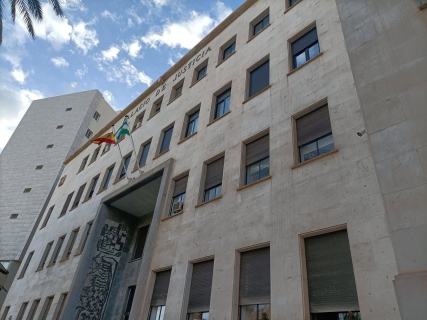

The Provincial Court of Almería has imposed a sentence of seven and a half years in prison on a practice tutor of a student in a vocational training program in computer science for sexually abusing him on two occasions, taking advantage of his role as a hierarchical superior, since the student's grades depended on whether he passed the practices and obtained his qualification.
The resolution, which Europa Press has accessed and against which an appeal can be filed, also establishes for the convicted the prohibition of approaching and communicating with the victim for 15 years, as well as the payment of 9,000 euros as civil liability for the moral damages caused.
The Third Section of the Court emphasizes that, in both episodes, the victim "felt constrained in his sexual freedom in the face of the demands of his superior," who was the person "responsible for his grades in the practices he was carrying out and needed to pass in order to access the job market."
The accused, a member of a computer company and for whom the Prosecutor's Office and the private prosecution requested 14 years in prison, took over the tutoring of the practices of a student from a high school in the capital of Almería in March 2022.
According to the ruling, on April 19 of that year, when both were alone in the server room of a music school, the tutor locked the door "with a key" and told him that he was going to "test him," implying that if he wanted to pass, he had to comply with his sexual demands.
He also indicated that if he complied with his wishes, he would "obtain certain privileges" during the practices and then approached him with lascivious intent. In this way, he violated the sexual freedom of the student, who lacked "the capacity to react" and felt "severely pressured."
The ruling highlights that the tutor took advantage of the fact that they were alone to act with "clear intent to satisfy his libidinous desires" and to assert "his privileged condition and position as a tutor," although it rules out that he used physical violence.
WITHOUT A "THREATENING CONTEXT"
The court details that the situation was repeated the next day at the accused's home, where he again sexually took advantage of the student after insisting that he maintain relations.
In this second episode, the Court appreciates a "lack of consent, since on this occasion the victim "repeatedly refused" to have relations, although it dismisses that there was an "intimidating context." As a result of what happened, the affected person has needed psychological and psychiatric treatment.
During the trial, the accused admitted that he had sexual relations with the student on two occasions, although he tried to minimize the type of practices and denied that they occurred under coercion. He maintained that there was a prior "flirting" with the student, to whom, the day before the first meeting, he sent a photograph of his penis via WhatsApp.
In contrast to this version, the court gives full credibility to the testimony of the harmed party, who from the complaint to the oral hearing maintained that the relations were not consensual, but that he felt "intimidated" and "coerced" by his tutor, being "his superior" and "responsible for his practices," which is why he agreed to his demands "out of fear or dread."
The student reported that, after the first sexual assault, he was in "shock" and "didn't know how to react," and that on the second occasion he expressed his "opposition," although he ended up yielding to the pressures and the accused's allusions to his power to decide on the approval of the practices.
The testimony of the victim was supported by the director of the educational center, who stated that the student left the practices claiming that "something serious had happened," although she did not know the extent of what happened until she spoke with the boy's mother. "There would be no reason for the harmed party to leave those practices if, as the defense claims, the sexual relationship was consensual," reasons the court.
In the same way, a friend of the student explained that he told him about the problems he was having in his internship with his boss, who "was coercing him to have sexual relations with him." The psychological examination conducted on the harmed party confirmed that he was not faking or exaggerating, presenting a post-traumatic stress disorder compatible with a sexual assault.