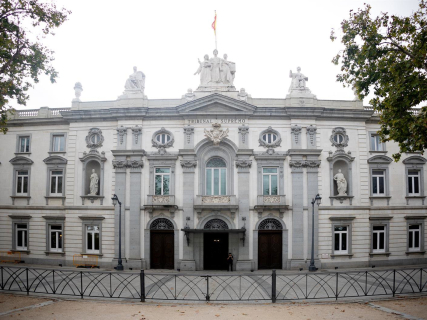

The Executive has delivered to the Supreme Court the list of the 163,355 citizens who obtained Spanish nationality through the so-called 'law of grandchildren' and who will not be able to participate in the upcoming general elections if they do not prove their condition as descendants of exiles, as the high court had requested last Friday.
According to government sources told Europa Press, the documentation was delivered within the deadline set by the Supreme Court, which ended at 3:00 p.m. this Wednesday, and includes the nominal list of those 163,355 people.
The same sources specify that the State Attorney's Office has asked the court to, given that these are especially sensitive data, declare the list as reserved, in order to prevent the parties from making improper or malicious use of that personal information.
They also detailed that the Ministry of Foreign Affairs, European Union and Cooperation has coordinated the work of the consulates in the review of the naturalization files processed in the different consular offices, also authorizing all the technical assistance requested in order to be able to complete the task within the set time.
According to their account, the first telegram with instructions from Justice to the consular offices to collect the data was sent on September 15, after notification of the order by which the Supreme Court agreed to temporarily suspend the voting rights of those naturalized under the 'law of grandchildren'.
In addition, they explain that the Ministry of the Presidency, Justice and Relations with the Courts sent last October 15 to the Electoral Census Office the list of 76,600 people who appear in DICIREG (digital Civil Registry) as naturalized under the provisions of the Democratic Memory Law, which was the only information that department had.
Procedures applied and scope of the voting veto
Sources in the Executive point out that "a large part" of these people will presumably see their right to suffrage suspended, as requested by the political party Vox and other "far-right" associations.
They emphasize that those affected obtained Spanish nationality following the procedure established in the Democratic Memory Law, approved in Congress in 2022, and in the so-called 'law of grandchildren', the instruction that specified that process and recognized the presumption of exile.
They insist that these are "identical" requirements and procedures to those provided for after the 2007 Historical Memory Law, which were applied with "full normality" and under whose force numerous electoral contests were held.
The Government calculates that, taking the usual levels of external participation as a reference, if the more than 160,000 people were registered in the Census of Spaniards Resident Abroad, the potential effect would be less than 14,000 votes distributed among 52 constituencies, which would represent less than 0.06% of the votes cast in the 2023 general elections.
The effective impact would be even smaller, since the list includes people who are not part of the Electoral Census of Absent Residents (CERA), such as minors or deceased citizens, the same sources specify.
Supreme Court requirement and possible fine
Last Friday, the Supreme Court gave the Government a period of five days to send it the list of 163,020 affected by the precautionary suspension of the vote linked to the 'grandchildren law' and warned of the imposition of a possible fine if the requirement was not met.
That period was expressly addressed to the ministers of the Presidency, Justice and Relations with the Courts, Félix Bolaños, and of Foreign Affairs, European Union and Cooperation, José Manuel Albares, urging them to send to the Administrative Litigation Chamber, the Central Electoral Board and the Electoral Census Office the "nominal" list of the affected persons.
"With express warning to the aforementioned that, if after the period of five days which, in any case, will end on October 28, 2026, they do not send the nominal list in question, this Chamber may agree on a coercive fine or deduce, as appropriate, the pertinent testimony of particulars to demand the criminal liability that may correspond," warned the Supreme Court.
The high court indicated that the fine would amount to 1,000 euros for the ministers who "fail to comply with this requirement" and left open the possibility of "reiterating these fines until full execution of the judicial ruling, without prejudice to other patrimonial liabilities that may arise".