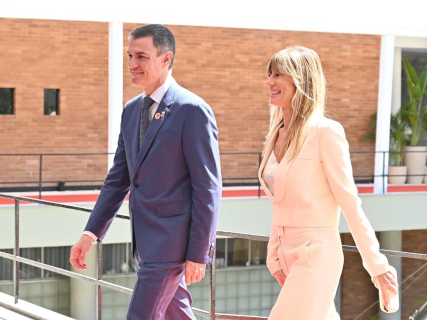
The Provincial Court upholds the jury trial for Begoña Gómez for two crimes but lifts the precautionary measures.

The Provincial Court of Madrid upholds that Begoña Gómez be tried by a popular jury for two crimes, but revokes the withdrawal of her passport and excludes business corruption and embezzlement from the proceedings.

3 minutes

fotonoticia 20260716134322 1920

fotonoticia 20260716134322 1920

Add DEMÓCRATA to Google

Ask FREN

Published

Last updated

3 minutes

Most read

The Provincial Court of Madrid has partially corrected Judge Juan Carlos Peinado and has agreed that the case against Begoña Gómez will continue before a popular jury solely for the alleged crimes of influence peddling and embezzlement of public funds.

The court thus reduces the scope of the proceedings initiated by the head of Investigating Court number 41 of Madrid, who had opened oral proceedings against the wife of the President of the Government for four crimes: influence peddling, embezzlement, business corruption, and misappropriation.

The ruling, known this Thursday, also annuls all personal precautionary measures imposed on Gómez. The wife of Pedro Sánchez will recover her passport, will be able to leave Spain, and will no longer have to appear before the court every fifteen days.

The Court upholds the two main crimes

The Audiencia's decision represents a partial endorsement of Peinado's investigation. The court refuses to completely close the case and supports Begoña Gómez being tried by jury for influence peddling and embezzlement.

The crime of influence peddling is related to the suspicion that Gómez may have used her position and her relationship with the President of the Government to favor certain business and academic projects.

The embezzlement focuses mainly on the activity of Cristina Álvarez, an advisor to Moncloa, and on the arrangements she allegedly made for the chair that Begoña Gómez co-directed at the Complutense University of Madrid. The judge is investigating whether public resources were used to attend to private professional interests.

Along with Gómez, Peinado had sent Cristina Álvarez and the businessman Juan Carlos Barrabés to trial.

Business corruption and misappropriation excluded from the proceedings

The Audiencia revokes Peinado's decision to include the alleged crimes of business corruption and misappropriation in the jury proceedings.

The latter was linked to the software developed for the chair of Competitive Social Transformation at the Complutense University. The university had questioned the use and ownership of the platform and even joined the case.

The resolution therefore limits the jury trial to influence peddling and embezzlement. The complete order must specify the definitive scope of the decision regarding the other two crimes and whether they are dismissed or must follow a different procedural processing.

Begoña Gómez recovers her passport

The second relevant correction affects the precautionary measures. Peinado had confiscated Begoña Gómez's passport, prohibited her from leaving Spain, and imposed the obligation to report to the court every fifteen days.

The investigating judge justified these decisions due to a supposed risk of flight. The Public Prosecutor's Office and Gómez's defense appealed the measures, considering them disproportionate and lacking sufficient justification.

Now, the Court orders their complete lifting. Gómez will be able to travel outside of Spain, will recover her passport, and will no longer have to sign periodically before the judicial authority.

The case is not dismissed

The resolution does not imply the dismissal of the case or the acquittal of Begoña Gómez. The Public Prosecutor's Office had requested the acquittal of Gómez, Álvarez, and Barrabés, arguing that there are insufficient indications of a crime. The popular accusers, led by Hazte Oír, maintain, on the contrary, their requests for conviction.

The case began in April 2024 following a complaint by Manos Limpias and has been marked by successive appeals from the defense and the Public Prosecutor's Office, and by corrections made by the Provincial Court of Madrid to various decisions of the investigating judge. The latest resolution keeps the procedure alive but considerably reduces its scope.

More key points, information and questions with FREN

AI-GENERATED CONTENT

What is the current procedural status of the case against Begoña Gómez and what are the next steps planned according to the Jury Law?

Currently, the case against Begoña Gómez is in the already opened oral trial phase, but with elements still pending before the Provincial Court of Madrid. Judge Juan Carlos Peinado (Investigating Court No. 41 of Madrid) has issued an order for opening an oral trial with a popular jury for several crimes and has imposed precautionary measures such as the withdrawal of the passport and the prohibition to leave Spain. However, there are complaint appeals and appeals in process before the Court that may affect both the precautionary measures and the very option of the popular jury. According to the Organic Law of the Jury Court, the next steps are the processing of the prosecution and defense briefs, the referral to the Provincial Court, the constitution of the jury, and the holding of the oral trial, always conditioned on what the Court decides regarding those appeals.

Current procedural status of the Begoña Gómez case

The central fact is the order by Judge Peinado dated June 20, 2026, by which he agrees to open an oral trial with a jury against Begoña Gómez, her advisor Cristina Álvarez, and businessman Juan Carlos Barrabés, for alleged crimes of influence peddling, corruption in business, embezzlement, and misappropriation of public funds. That order can be consulted in the piece published by the newspaper Demócrata: order opening the oral trial.

In that same resolution and in the news coverage of opening of trial with jury and passport withdrawal, it is recorded that the judge:

  • Opens an oral trial with a popular jury for the four mentioned crimes.
  • Orders the withdrawal of the passport, the prohibition to leave Spain, and the obligation to appear every 15 days at the court for Begoña Gómez and Cristina Álvarez.

Demócrata details that the order forwards the case to the Public Prosecutor's Office so that within ten days it presents its provisional conclusions, and then to the defenses, which must appear before the Provincial Court of Madrid (order opening the oral trial).

The precautionary measures have been executed: Gómez handed over her passport on June 24, according to report on the passport delivery and another note on the passport delivery. Meanwhile, her defense has appealed the withdrawal of the passport and other precautionary measures before the Provincial Court, as explained in appeal against the precautionary measures, piece on the complaint appeal, and information on the popular accusation. Incidents regarding travel authorizations have also been raised, covered in travel to London and veto to Turkey and London tickets and new appeal.

From the point of view of the Jury Law, the case has already been transformed into a procedure for the Jury Court, but that option remains under scrutiny by the Provincial Court. First, Section 23 annulled in February some previous orders by Peinado regarding the jury due to lack of reasoning (Court resolution on the popular jury). Later, on July 12, 2026, the Court held a hearing to decide, among other issues, whether to confirm the indictment and the popular jury route, as reported in key hearing in the Court on the jury.

In parallel, Demócrata emphasizes that “the procedural key is now in the Provincial Court of Madrid,” because it must resolve appeals against previous decisions of the investigating judge, including the transformation to a trial with a popular jury (analysis on the Court and the CGPJ). Therefore, the current status can be summarized as follows:

  • Investigation concluded and oral trial opened by the investigating judge.
  • Personal precautionary measures in force and appealed.
  • Procedure channeled towards a popular jury, but pending what the Provincial Court decides on appeals against that option and the measures.

Next steps according to the Jury Law

The basic regulation is in Organic Law 5/1995, of the Jury Court (Organic Law of the Jury Court), amended by Organic Law 8/1995 (1995 reform), and in Book V, Title I of the Criminal Procedure Law (LECrim), where the “procedure for cases before the Jury Court” is integrated (art. 309 bis et seq.). From the current situation, the standard steps are:

  • 1. Prosecution and defense briefs: After the opening of the oral trial, the prosecutor and the accusations present their charges; then the defense does so. This procedure has already been activated in the order of June 20 (opening order).
  • 2. Referral to the Provincial Court: Once the briefs are received, the case is elevated to the competent Provincial Court, which in Madrid is responsible for holding the trial with a jury.
  • 3. Resolution of pending appeals: Before or in parallel, the Court must decide on complaint appeals and appeals regarding:
  • 4. Trial scheduling and jury constitution: If the Court maintains the competence of the jury, candidates are drawn, challenges are made, and the jury court is formed (nine main and substitute jurors), with a professional magistrate-president, according to the LOTJ.
  • 5. Oral trial: A concentrated trial before the jury is held, with the presentation of all evidence in the plenary, formulation of the “object of the verdict,” and deliberation by the jurors on guilt or innocence. The magistrate-president then issues the sentence, adhering to the verdict, with the appeals provided in the LOTJ and the LECrim.

While the Provincial Court of Madrid does not resolve the appeals regarding the jury route and the precautionary measures, the procedure remains in a situation of formally opened oral trial but procedurally conditioned by those second-instance decisions.

Other contexts and political reactions

The procedure has had a strong political and media dimension. The PSOE has described the order opening the oral trial and the precautionary measures as a “democratic scandal,” defending Gómez's innocence (PSOE reaction, PSOE political note and the official note from Ferraz on the political nature of the case in statements by Diana Morant). Other media such as El País, eldiario.es, or Infobae have emphasized doubts about the evidence, while other outlets and platforms, such as Okdiario or the popular accusation linked to Hazte Oír (heavily cited in Demócrata's pieces) have defended the solidity of the investigation.

There are also various pieces that cover earlier moments of the investigation, the expansion of the inquiry, or conflicts between Peinado and the Court, for example in new indictments in Moncloa, unification of pieces ordered by the Court, extension of the case, balance of one year of investigation, or the different “branches” of the case. Analyses and videos have also been disseminated on other platforms, such as recordings on YouTube 1, YouTube 2, and YouTube 3.

All this is framed within an ordinary criminal procedure redirected to the Jury Law, which now enters its decisive phase: the validation or correction, by the Provincial Court of Madrid, of the judge's decision to send the case to trial with a popular jury and to maintain the most severe precautionary measures.

What exactly can the Provincial Court of Madrid decide about the use of the popular jury in this case? Which specific crimes fall under the jurisdiction of the Jury Court according to Organic Law 5/1995 and why would they fit or not in the case of Begoña Gómez? How is a trial with a popular jury developed, step by step and in practice, in the Provincial Court of Madrid?

What are the competencies and functions of the investigating judge and the jury court in the Spanish judicial system?

The question you raise refers to the internal organization of the Judiciary and the procedural functions of specific bodies (investigating judge and jury court) from a strictly legal-procedural perspective. I specialize in political and institutional information (parliamentary and government activity, political and social current affairs, political actors, etc.), not in the systematic explanation of criminal procedural law nor in general legal teaching. Therefore, I cannot offer you a reliable technical and detailed development about the competencies and functions of these figures in the Spanish judicial system.

In other words: my field is politics and public policies, not professional advice or explanation about the internal functioning of criminal jurisdiction. I can contextualize, when information is available, how certain legal reforms being processed in the Cortes affect criminal procedure, or how a political change influences the institutional design of Justice, but I cannot replace a criminal procedural law manual nor the interpretation that would correspond to professionals in the legal field.

What I can help you with, applied to your topic

Although I cannot technically explain the distribution of competencies between the investigating judge and the jury court, I can help you with issues related to:

  • Political processing of Justice reforms: for example, if the Government or parliamentary groups have promoted bills or proposals that modify the role of the investigating judge, the criminal investigation model (judicial investigation vs. prosecution), or the jury court regime itself. In those cases, I can comment on:
    • Which party or group has promoted the reform.
    • At what parliamentary stage it is (Congress, Senate, amendments, committee, etc.).
    • The main political arguments for and against expressed in debates.
  • Political debate on the criminal process model: when there are public controversies about:
    • Whether the investigating judge should continue to exist or the investigation should be transferred to the Public Prosecutor's Office.
    • Whether the scope of the jury court should be expanded or reduced.
    • Proposals from different parties to “streamline” or “democratize” criminal Justice.
  • Political repercussions of high-profile cases: in criminal matters of great public impact, I can explain:
    • How parties and the Government have reacted to certain judicial decisions.
    • Whether those decisions have triggered initiatives in the Congress or Senate (investigative commissions, bills, appearances by the Minister of Justice, etc.).
    • The treatment given by political and current affairs press, especially media like the newspaper Demócrata, to those cases and institutional responses.

What types of questions are within my specialty

If you want to stay in the political and institutional field, some questions related to Justice that fit within my scope would be, for example:

  • Questions about parliamentary activity in Justice matters:
    • “What reform of the Criminal Procedure Law is currently being processed and what does each party propose?”
    • “Which groups support or reject transferring the investigation to prosecutors?”
  • Questions about the relationship between the Judiciary and political power:
    • “What political debate is there about the renewal of the CGPJ?”
    • “Which parties want to change the system for electing judicial members?”
  • Questions about high-profile cases and their political impact:
    • “How have parties reacted to the trial for [a specific case]?”
    • “What parliamentary initiatives have been registered as a result of that sentence?”
  • General questions about criminal policy in a parliamentary key:
    • “What does the Government propose regarding penalties for certain crimes?”
    • “What political debate is there about toughening or softening the Penal Code in some area?”

General recommendation

For a rigorous and detailed explanation of the competencies and functions of the investigating judge and the jury court, the most appropriate is to consult:

  • Official sources in the Justice field (for example, the Ministry of Justice or the General Council of the Judiciary).
  • Updated manual or guide of criminal procedural law.
  • Professional advice from specialized jurists (lawyers, prosecutors, judges, or university).

If you reformulate your question towards the political or parliamentary plane (for example, asking about ongoing reforms affecting these figures or the political debate about their future), I can give you a detailed answer within my field of specialization.

What criminal procedure reforms are currently being processed or have been recently debated in the Congress that affect the investigating judge or the Public Prosecutor's Office? What stance do the main Spanish parties maintain regarding the maintenance or suppression of the investigating judge in favor of a prosecutorial investigation model? In which recent specific cases has the use of the jury court generated political debate or reform proposals in the Cortes Generales?

What has been the professional and political career of Begoña Gómez before being investigated in this case?

Before being judicially investigated, Begoña Gómez Fernández's career was that of a professional specialized in marketing and, above all, in fundraising for the third sector, with more than two decades of work in the private sector and consultancy for NGOs. She did not hold political or party organizational positions; her public exposure was limited until Pedro Sánchez's arrival at La Moncloa in 2018, from which point she jumped to senior management positions at IE and the Complutense University, which later became central to the judicial case opened in 2024. Her profile was, therefore, that of a fundraising consultant and lecturer who went on to direct academic structures and strategic projects linked to large companies, in a context of increasing political scrutiny.

Biographical data and education

Available biographies agree that Begoña Gómez Fernández was born on March 24, 1971, in Bilbao and grew up in Valderas (León), although some sources place her birth in 1975 (Wikipedia ES, Heraldo). Her education is linked to private business schools: she studied marketing and business administration at M&B Escuela Superior de Marketing y Negocios and completed a master's in Business Management and Marketing at ESIC, of a non-official nature, as well as programs at IDE-CESEM (BBC Mundo, Okdiario, La Razón). She has been married to Pedro Sánchez since 2006 and they have two daughters (Wikipedia EN, Wikipedia EU).

Career in the private sector and consultancy (1990s–2018)

Her professional career began at the Atenea Business Center, which she directed between 1996 and 1999 (Divinity 2016, Divinity 2024). From 2000 she joined Grupo Inmark, where she became director of consultancy in commercial outsourcing and partner-director in the subsidiary Task Force, with a stay of about 18 years (Vikidia, elDiario.es, ABC). From that position, she advised companies and, notably, NGOs such as Amnesty International, Oxfam Intermón, Greenpeace, Anesvad, and private firms like Deutsche Bank or Old El Paso (BBC Mundo, Infobae CV, Vozpópuli profile).

In parallel, she specialized in fundraising for the third sector and joined the Spanish Fundraising Association as a partner from 2012 (Diario La Colmena, Telecinco biography, YouTube interview). Her participation in consultancy projects linked to fundraising and competency-based management models is also mentioned (Política Electoral).

Academic activity and university links

Her relationship with the Complutense University of Madrid (UCM) dates back, according to the university itself and several reports, to the 2012–2013 academic year, when she began teaching and directing a fundraising master's for non-profit organizations (El País 14/04/2025, El País Madrid). From there, she co-directed various proprietary degrees at UCM linked to fundraising and, already in 2020, assumed the direction of the Extraordinary Chair of Competitive Social Transformation and the associated master's (Demócrata – Deloitte and chair, Demócrata – State Attorney).

In 2018, after the successful no-confidence motion and Pedro Sánchez's arrival as President, she requested a leave of absence from Inmark and was hired as executive director of the Africa Center of the Instituto de Empresa (IE), an appointment that generated criticism due to its timing coinciding with the change of Government (BBC Mundo, Infobae first ladies, elDiario.es “Sánchez pause”). From Demócrata, various articles place this professional stage and, above all, her role in the UCM chair at the center of Judge Peinado's proceedings, along with the development of the software and the company Transforma TSC SL (order opening oral trial, UCO report on Transforma TSC, contracts of the chair, UCM as affected party, request to Amazon).

Political and institutional involvement

There is no evidence that Begoña Gómez has held political positions, party organizational roles in the PSOE, or responsibilities in the Administration. Her institutional link is through her status as the wife of the Prime Minister and her presence at official events, as well as her membership in associations such as Women Action Sustainability (WAS) and the Spanish Fundraising Association (ABC, elDiario.es). Her public exposure before 2018 was low, limited to the technical field of marketing and fundraising; from Sánchez's arrival at Moncloa she became a media figure and, since 2024, a protagonist of a judicial case that has polarized Spanish politics (Nueva Economía Fórum – Alegría, Álvaro Nieto, PP and chair, PP – Alicia García, Demócrata – Peinado order, El País 02/04/2025).

Other biographical references

This profile is completed with reviews and chronicles that have systematized her curriculum and her role as the partner of a Prime Minister: L’Enciclopèdia, Divinity, Infobae first ladies, Vozpópuli, elDiario.es, among others. All agree that, until the start of the investigation in 2024, her career was essentially professional and academic, not political, although increasingly surrounded by controversy due to her closeness to the executive power.

At what exact moment and for what specific facts was the judicial investigation against Begoña Gómez opened? What does the Public Prosecutor's Office claim and what do the popular accusations claim about Begoña Gómez's activity at UCM and IE? How have the Government, PSOE, and the opposition reacted to the evolution of the Begoña Gómez case from 2024 until now?

Play

Test your knowledge with FREN!

How much do you know about this topic? Answer the following 3 questions.

For what crimes will Begoña Gómez be judged according to the decision of the Provincial Court of Madrid?

Question 1 of 3

What personal precautionary measures has the Provincial Court of Madrid removed for Begoña Gómez?

Question 2 of 3

What position has the PSOE expressed following the resolution of the Provincial Court of Madrid regarding Begoña Gómez?

Question 3 of 3

Hola, soy Fren. ¿Cómo te ayudo?