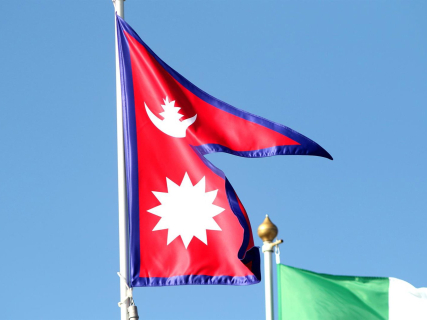
At least 55 dead and 403 missing due to a flood between Nepal and Tibet

The Nepalese Tourism Board estimates that 341 foreigners are missing, including two Spaniards. Authorities have deployed helicopters and ground teams, but the destruction of roads and bridges complicates the rescues.

3 minutes

fotonoticia 20260826145414 1920

fotonoticia 20260826145414 1920

Add DEMÓCRATA to Google

Ask FREN

Published

Last updated

3 minutes

Most read

At least 55 people have died and another 403 are missing after the violent flood that has swept through several towns in northern Nepal, near the border with Tibet. Among the unlocated individuals are 341 foreigners, including two Spanish citizens, according to the latest report released by Nepalese authorities.

The rise hit the mountainous district of Rasuwa on the morning of this Wednesday. Water, mud, and rocks swept away villages, markets, roads, bridges, and hydroelectric facilities located along the Bhote Koshi River, one of the main waterways that cross the border between Nepal and China.

The toll remains provisional. Numerous areas remain cut off, and emergency teams have still not been able to determine the exact number of people trapped or swept away by the water.

Two Spaniards among the missing

The Nepal Tourism Board has counted 403 missing persons, of which 341 are foreigners. Among them are two Spanish citizens, although their identities and the circumstances in which contact was lost with them have not yet been provided. A significant portion of the foreigners were traveling to Tibet to participate in the pilgrimage to Mount Kailash and Lake Mansarovar. This route attracts thousands of Hindu, Buddhist, and Jain faithful each year.

The first lists also include citizens from India, the United States, the United Kingdom, Malaysia, South Korea, South Africa, Australia, and the Netherlands. Authorities are working with travel agencies to verify how many people were actually in the affected area and if some managed to reach safety without yet communicating their situation.

The flood sweeps away towns, bridges, and hydroelectric plants

The mass of water reached around 9:15 AM — 3:30 AM in mainland Spain — the course of the Bhote Koshi and particularly hit the towns of Timure, Rasuwagadhi, and Syabrubesi. Videos released from the area show collapsed buildings, swept-away vehicles, and large areas covered in mud and debris.

The flood has also interrupted one of the main land connections between Nepal and Tibet. On the Chinese side, a landslide reached the border port of Gyirong and cut off roads, communications, and electricity supply.

The Chinese authorities have deployed more than 570 rescuers at the border crossing. The depth of the sediments and the damage suffered by the accesses force part of the journey to be made on foot to the most affected points.

The Nepalese electrical system has also suffered significant damage. Several hydroelectric plants have been paralyzed and around 430 megawatts of generation capacity have been affected, according to the Ministry of Energy of Nepal.

Helicopters and ground teams search for survivors

The Nepalese Army has mobilized six military helicopters and another eight aircraft from private companies. At least 29 people had been rescued during the first hours of the operation.

The efforts are advancing with difficulties. The level of the rivers, the instability of the terrain, and the destruction of roads prevent access to some localities, while the helicopters cannot land in certain areas.

The Government has ordered the evacuation of the population located in the lowest areas and has asked residents to stay away from the banks of the Bhote Koshi, Trishuli, and Narayani rivers. India and China have offered assistance and are maintaining contact with Nepal to coordinate search operations.

An earthquake and a landslide, possible origin of the catastrophe

The Nepalese Foreign Minister, Shishir Khanal, has initially attributed the flooding to an earthquake recorded shortly before the flood. The earthquake would have caused a large ice and rock avalanche that temporarily blocked the river and subsequently released a huge mass of water.

The International Center for Integrated Mountain Development also points to an avalanche of ice and rock in the Lhende Khola river, a tributary of the Bhote Koshi. However, the exact origin of the catastrophe has not yet been confirmed.

Experts have warned that a blockage remains upstream and do not rule out a second flood. Authorities have activated alerts in Nepal and in several territories of northern India due to the possibility that the rise may advance towards areas located downstream.

The Chinese president, Xi Jinping, has ordered to intensify the searches, evacuate exposed people, and strengthen surveillance against possible subsequent landslides or floods.

More key points, information and questions with FREN

AI-GENERATED CONTENT

What are the usual steps followed by the government of Nepal after a natural disaster such as a flood to request international aid?

After a severe natural disaster, such as a flood with casualties and massive damage, the Government of Nepal follows a pattern very similar to that of other countries when deciding to request international aid. The specific steps, names of plans, and agencies are unique to the country, but the general operational framework aligns with how the United Nations, European civil protection mechanisms, and bilateral cooperation described in the consulted sources function.

1. Internal assessment and activation of the national system

In the first hours, the priority is internal: activating the national disaster management system, mobilizing rescue teams, armed forces, and emergency services, and conducting an initial assessment of damages and needs. In other countries, such as Colombia or Japan, this is organized through a crisis management center or office and an emergency response team that coordinates the actions of the State and local authorities, as described for the Colombian earthquake and the earthquake in Japan in this analysis about Colombia and this report about Japan . Nepal follows a similar logic: centralizing command, activating national plans, and organizing rescue, evacuations, and shelters.

Meanwhile, data is collected on deaths, injuries, missing persons, infrastructure damage, and displaced population. This information forms the basis for deciding whether the emergency exceeds national capacity and external reinforcements are needed, as explained for other countries when declaring a “national disaster situation,” which serves to concentrate resources and use extraordinary instruments ( Colombian example ).

2. Political decision to request international aid

The next step is political-institutional: the Government assesses whether its own resources, combined with those of national partners (provinces, municipalities, army), are sufficient to manage the flood. If not, the door opens to international aid.

The United Nations makes it clear that although its teams can offer support, large-scale international response is activated only when the affected State submits an official request for assistance. In the case of the Colombian earthquake, the Office for the Coordination of Humanitarian Affairs (OCHA) emphasizes that it is “prepared to respond” but awaits an “official request for international assistance” from the Government ( OCHA information ). Nepal would follow the same channel: the decision is made at the central Government level and channeled through diplomatic and UN coordination routes.

3. Formal request to the UN and activation of OCHA and INSARAG

Once the decision is made, the Nepalese Government sends a formal request for international aid. This usually:

  • Specifies the type of disaster (for example, floods with landslides).
  • Quantifies preliminary damages and affected areas.
  • Indicates what types of resources are needed: search and rescue teams, logistical support, field hospitals, etc.

With this request, OCHA coordinates the international response, as it does in other emergencies described in the news: it keeps its teams “mobilized” and “at the disposal of governments to provide necessary aid” and coordinates the work of agencies and NGOs on the ground ( message from the UN Secretary-General on floods in Asia ).

If urban search and rescue (USAR) teams are needed, the INSARAG network coordinates the deployment of certified units similar to those described for Colombia and Venezuela, with experts in collapsed structure rescue and specialized medical support.

4. Activation of the EU Civil Protection Mechanism

Third countries, such as Sri Lanka or Colombia, can request support from the European Union. The logic is the same as when Spain requests aid: the affected State submits a request detailing needed resources, which is channeled to the European Commission’s Emergency Response Coordination Centre (ERCC), which distributes the request to participating States and organizes offers, transport, and logistics ( explanation of the European Civil Protection Mechanism ).

In real cases of flooding in third countries, the mechanism has been activated with shipments of medical teams, specialists, and shelter materials, and with emergency mapping support via satellite ( Sri Lanka example ). In a severe flood in Nepal, the procedure would be analogous: request from the Nepalese Government, dissemination by the ERCC, and offers of resources from European States.

5. Maintaining national control and coordination on the ground

Both within the UN framework and the European one, international teams integrate into the affected country’s system and act under its instructions, as the sources on the European mechanism explain. International cooperation does not replace national command: it strengthens it with additional capabilities, while Nepal continues directing evacuations, rescues, and reconstruction from its own civil protection and risk management structures.

What powers does the Minister of Foreign Affairs of Nepal have in the management of international emergencies?

I do not have specialized access or specific tools regarding the institutional organization of Nepal, and I am designed to work deeply mainly with information about the politics and institutions of Spain. Therefore, I cannot accurately describe the specific, legal, and formal powers of the Minister of Foreign Affairs of Nepal in the management of international emergencies (for example, the specific articles of their Constitution, government laws, or internal Ministry regulations).

What I can do is offer a general framework, based on how Ministries of Foreign Affairs usually operate in most States, to help you understand what kind of powers a foreign affairs official typically has in managing international emergencies, and from there you can cross-check that information with specific sources about Nepal.

1. Typical role of a Foreign Minister in international emergencies

In many countries, the Minister of Foreign Affairs (or equivalent) plays a central role in three main areas when an international emergency occurs: diplomatic coordination, protection of nationals abroad, and international cooperation. Although details vary according to each State’s Constitution and laws, these three axes are quite consistent.

  • Diplomatic coordination: the minister leads or oversees official communication with other States, international organizations (such as the UN, regional organizations, or development banks), and multilateral humanitarian actors. This includes transmitting aid requests, offering support to third countries, or participating in emergency meetings at the international level.
  • Consular and nationals’ protection: usually the Foreign Ministry manages embassies and consulates. In an emergency (natural disaster, conflict, attack, global health crisis, etc.), these consular services coordinate to locate, assist, evacuate, or repatriate the country’s citizens affected abroad. The minister sets political guidelines and priorities in these operations.
  • Channeling international aid: when the emergency occurs on national territory, the Foreign Minister usually participates in receiving and coordinating aid arriving from abroad (rescue teams, medical supplies, emergency funds). When the emergency affects a third country, the minister can propose and organize the aid package that their own country offers.

2. Usual powers compared to other ministries

In emergency management, the Foreign Minister normally does not act alone. Ministries such as Interior, Defense, Health, or Civil Protection usually also intervene, depending on the nature of the crisis. In this division:

  • Foreign Affairs handles the international and consular dimension: relations with other States, coordination with international organizations, and protection of citizens abroad.
  • Interior/Civil Protection manage the response within the country (internal evacuations, security forces, emergency services).
  • Defense can provide logistical and military capabilities, especially in evacuations and strategic transport.
  • Other sectoral ministries intervene depending on the type of emergency (health, agriculture, environment, etc.).

The Foreign Minister, in this scheme, is usually the country’s “face” externally when explaining needs or announcing aid commitments, and participates in interministerial crisis committees that make strategic decisions.

3. Limitations of this response and what I can do for you

All the above describes general trends, not Nepal’s specific legal framework. To know precisely what powers the Minister of Foreign Affairs has there, you would need to consult:

  • The Constitution of Nepal and government organization laws.
  • Regulations governing emergency management and civil protection in that country.
  • Official sources from Nepal’s own Ministry of Foreign Affairs.

I specialize in Spanish politics: Congress, Senate, Government, autonomous communities, Official State Gazette, regulations, and political actors. I can help you, for example, analyze the powers of Spanish ministries, legislative reforms, parliamentary votes, party positions, or procedural functioning of institutions in Spain.

If you reformulate your question towards the Spanish context (for example, about Spain’s Ministry of Foreign Affairs or the coordination of international emergencies from the Spanish State), I can provide a much more precise answer supported by official and updated sources.

What is the parliamentary composition of Nepal after the latest elections and which parties form the current government?

I cannot reliably provide the exact parliamentary composition of Nepal after the latest elections nor the closed and updated list of parties forming the government today, because I specialize in the politics and institutions of Spain and do not have direct access, through the tools I work with, to official and real-time data from other countries. However, I can explain how the Nepalese system is organized, what kind of information you need to look for, and in which sources you will find it accurately and updated.

Political and parliamentary system of Nepal (basic overview)

Nepal is a federal parliamentary republic. Its national legislative power is structured in a bicameral Federal Parliament:

  • A Lower House, the House of Representatives (Pratinidhi Sabha), which is the politically more relevant chamber and on which government formation depends.
  • An Upper House, the National Assembly (Rastriya Sabha), with review and territorial representation functions.

The federal government is formed around the party or coalition that obtains the parliamentary majority in the House of Representatives. The prime minister must have the confidence of that chamber, and coalition agreements between parties are common.

What specific data you are looking for

To answer your question precisely about Nepal, two sets of data are actually needed:

  • The distribution of seats by party in the House of Representatives after the latest general elections (for example: X seats for party A, Y for party B, etc.).
  • The composition of the current federal government: which party holds the head of government (prime minister), which other parties support or form the governing coalition, and whether there is external support from parties not formally in the cabinet.

Since this information is very time-sensitive (“after the latest elections” can change if early elections are called or the coalition is reconfigured), any answer based only on prior knowledge could be outdated or inaccurate.

Where and how to obtain Nepal’s parliamentary composition

To get the updated parliamentary composition, I recommend checking three types of sources:

  • Official website of Nepal’s Federal Parliament. It usually offers member lists by party and sometimes visualizations of seat distribution. It is the most reliable source for exact allocation.
  • Nepal’s Election Commission. After each general election, it publishes official results, usually with:
    • Votes obtained by party and constituency.
    • Seat allocation both by simple majority and proportional representation (if applicable).
  • International organizations and observatories (for example, IDEA International, Inter-Parliamentary Union, or comparative parliamentary databases), which usually summarize:
    • Total number of seats in each chamber.
    • Distribution of seats by party after the latest elections.

How to identify which parties form the current government

To know which parties form the government at this moment in Nepal, follow this guideline:

  • Check the official portal of the Government of Nepal and the Prime Minister’s Office, where you usually find:
    • The name of the prime minister.
    • The list of ministers and their portfolios.
    • Sometimes, the party affiliation of each minister.
  • Complement with international and Nepalese media (BBC, Al Jazeera, The Kathmandu Post, Himalayan Times, etc.), which normally describe:
    • The coalition agreement reached after the elections.
    • Which parties are part of the governing coalition.
    • If there are parties that support from outside without holding ministries.

Summary

In summary: I cannot give you right now a numerical list with party names showing how Nepal’s Parliament is distributed after the latest elections nor the details of which parties make up the current government, because my specialization and sources focus on Spain. However, with the above indications you can easily locate:

  • The current seat distribution in Nepal’s House of Representatives, party by party.
  • The current governing coalition and which formations support the prime minister.

If you want to do a comparative analysis with the Spanish parliamentary system (types of coalitions, party system fragmentation, electoral rules, etc.), I could help you in detail based on that data.

Play

Test your knowledge with FREN!

How much do you know about this topic? Answer the following 3 questions.

How many foreigners are among the missing after the flood in northern Nepal?

Question 1 of 3

Which infrastructures were severely damaged by the flood according to the Ministry of Energy of Nepal?

Question 2 of 3

What natural phenomenon is considered a possible cause of the disaster according to the Minister of Foreign Affairs of Nepal?

Question 3 of 3

Hola, soy Fren. ¿Cómo te ayudo?