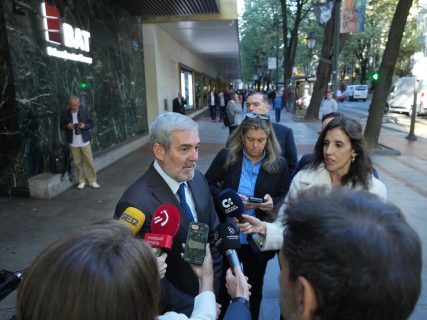

The president of the Canary Islands, Fernando Clavijo, emphasized this Monday in Bilbao that he does not intend to be "unjust with the Government of Spain," but rather to achieve that "the problems" faced by the islands due to the increase in the arrival of migrants are "resolved." For this reason, he explained, he sent a letter to President Pedro Sánchez to ask for "explanations" and the adoption of urgent measures.
With these words, he responded to the Minister of Territorial Policy, Ángel Víctor Torres, who in an interview on RNE stated that Clavijo "is unjust" for accusing the central Executive of "doing nothing" in the face of the migratory surge, and maintained that it is the PP, partner of the Coalition Canaria Government, that "does nothing and puts obstacles in the way" regarding migration issues.
The head of the Canary Executive, who participated in the presentation day of the Future Government Center, promoted by NTT DATA, placed Torres' statements in the context of the electoral pre-campaign and "political polarization," although he stressed that he has addressed himself exclusively to Sánchez, "with education and respect," driven by "the frustration" that it generates for him that the Security Board has not been convened despite having requested it three times from the Ministry of the Interior.
Clavijo detailed that in his letter he only asks the president of the Government to clarify whether the intelligence services were aware in advance that a migratory surge would occur in the archipelago, "why that coordination with the autonomous community did not take place, and what measures have been taken specifically."
"It is not about generating controversies, but about putting in place the necessary instruments and measures, first, to prevent the arrival of those cayucos and those pateras; secondly, to ensure that the attention is dignified for the immigrants, who in my case are unaccompanied foreign minors, and that there are resources," he indicated, insisting that the resources that attend to migrants in the Canary Islands are "overwhelmed, and that it has "an impact on health services," especially on the island of El Hierro.
"We are still not resolving some of the issues from previous stages. Therefore, I do not want to be just or unjust with the Government of Spain. I want the problems of the Canary Islands to be resolved," he reiterated.
The regional president has stated that he is aware that "some issues are difficult to understand for those who obey instructions from Madrid," making it clear that he does not consider himself in that situation. "I have to worry about my citizens and about the attention to those people," he added.
In this line, he reiterated that "the only thing" he demands "is information about what exists, what has been done, or what is intended to be done." "And I am offering collaboration to be able to do it together. I cannot understand those statements," he stated, reiterating that he trusts he will receive a response from the central Government to the letter sent to Pedro Sánchez.
Shared management of the Canary Islands airports
Regarding the meeting that the central Government and the Canary Executive will hold this week about the future management model of the airports of the archipelago, and when asked if he aspires to a scheme similar to that agreed with Euskadi, he answered that yes. "Our Statute of Autonomy is from the year 2018, the Statute of Euskadi is earlier, and we believed that we even had a little more leeway to advance in co-management," he pointed out.
After highlighting that the meetings held so far "have gone well," he recalled that "there is a principle of agreement" that could be specified in the bilateral commission on the upcoming 29th. "It is an example that, when working with loyalty, with coordination, and thinking about the citizen, agreements are reached, as we have reached on other occasions," he concluded.