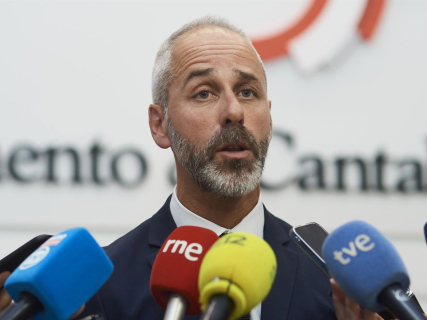

The Education Counselor, Sergio Silva, defended this Monday in the Plenary of the Parliament that one of the main responses of the Government of Cantabria to the poor results of the PISA 2025 Report must be to reinforce from an early stage the stimulation of oral language and reading comprehension in childhood.
Alongside this line of action, he also mentioned the Law of Authority of the Teaching Staff of Coexistence, aimed at improving the climate in classrooms and the learning environment —a regulation that was approved today— as well as the specific reinforcement in mathematics and reading within the academic support plans.
Silva explained that progress is being made in the creation of a network of reference centers that allows for the extension and sharing of good pedagogical practices, and he pointed out that the implementation of an early warning system to detect disconnection or risk of school failure in a timely manner is being analyzed.
The Education Minister appeared this afternoon, at his own request, to assess the conclusions of the PISA Report, which confirm a setback both in Spain and in Cantabria, especially in reading comprehension —the most affected competency, with a drop of 33 points in the community— and also in mathematics and science, with decreases of 25 and 15 points, respectively.
However, he emphasized that, in this scenario, Cantabria has established itself as the most equitable educational system in the country, reflecting that the socioeconomic background of students does not condition their academic performance.
The counselor highlighted that PISA places Cantabrian education in fourth place in Spain, maintaining a solid position despite the widespread collapse, and with the second lowest repetition rate in the national territory.
Even so, he described the figures for 2025 as a "monumental setback" and criticized that the central Executive has avoided opening a debate that he considers "necessary" after the results of the international evaluation conducted on 4th-year ESO students were known.
As he indicated, the situation "is not monocausal" and responds to "many causes" that can occur simultaneously, including the aftermath of the pandemic, changes in reading habits, intensive use of screens and digital devices, discipline problems, greater diversity in classrooms, shortcomings in the governance of the system, and possible failures in the implementation of the curriculum.
In this context, Silva has attacked the LOMLOE, which he blames for having established "a culture of generalized approval, of small effort, of abstract and heterogeneous curricular content."
From the opposition, the spokespeople of PSOE and PRC, Jorge Gutiérrez and Teresa Noceda, have reproached him for dedicating part of his speech to questioning the Government of Spain when the autonomous community has full competencies in educational matters.
Noceda has maintained that in 2023 the Executive of the Popular Party received "a good educational system, among the best in Spain" and has defended that public education constitutes "a strength" in Cantabria.
In turn, Gutiérrez has urged him to "not use partisan slogans" when addressing the educational situation and to "stop hiding" behind statistics to assume his own political responsibility.
In the turn of Vox, its spokesperson, Armando Blanco, has emphasized the "dramatic" nature of the records in reading comprehension. He has also pointed out that it is not possible to be "objective" when comparing with previous calls, given that the percentage of immigrant students in classrooms in the year 2025 has been 60% higher. "Their performance is lower," he said.