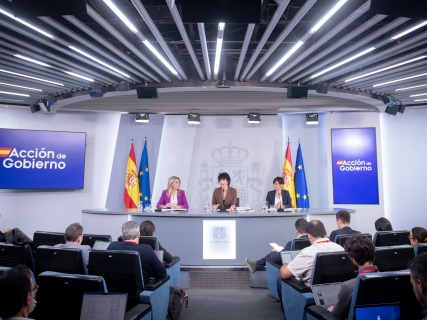

This week the Council of Ministers has made SEVEN appointments.
WHO ARE
In Treasury:
- President of the Independent Authority for Fiscal Responsibility, Inés Olóndriz de Moragas.
- Secretary General of Autonomous and Local Financing, Mónica García Sáenz.
- Director General of Budgetary Stability and Territorial Financial Management, Luis María Temes Castrillón.
- Director of the Cabinet of the Minister of Finance, Sonia Rodrigo Ibánez.
In Digital Transformation and Public Function:
- President of the Council for Transparency and Good Governance, María de la Concepción Campos Acuña.
In Economy, Commerce and Business
- Director of the Cabinet of the First Vice President of the Government, Julio Manuel Poyo-Guerrero Rodríguez.
- Deputy Director of the Cabinet of the First Vice President of the Government, María Mateo Feito.
TO THE BOE: ELEVEN ROYAL DECREES.
WHAT DO THEY REGULATE?
At the proposal of the Presidency of the Government, the modification of RD 1/2024,
by which the Delegated Government Commissions are established.
At the proposal of Presidency, Justice and Relations with the Courts, the modification of the Regulation of Law 23/1982, of National Heritage, approved by Royal Decree 496/1987.
At the proposal of Education, Vocational Training and Sports, Treasury, Social Rights, Consumer Affairs and 2030 Agenda and Digital Transformation and Public Function, the establishment of the Spanish Sign Language Diplomas (DLSE) and the modification of several regulatory norms.
- Orders and formally recognizes sign language as a language, similar to the Diplomas of Spanish as a Foreign Language, with six levels of linguistic competence; A1, A2, B1, B2, C1 and C2.
- The Royal Board on Disability will be the body responsible for the organization of the tests and the administrative and economic management of the diplomas, under the academic direction of the Center for Linguistic Normalization of Spanish Sign Language (CNLSE).
At the proposal of Digital Transformation and Public Function, Treasury and Science, Innovation and Universities, the approval of the Statute of the Center for Technological Development and Innovation (CDTI).
On the proposal of Science, Innovation and Universities, the approval of the Statutes of the Royal National Academy of Medicine of Spain.
At the proposal of Digital Transformation and Public Function, SIX:
The first regulates the modification of RD 47272024, by which the basic organic structure of the Ministry of Science, Innovation and Universities is developed.
The second, the modification of RD 960/2022, which regulates the direct granting of a subsidy to public bodies for civil protection and emergency management of the Autonomous Community of Extremadura, the Valencian Community and the Madrid City Council to develop, implement and validate 5G services and communications for emergencies, within the framework of the Recovery, Transformation and Resilience Plan - Funded by the European Union - Next Generation EU.
The third, the modification of RD 987/2021, by which the direct concession to the autonomous communities and to the cities of Ceuta and Melilla of aid for the execution of various actions to strengthen connectivity in public reference centers is approved, within the framework of the Recovery, Transformation and Resilience Plan.
The fourth, the modification of RD 1124/2024, which regulates the direct granting of a subsidy to Telefónica de España for the project of deploying a submarine cable between the Peninsula and the island of Gran Canaria, of the Connecting Europe Facility-Digital, aimed at strengthening interconnections in the territory of the State, within the framework of the Recovery, Transformation and Resilience Plan - Funded by the European Union - Next Generation EU.
The fifth, the direct granting of aid to research projects selected in the international competitive calls of the European Union's Chips Joint Undertaking (Chips JU), program «UNICO Chips JU - R&D», within the framework of the Recovery, Transformation and Resilience Plan - Funded by the European Union - Next Generation EU.
The sixth, direct grant of aid to research projects selected in the international competitive calls of the European Union's Chips Joint Undertaking (Chips JU), program «UNICO Chips JU - Quantum Pilot Lines», within the framework of the Recovery, Transformation and Resilience Plan - Funded by the European Union - Next Generation EU.
OTHER AGREEMENTS:
THE PRESIDENT OF THE GOVERNMENT WILL FILE TWO APPEALS OF UNCONSTITUTIONALITY.
AGAINST WHAT LAWS?
- Against Decree-Law 10/2025, of the Consell, on urgent measures in matters of ports of the Generalitat and for the minimization of the impact generated by the DANA on the La Albufera Natural Park.
- Against certain precepts of Law 4/2025, on the landscape of La Rioja.
THE GOVERNMENT AUTHORIZES THE SIGNING OF AN AGREEMENT BETWEEN ADIF, THE GOVERNMENT OF CANTABRIA AND THE TORRELAVEGA CITY COUNCIL FOR THE EXECUTION AND FINANCING OF THE RAILWAY INTEGRATION WORKS IN TORRELAVEGA (CANTABRIA) FOR AN AMOUNT OF 138.9 MILLION EUROS.
WITH WHAT SCOPE?
- Integrates the actions that were not completed during the term of the previous agreement, finalized in December 2025.
- The actions include the drafting of the urbanization project for the surroundings of the new passenger building, accesses and necessary road reorganization (45,000 m2) and the execution of the works corresponding to the undergrounding, new passenger building, station parking and urbanization works.
- Adif will contribute 50% of the budget, the Government of Cantabria 30% and the Torrelavega City Council, the remaining 20%.
THE GOVERNMENT APPROVES THE INITIAL PROPOSAL OF EXPANSION OF THE SIERRA DE GUADARRAMA NATIONAL PARK AND AUTHORIZES THE TAIBILLA CANALS ASSOCIATION THE CELEBRATION OF A CONTRACT OF THE SUPPLY OF ELECTRICAL ENERGY, PERIOD 2026 - 2027, FOR AN AMOUNT OF 91.2 MILLION EUROS.
THE GOVERNMENT APPROVES THE GENERAL PLAN OF OFFICIAL PUBLICATIONS OF THE GENERAL STATE ADMINISTRATION FOR THE YEAR 2026.
PRESIDENCY, JUSTICE AND RELATIONS WITH THE COURTS WILL EXTEND THE COMMISSION TO INECO FOR THE SUPPORT TO THE ELECTRONIC JUDICIAL ADMINISTRATION IN THOSE ACTIONS RELATED TO THE TECHNOLOGICAL MODERNIZATION OF THE ADMINISTRATION OF JUSTICE.
WHY AMOUNT?
- For an amount of 45 million euros.
Furthermore, the Center for Legal Studies is authorized to grant financial aid for the preparation of competitive examinations for entry into the Judicial and Prosecutorial Careers, into the Corps of Lawyers of the Administration of Justice and into the Corps of State Lawyers, for a maximum global amount of 18 million euros.
HEALTH WILL SIGN TWO FRAMEWORK AGREEMENTS FOR AN AMOUNT OF 98.4 MILLION EUROS.
FOR WHAT PURPOSE?
- The selection of suppliers for the environmentally friendly supply of endoscopy equipment for several autonomous communities, INGESA centers in Ceuta and Melilla, and State Administration bodies, for an amount of 48.4 million euros.
- The selection of suppliers for the environmentally friendly supply, installation, and commissioning of endoscopy towers, ecoendoscopy ultrasound scanners, and auxiliary digestive endoscopy equipment for several Autonomous Communities, INGESA centers in Ceuta and Melilla, and State Administration bodies, for an amount of 50 million euros.
DEFENSE WILL ENTER INTO A FRAMEWORK AGREEMENT FOR MANAGEMENT SERVICES OF THE MINISTRY'S EARLY CHILDHOOD EDUCATION CENTERS AND ITS AUTONOMOUS BODIES, FOR AN AMOUNT OF 48 MILLION EUROS.
TRANSPORT AND SUSTAINABLE MOBILITY WILL AWARD A WORKS CONTRACT FOR AN AMOUNT OF 17.2 MILLION EUROS.
WITH WHAT PURPOSE?
- The construction of the new Casilla de los Pinos station in Dos Hermanas.
SOCIAL RIGHTS, CONSUMPTION AND AGENDA 2030 WILL CARRY OUT IN ADVANCE A CALL FOR GRANTS FOR AN AMOUNT OF 110.8 MILLION EUROS.
WHAT IS IT ABOUT?
- Regarding the state subsidies of 0.7% for the realization of social interest activities corresponding to the year 2026.
- The aid will be called by the Ministry of Social Rights, Consumer Affairs and Agenda 2030 for an estimated maximum credit of 110.8 million euros, a figure that must be adjusted once the Ministry of Finance determines the definitive collection.
- Among the areas covered by the priorities of the call are access to housing, comprehensive socio-health care, care for people with educational or labor insertion needs, the fight against violence against women, or the promotion of equal treatment and non-discrimination.
- The financing of the aid is done through the collection via the X Solidaria of the income tax return and the Corporate Tax, which is destined for social interest activities.
AT THE PROPOSAL OF SCIENCE, INNOVATION AND UNIVERSITIES, THE STATE RESEARCH AGENCY IS AUTHORIZED TO PROCESS SEVERAL CALL FOR AID PROCEDURES, FOR A TOTAL AMOUNT OF 159.8 MILLION EUROS.
WHAT HELPS?
- Aid to incentivize the incorporation of consolidated talent "ATRAE Program", within the framework of the State Human Resources Program of the State Plan for Scientific, Technical and Innovation Research for the period 2024-2027, for an amount of 45 million euros.
- Aid for the year 2026 for research projects selected in international competitive calls and international concerted actions of a scientific-technical nature, within the framework of "International Collaboration Projects" actions, within the framework of the State Transfer and Collaboration Program of the State Plan for Scientific and Technical Research and Innovation for the period 2024-2027, for an amount of 19.8 million euros.
- Public accreditations and aid to Severo Ochoa Centers of Excellence and María de Maeztu Units of Excellence associated with said accreditations, within the framework of the State Plan for Scientific, Technical and Innovation Research 2024-2027, for an amount of 95 million euros.
In addition, the CDTI will launch for the year 2026 the procedure for granting aid aimed at new business projects by innovative companies (NEOTEC Program), within the Innovation Program of the State Plan for Scientific and Technical Research and Innovation 2024-2027, for an amount of 20.4 million euros.
On the other hand, the State Agency Spanish Space Agency will make a voluntary contribution to the European Space Agency (ESA), for a total amount of 625 million euros in the year 2026, and another to the United Nations Office for Outer Space Affairs, for an amount of 85,329.690 euros in the year 2026.
TERRITORIAL POLICY AND DEMOCRATIC MEMORY REPORTS ON THE EMERGENCY DECLARATION OF AN ASSIGNMENT TO TRAGSATEC FOR AN AMOUNT OF 10 MILLION EUROS.
WHAT DO I ORDER?
- That related to the execution of certain benefits and the extension of their corresponding start period, in accordance with RD-l 5/2026, by which urgent measures are adopted in response to the damages caused by various adverse meteorological phenomena, of special affectation in the autonomous communities of Andalusia and Extremadura.
Furthermore, Minister Ángel Víctor Torres reports on the report of the Consultative Commission for the determination of the headquarters of the Independent Administrative Authority for the Technical Investigation of Railway, Maritime and Civil Aviation Accidents and Incidents.
Finally, the Department will make a voluntary economic contribution, corresponding to 2026, to the OECD, for an amount of 200,000 euros.
ECOLOGICAL TRANSITION AND DEMOGRAPHIC CHALLENGE GIVES ACCOUNT OF THE DECLARATION OF EMERGENCY OF A WORK.
WHAT WORK?
- The work to restore the water supply to the population of Hellín and to the irrigation of the region through the Hellín canal by repairing the Liétor weir (Albacete), as a consequence of the rainfall that occurred between January 26 and 30, 2026.
CULTURE REPORTS ON TWO EMERGENCY DECLARATIONS FOR AN AMOUNT OF 1.1 MILLION EUROS.
WHAT IS ITS OBJECT?
- The contracting of the works for the replacement of the thermal production unit and associated facilities at the National Museum of Performing Arts in Almagro (Ciudad Real), for an amount of 430,549.02 euros.
- The contracting of the works for the repair of the roof of the State Public Library in Girona, for an amount of 693,936.85 euros
TREASURY WILL AUTHORIZE AN EXTRAORDINARY CREDIT, LIMITS AND MODIFICATIONS OF LIMITS TO ACQUIRE EXPENDITURE COMMITMENTS CHARGED TO FUTURE FISCAL YEARS, LONG AND SHORT-TERM DEBT OPERATIONS AND AN ASSIGNMENT TO VARIOUS BODIES AND AUTONOMOUS COMMUNITIES.
TO WHICH ONES?
The extraordinary credit:
- To the State Public Employment Service, to finance services and programs corresponding to active employment policies, for an amount of 25 million euros.
The spending limits:
- To the General Directorate of Public Health and Health Equity of the Ministry of Health, for the processing of expenditure files regarding public subsidies to the "Gasol Foundation" for the development and expansion of the methodology of the FIVALÍN program against childhood obesity.
The modifications of spending limits:
- To the Ministry of Culture, to enable the execution of various works by the Management of Infrastructures and Cultural Equipment.
- To the Ministry of Health, to enable the Mental Health Commissioner to process different service contracts in the field of mental health.
- To the Ministry of Social Rights, Consumer Affairs and Agenda 2030, for the early processing of technical assistance contracts related to the European Social Fund Plus (ESF+) Program.
- To the Ministry of Agriculture, Fisheries and Food, for the processing of new expenses in the budgetary application "Real investments".
- To the Spanish Agrarian Guarantee Fund (FEGA), for the early processing of aid calls within the framework of the Common Agricultural Policy Strategic Plan.
- To the Ministry of Interior, to cover expenses derived from the rental of premises for the Center for Penitentiary Studies and the central headquarters of the General Secretariat of Penitentiary Institutions.
- To the Ministry of Transport and Sustainable Mobility, to carry out various actions related to "Real investments".
- To the Ministry for Ecological Transition and the Demographic Challenge, for the processing of various contracts related to current expenses in goods and services and the realization of investments.
The borrowing operations:
- In the long term, to the Autonomous Community of Catalonia, for a maximum amount of 3,111 million euros.
- In the short term, to the Autonomous Community of the Basque Country, for a maximum amount of 800 million euros.
The assignment:
- From the AEAT to the FNMT, for the manufacturing, storage, custody, distribution and delivery of duty-stamped products, bingo game cards and tax refund checks, for a period of one year from April 12, 2026, for an amount of 15.2 million euros.
In addition, the modification of the contract signed by the AEAT and the UTE new AEAT Valencia headquarters for the works of the new headquarters of the special delegations of the AEAT and of Economy and Finance of Valencia has been authorized.
THE GOVERNMENT APPROVES AN INSTITUTIONAL DECLARATION ON THE OCCASION OF INTERNATIONAL CHILDREN'S AND YOUTH BOOK DAY.
REPORTS:
- Industry and Tourism reports on the report on conjuncture and tourism forecasts: April 2026.
- Science, Innovation and Universities reports on the report on the Spanish system of validations and declarations of equivalence of foreign university degrees. Situation 2025.