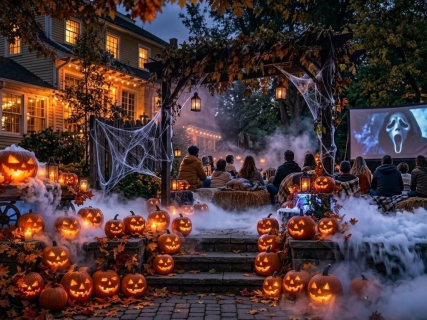

Halloween is celebrated on October 31, All Saints’ Day is on November 1, and All Souls’ Day corresponds to November 2. They are three dates related by the calendar and by some of their traditions, but they do not mean the same thing.
In 2026, Halloween falls on Saturday; All Saints’, on Sunday; and All Souls’, on Monday. That succession makes it easier for the celebrations to mix: the night of costumes gives way to family visits to cemeteries and, in some territories, to an additional festive day.
The religious distinction is clear. The Catholic Church dedicates November 1 to all saints, including those who have not been canonized nor are known by name. On the 2nd, instead, it prays for deceased faithful. Halloween occupies the eve of the first celebration, a relation that remains in the origin of its name.
What Halloween is and why it is celebrated on October 31
Halloween is the celebration of the night of October 31. Its name comes from the English expression All Hallows’ Eve, which means the eve of All Saints’ Day.
Although today it is associated above all with costumes, pumpkins, scary stories, and the custom of asking for candy, its evolution brings together different traditions. Among its antecedents is Samhain, a festival from the Celtic world linked to the end of the harvest and the beginning of the darkest part of the year.
Over the centuries, seasonal customs and Christian celebrations became related and transformed. The contemporary festival is the result of that evolution, not the exact reproduction of a single ancient rite.
For that reason, Halloween is not another name for the Day of the Dead. The first is celebrated the night before All Saints’ Day; the Catholic commemoration of the deceased takes place two days after October 31.
What is celebrated on All Saints’ Day, November 1
All Saints’ Day is a solemnity of the Catholic Church dedicated to those who, according to its faith, share in life with God. It includes both officially recognized saints and those whose holiness does not have a public declaration.
The celebration is not limited, therefore, to the figures that appear in religious images or have their own date on the calendar.
Its antecedents are in the collective commemorations of the martyrs of the first centuries of Christianity. The fixing of November 1 came later: Vatican News links the choice of that date with Pope Gregory III, in the 8th century, and the dedication of a chapel in Saint Peter’s to all the saints.
This historical difference matters: one thing is the origin of the joint celebrations of the martyrs and another the consolidation of All Saints’ Day on November 1.
Why is All Souls’ Day on November 2
The Day of the Faithful Departed is dedicated to prayer for those who have died. In the Catholic tradition, those prayers are offered especially for those who need purification before reaching the fullness of life with God.
The choice of November 2 is linked to Saint Odilo, abbot of Cluny. In the year 998 he established the commemoration of the dead in the monasteries that depended on him. The practice later spread.
Prayer for the deceased was earlier than that decision. Odilo’s contribution was to fix a specific day, immediately after All Saints’, to celebrate it in his monastic community.
The two dates thus express complementary ideas within Catholicism: November 1 celebrates the saints and November 2 commends the departed.
When do you go to the cemetery: November 1 or 2?
In Spain it is customary to visit cemeteries on All Saints’ Day, although the liturgical commemoration of the dead is the following day. Family tradition does not necessarily reproduce the exact separation of the religious calendar.
Cleaning a gravestone, bringing flowers or gathering to remember someone are customs that are distributed between both days and the nearby days. Families’ availability and time off from work also influence the chosen date.
The EFE information on these celebrations precisely reflects that overlap: many faithful begin on day 1 the rites associated with remembering the dead, which contributes to both days being identified as one.
There is no single mandatory date to make a personal visit to the cemetery. Those planning to go this weekend should check the opening hours of their site and any special transport services announced by their city council.
Is Monday, November 2, 2026 a holiday?
The labor and religious calendars are different. The fact that November 2 is All Souls’ Day does not automatically make it a public holiday throughout Spain.
This year, as All Saints’ Day falls on a Sunday, some communities move the workday rest to Monday. Madrid and Andalucía, for example, expressly include that transfer in their official calendars.
That change affects the workday rest, not the meaning of the celebrations: All Saints’ Day remains November 1 and the commemoration of the Faithful Departed continues on the 2nd.
To know whether people work, whether there is class, or whether a shop opens, the corresponding calendars must be consulted. A labor holiday also does not by itself allow one to deduce the hours of all establishments.
Is Mexico’s Day of the Dead the same as Halloween?
They are not equivalent either. The Mexican Day of the Dead brings together its own traditions, among them offerings and family celebrations dedicated to those who have died.
Unesco explains that, in Mexican indigenous communities, these festivities celebrate the transitory return of deceased loved ones. It recognizes them as a cultural expression deeply rooted in community life.
The closeness of the dates and the presence of skulls in some representations can cause confusion, but they do not turn the Day of the Dead into a variant of the costume party.
Buñuelos, santo bones, and panellets: the other November traditions
In Spain, these days also have a gastronomic dimension. Buñuelos de viento and huesos de santo fill the windows of pastry shops, while panellets hold a prominent place in Catalonia.
According to Asempas data collected by EFE, traditional Madrid bakeries sold around 400,000 kilos of buñuelos and 88,000 kilos of huesos de santo in the 2025 campaign. These are figures from last year.
Literature is part of that same imagination. The performances of Don Juan Tenorio and the memory of El monte de las Ánimas, by Gustavo Adolfo Bécquer, keep alive a Spanish tradition of stories, memory and mystery around the beginning of November.
Costumes, flowers and sweets can coincide on the same weekend. To distinguish the dates, it is enough to keep their order: Halloween, October 31; All Saints’ Day, November 1; and Faithful Departed, the 2nd.