
The president of Melilla, Juan José Imbroda, has emphasized the "firm and forceful commitment" of the leader of the PP, Alberto Núñez Feijóo, to the present and future of Ceuta and Melilla, valuing very positively his words in which he demanded the return of all migrants who have accessed irregularly, "including minors."
Imbroda has labeled Feijóo's statements as "very fortunate," understanding that they demonstrate "a conviction and real knowledge" about the decisions that, in his opinion, are required to ensure the future of both cities.
Among the initiatives defended by Feijóo, the popular leader has highlighted "the implementation of a reactivation plan for Ceuta and Melilla, as well as the need for the central Government to promote a Special Regime Law that allows for the legal protection of its fiscal and investment framework and the bonuses to Social Security."
The head of the Melilla Executive considers that these proposals are "very interesting and very important" to bolster the economic and social development of Ceuta and Melilla and to consolidate a scenario of stability for the coming years.
In the same way, he has highlighted Feijóo's idea of reinforcing the coordination and links of the two cities with the institutions of the European Union, so that they can receive treatment similar to that of the outermost regions in matters such as access to European funds, the tax regime, or border management.
Another point that Imbroda has wanted to highlight is the defense of the Spanish identity of Ceuta and Melilla made by Feijóo during his stay in Ceuta. According to the highest responsible of the PP in Melilla, the national leader conveyed a resounding message to Morocco about the "unequivocal character" of Spanish sovereignty over both cities, while offering to maintain a relationship based on "friendship and loyalty" between the two countries.
"That gives us morale, excitement, and hope that this will be resolved when the Spaniards can vote and can decide freely," Imbroda has stated, who has shown himself convinced that Feijóo will end up being the next president of the Government of Spain.
The popular leader has finally reiterated that Ceuta and Melilla "really need" Feijóo to access La Moncloa and has expressed his gratitude for his "conviction and firm commitment" to the two autonomous cities.
Field hospital at the HUME
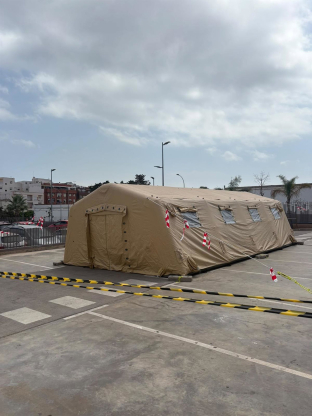
In another order of things, the National Institute of Health Management (Ingesa) has set up a field hospital tent this Thursday in an open area of the University Hospital of Melilla (HUME) with the purpose of reviewing its condition and checking its operability. This is an intervention that, as the agency has emphasized, "does not respond to any emergency situation nor to an immediate forecast of use."
Ingesa Melilla has detailed that throughout the day assembly tests are being carried out to assess the conditions of the structure, detect potential maintenance needs, and ensure that the tent is ready for use if at any moment it becomes necessary.
The agency has added that this installation is part of the prevention and preparation actions included in the General Health Emergency Plan that Ingesa Melilla is currently working on.
The intention is for the assembly and disassembly of this infrastructure to be repeated periodically, with an annual frequency, as a way to verify its conservation and guarantee its availability in the event of a possible contingency.
Ingesa has stressed that the presence of the tent should be interpreted exclusively as a task of prevention, review, and preparation, aimed at strengthening the institutional response capacity to unforeseen situations.
Likewise, it has announced that in the coming dates other modules will be added in different points of the city to carry out maintenance tasks and have an organized response to different disaster scenarios.