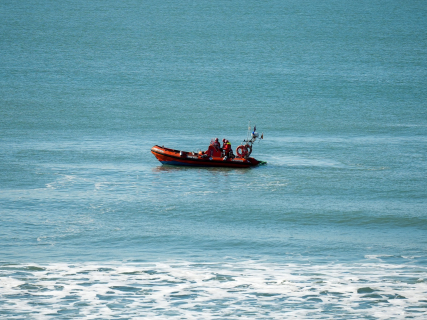

The behavior of the sea surprised this week bathers and neighbors of Santa Pola. The level of the Mediterranean receded suddenly to return afterwards with force, surpassing the usual limit of the beach and reaching areas close to the promenade in Playa Lisa and Gran Playa.
The episode occurred on Monday, August 24. In Santa Pola, the withdrawal began to be noticed around 1:30 PM and, approximately three hours later, the water advanced again until it reached the roadway of the Blasco Ibáñez promenade in Playa Lisa. The Local Police made preventive traffic cuts and there are no significant material damages.
The phenomenon is known as meteotsunami or rissaga. Despite its name and the images of a sudden withdrawal of the sea, it was not a consequence of an earthquake. The State Meteorological Agency (AEMET) has explained that its origin lies in the atmosphere and in the interaction of certain disturbances with the marine surface.
Why the sea receded in Santa Pola
A meteotsunami occurs when certain atmospheric gravity waves generate pressure changes capable of transmitting energy to the sea. The result can be a rapid rise or fall in the water level at beaches and ports, even if there is no seismic movement beneath the Mediterranean.
For the oscillation to reach a noticeable magnitude, resonance also intervenes. If the characteristics of the atmospheric disturbance and those of the sea coincide in a certain way, the wave can be amplified. The very configuration of a bay or a port can further reinforce the movement.
This explains why the episode did not have exactly the same intensity at all points along the coast. While some beaches mainly recorded a visible withdrawal of the water, in other areas currents or sufficiently significant rises appeared to reach normally dry spaces.
It was not a tsunami caused by an earthquake
The main difference lies in the origin. A proper tsunami can be generated by a submarine earthquake, a landslide, or another sudden displacement of a large mass of water. In a meteotsunami, the energy comes from the atmosphere.
AEMET has explained that these episodes do not constitute a new phenomenon. In the Mediterranean, the rissagas of Ciutadella, in Menorca, are especially known, where certain meteorological configurations and the very shape of the port can considerably amplify the oscillations.
For this reason, a sudden withdrawal from the Mediterranean does not automatically imply that an earthquake has occurred. In the episode recorded in the Comunitat Valenciana, the explanation provided by meteorologists is atmospheric.
The water reached the asphalt in Playa Lisa
One of the points where the consequences were most visible was Santa Pola. In Playa Lisa and Gran Playa, the water exceeded the usual sandy area and reached paved areas near the Blasco Ibáñez promenade.
The Local Police opted to temporarily cut off traffic on the affected streets. The measure also aimed to prevent the passage of vehicles from displacing the accumulated water towards the terraces of bars and restaurants in the area.
The episode ended without significant material damage, according to the available local information. The spectacularity of the images was mainly due to the speed with which the position of the coastline changed in a matter of hours.
Dénia recorded a drop of almost half a meter in five minutes
The oscillations were not limited to Santa Pola. They were also detected in other points along the Valencian coast, including Dénia, Xàbia, Gandia, and Cullera. AEMET related these movements to the same type of atmospheric phenomenon.
In Dénia, one of the variations quantified most clearly occurred: the sea level dropped almost half a meter in just five minutes before recovering. The associated currents made it difficult for some vessels to enter the port.
In Xàbia, striking changes were also observed in places like Arenal beach and the Fontana Canal. The retreat temporarily exposed parts of the shore that usually remain underwater.
What to do if the sea suddenly withdraws again
Although a meteotsunami does not have a seismic origin, rapid variations in water level can generate intense currents and dangerous situations. If an anomalous and rapid withdrawal of the sea is observed, the prudent option is to exit the water and move away from the coastline.
It is not advisable to approach the areas that have suddenly been exposed to observe the phenomenon. The movement is part of an oscillation, and the water may return later, as happened in Santa Pola. Caution should also be increased in ports, channels, and breakwaters, where currents can intensify.
If Local Police, Civil Protection, or rescue services restrict access to an area, their instructions must be followed until the sea level stabilizes. In the Santa Pola episode, precisely, the preventive cuts allowed limiting circulation next to the areas reached by the water.
Can another meteotsunami occur?
These phenomena depend on specific atmospheric conditions and their intensity is difficult to anticipate accurately for each beach or port. The configuration of the coast plays an important role in amplifying the oscillations.
After the episode on Monday, it was not ruled out that new movements could be recorded if similar weather conditions persisted in the following days. That does not mean that there is certainty that it will happen again nor that it will do so with the same intensity.
Santa Pola, moreover, has already recorded phenomena of this type previously. The precedents show that, although rissagas are much more known in places like Menorca, they can also appear on the Valencian coast when the necessary atmospheric and maritime conditions coincide.