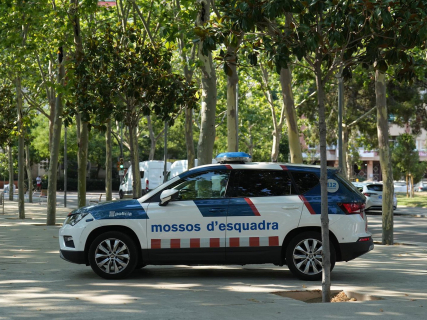

The Foundation for Applied Economic Studies (Fedea) has released a report this Wednesday in which it places the Catalan autonomous police as the non-homogeneous competence with the highest cost for the State, with an estimate of 1.855 billion euros in 2023. Based on this calculation, the research center proposes to take advantage of the reform of the autonomous financing model to rethink the catalog of singular competences.
The analysis, prepared by the director of Fedea, Ángel de la Fuenta, focuses on the financing of these specific competences and is presented amid the ongoing discussion about the reform of the autonomous financing system that will be addressed next week in the Council of Fiscal and Financial Policy.
In the document, Fedea questions the methodology of "historical cost" currently applied, considering that it generates "very disparate and incoherent valuations" for the same service depending on the autonomous community. De la Fuenta argues that these differences are "practically invisible" to the public because the Ministry of Finance does not periodically disseminate the detailed information.
After examining the 2023 fiscal year, Fedea estimates the total disbursement associated with singular competences at 8.319 billion euros, that is, those functions that are only exercised by certain autonomous communities.
After the Catalan autonomous police, the second singular competence with the highest cost is the personnel of the Administration of Justice, with 1.765 billion euros, followed by the provincial participation in State revenues, which totals 1.329 billion.
The report then details other relevant items: funds for linguistic normalization reach 813 million, provincial hospitals account for 606 million, and the penitentiary institutions of Catalonia represent 603 million.
Cost differences in education and justice
In this context, the study includes examples of significant spending divergences for equivalent services, which it qualifies as "hardly justifiable."
In the management of the Administration of Justice, transferred to ten autonomous communities, the cost per inhabitant shows a range exceeding 80 index points. Thus, Asturias has received 81.8 euros per resident, while Galicia has received 35.5 euros and the Community of Valencia 37.7 euros.
The disparities are accentuated in the financing of religion teachers, where the spending per student of school age presents deviations of more than 150 index points. Asturias leads this distribution with 88.7 euros per student, compared to the 20 euros of Catalonia or the 29.2 euros of the Balearic Islands.
Regarding the assessment of the provinces' competencies, the report places Madrid with 136 euros per capita, compared to the 367 euros of Extremadura.
Criticism of the use of VAT and reform proposal
In the context of the negotiation of the new financing system, Fedea rejects the idea of the Ministry of Finance to allow communities to fund these non-homogeneous competencies through the transfer of an additional VAT tranche of up to 90%.
Ángel de la Fuenta considers that this formula reduces transparency, complicates the comparison of actual costs between territories, and makes it difficult for these services to be integrated in the future into the general financing scheme.
As an alternative, Fedea proposes to organize the singular competencies into different groups. For those intended to be assumed by all communities in the medium or long term, such as justice or religion teachers, it suggests gradually adapting their assessment to the spending needs formula of the general block.
In the case of functions that are likely to remain singular for geographical or political reasons, such as prisons or the regional police, the report advocates setting objective reference costs.
The director of Fedea concludes that the reform of regional financing must be accompanied by a homogenization of criteria, urging the elimination of the multiplicity of regimes for uniprovincial communities and to publish all financing transparently, regardless of the means by which it is articulated.