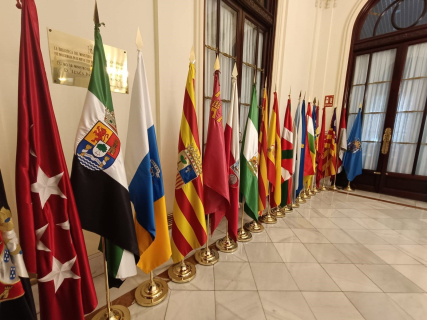

The regionalist parties face the general elections on November 29 with very different strategies. While in territories like Navarra or the Canary Islands some formations have sealed agreements to go to the polls together, others have opted not to present themselves and focus their efforts on the upcoming regional and local elections.
Thus, part of the territorial spectrum has decided to join forces through coalitions, another will run with their own lists, and four parties have resolved to stay out of the state contest to prepare for the regional and municipal elections of 2027.
In this block of alliances is Coalición Canaria (CC), which has promoted a joint candidacy with around twenty forces from the archipelago; Unión del Pueblo Navarro (UPN), which will present itself with the PP; and Teruel Existe and Aragón Existe, which have articulated a coalition to defend the claims of the province of Teruel and the whole of Aragón in a coordinated manner.
On the opposite side, the Partido Regionalista de Cantabria (PRC), Unión del Pueblo Leonés (UPL), Por Ávila, and the Partido Riojano (PR+) have decided not to participate in the general elections.
Between these two approaches are formations like Soria ¡YA!, Geroa Bai, and Adelante Andalucía, which maintain the commitment to their own lists, while the Agrupación Socialista Gomera (ASG) and the Agrupación Herreña Independiente (AHI) will limit their presence to the Upper House.
Alliances to strengthen territorial weight
The search for agreements has become one of the chosen ways to try to gain territorial influence in the Cortes.
In the Canary Islands, CC, Municipalistas Primero Canarias, and about twenty organizations will run under the brand Mesa de Unidad Canaria, which groups forces from the eight islands. The goal is to recompose the unity of Canary nationalism and increase its capacity to defend the interests of the archipelago in Madrid.
The list for Congress for Las Palmas will be headed by Teodoro Sosa, with María Fernández as "number two," while Cristina Valido will repeat as head of the list for Santa Cruz de Tenerife, followed by Jonathan Felipe.
In Navarra, UPN has decided to seal an alliance with the PP, endorsed by 93.5% of its Political Council, with the purpose of protecting the foral regime and the Economic Agreement, as well as promoting infrastructures like the second phase of the Canal de Navarra.
In Aragón, Teruel Existe and Aragón Existe will run under the name Coalition Exists, with the intention of demanding solutions to the deficits in infrastructure, financing, and public services.
These agreements respond to a common concern: to prevent the demands of their territories from being sidelined in a campaign marked by the confrontation between the large national parties. At the same time, other forces consider it essential to preserve their own electoral identity, even at the cost of renouncing alliances.
Defense of a voice of its own in Congress
In this group is Geroa Bai, which will run in Navarra with its own lists to the Cortes after failing to reach an understanding with the PSOE or with Izquierda Unida (IU) for a joint candidacy of the Navarre progressive space.
In this way, the spokesperson in the regional parliament, Pablo Azcona, will head the list to Congress and Mayte Espinosa will be the candidate for the Senate.
Soria ¡YA! also maintains its commitment to candidacies linked to the territory, with Juan Antonio Palomar as the head of the list to Congress and David Romera to the Senate.
In Andalusia, Adelante Andalucía will present itself in the eight provinces to the Lower House with a campaign focused on housing and urban speculation, in addition to the everyday problems related to transportation, wages, and the cost of living.
For its part, the Agrupación Socialista Gomera (ASG) and the Agrupación Herreña Independiente (AHI) have decided to concentrate their intervention in the Senate, with lists in their respective islands.
Four parties reserve forces for 2027
In contrast to those seeking a seat in the Cortes, the PRC, UPL, Por Ávila, and PR+ have concluded that the general elections are not the best ground for their objectives and have opted to reserve resources for the regional and municipal elections of 2027.
In the PRC, the issue generated internal debate. Its Executive Committee agreed not to run by 39 votes in favor and 14 against, after gathering the opinion of the local and regional boards. Its general secretary, Miguel Ángel Revilla, has attributed the renunciation to the strong state political polarization and to the "difficulties" in achieving representation in Congress.
UPL has made a similar decision considering that the deployment of resources required for a national campaign could "condition" its options in the local elections.
For Ávila has ruled out participating understanding that the campaign will revolve around the figure of the president of the Government, Pedro Sánchez, and not around the specific needs of the province, such as the problems of connection by road and railway.
The Riojan Party, finally, has decided to reserve its efforts for the elections to the Parliament of La Rioja and for the mayorships of its 174 municipalities.
In this way, the campaign of 29N will serve to measure three strategies among the territorial parties: alliances to gain parliamentary weight, own candidacies to maintain a differentiated voice, and the renunciation to compete to concentrate on the autonomous and municipal sphere.