
A painting that had been outside the international art circuit for decades could be a new original work by Caravaggio. Italian historian Maria Cristina Terzaghi, one of the leading specialists in the Baroque painter and one of the experts who identified the "Ecce homo" discovered in Madrid in 2021, has attributed to the artist a canvas located in the back room of a Paris gallery. The painting, titled "Young man with a pitcher of roses", depicts a young boy accompanied by a glass container with flowers and would have been made between 1596 and 1597, during the first years of Michelangelo Merisi da Caravaggio in Rome.
The find has been made known by the researcher herself in an article published this Sunday, November 8, in the Italian newspaper La Repubblica. As she subsequently explained to El País, the specialist found the work about three years ago, when she was invited to examine a painting that remained in a Paris gallery. Although she initially showed skepticism, her impression changed when she looked at the canvas. Since then, she has worked on reconstructing its provenance and on analyzing the stylistic elements that, in her view, make it possible to attribute it to the Italian painter.
The news represents a new chapter in the search for missing works of Caravaggio, one of the great representatives of European Baroque, whose preserved output is especially limited. However, the attribution still must be distinguished from a general acceptance of authentication by the scientific community. For now, it is a proposal defended by Terzaghi, supported by historical and artistic arguments, but it will have to be examined by other specialists.
The find in a Paris gallery: a painting lost for more than a century
The story began three years ago, when Maria Cristina Terzaghi went to a Paris gallery to examine a painting that until then had remained outside public knowledge. The researcher has said that she found the painting in a back room of the establishment and that, despite the dirt accumulated on its surface, she was impressed by its quality.
The work depicts a young man with a melancholic expression, dressed in a white shirt and placed beside a crystal jug with roses. The composition stands out for its treatment of light, the precision of its reflections, and the rendering of natural details—elements that Terzaghi considers characteristic of the artist’s early paintings. The canvas measures 66 by 52.5 centimeters and currently belongs to a French private collection, whose owners had preserved the work without knowing its possible authorship.
Until now, historians knew of the existence of "Young Man with a Rose Jug", but they had not identified the original with certainty. The composition was known through four old copies, one of which is preserved in the High Museum of Art in Atlanta, which made it possible to reconstruct how the missing painting would have been. The painting located in Paris would constitute a fifth version and, according to the specialist, would be the original model from which the others were derived.
Although the attribution has been presented publicly this November, the existence of the painting had already become known in some specialized circles during 2025. Terzaghi had advanced his hypothesis in the catalog of an exhibition on Caravaggio, while the Spanish magazine Ars Magazine published in January of that year information about a possible work by the artist preserved by a French family. The new development is that the researcher has now publicly explained her arguments and images of the canvas have been circulated.
From the Borghese collection to Paris: the journey of a possible Caravaggio
One of the main arguments that Terzaghi uses to support authorship is the historical documentation that would make it possible to reconstruct a large part of the painting’s journey over more than four centuries. According to her research, the painting appears mentioned in an inventory dated August 1, 1607 relating to the assets of Giuseppe Cesari, known as the Cavalier d'Arpino, an Italian painter in whose workshop Caravaggio had worked during his youth.
The collection of Cesari ended up in the hands of the Papal State after the artist was implicated in a judicial proceeding related to an assault. His works then passed to Pope Pablo V, who subsequently handed them to his nephew, the cardinal Scipione Borghese, one of the main art collectors of the time. That collection formed the origin of the current Borghese Gallery in Rome, an institution that preserves several paintings by Caravaggio.
"Young man with a rose vase" appears in the inventories of the Borghese collection of 1693 and would have remained associated with it at least until 1831. From that moment on, its path is less clear. Terzaghi argues that the painting left Italy and arrived in France, although he has not yet been able to fully reconstruct the period that separates its presence in the Roman collection from its later appearance in Paris.
The next known documentary trace is located in 1909, when the widow of a Parisian bookseller sold the painting at an auction where it was listed as a work by an anonymous Italian painter. It was acquired by an ancestor of the current owners, who kept it for generations without any possible connection to Caravaggio coming to light. This provenance constitutes an important element of the hypothesis, but the connection between the current canvas and all the historical inventories still needs to be examined as a whole.
The detail of the vase that could hide a Caravaggio self-portrait
The painting presents a particular feature that has aroused special interest among researchers: the reflection of water inside the glass vase. According to Terzaghi, in that small space a window and the figure of another young man can be distinguished, an element that could constitute a self-portrait by Caravaggio himself, although this interpretation has not yet been demonstrated.
The detail is relevant because it coincides with a description made by Giovanni Baglione, a contemporary painter and the artist’s rival, who left a record of a work in which Caravaggio had represented a vase of flowers with special attention to the water transparencies, the reflections of the glass, and the drops of dew on the petals.
The coincidence between that description and the painting found in Paris is one of the elements used to support the claim that the canvas could correspond to the original work. The precision of the luminous effects and the treatment of everyday objects fit, according to Terzaghi, with the technical and visual investigations that Caravaggio developed during his first years in Rome, when he was still defining the pictorial language that would eventually make him one of the most influential artists of his time.
The specialist also links the composition with "Boy bitten by a lizard", another youthful work by the Italian painter. Both depict young figures accompanied by natural elements and could form part of an artistic exploration of the senses. In this interpretation, the lizard painting would be related to touch, while "Young man with a ewer of roses" would represent smell, through the flowers that accompany the protagonist.
The same expert who identified the "Ecce homo" of Madrid in 2021
The announcement has gained particular impact due to the career of Maria Cristina Terzaghi, a professor of Art History at the University Roma Tre and one of the specialists who participated in the recognition of the "Ecce homo" of Caravaggio discovered in Madrid in 2021.
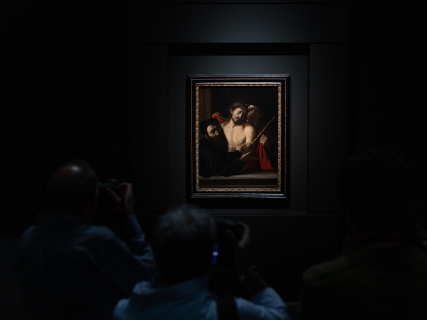
That painting was going to be auctioned at the Ansorena house with a starting price of 1,500 euros, after having initially been cataloged as a work from the circle of José de Ribera. The intervention of several art historians, including Terzaghi, made it possible to recognize its possible importance and led the Spanish Ministry of Culture to declare the painting non-exportable while the corresponding studies were being carried out.
After a process of research, restoration, and analysis of its provenance, the work was recognized as an original by Caravaggio and was exhibited at the Museo del Prado between May 2024 and February 2025. The case became one of the most significant artistic rediscoveries of recent years and placed the Italian researcher among the central figures in the identification of the painting.
Now, Terzaghi considers that the canvas located in Paris could represent a comparable discovery, although the new attribution has not yet followed a public study and validation process equivalent to the one that made it possible to recognize the Madrid “Ecce homo”. In addition, the identification of Caravaggio works often generates intense debates among specialists, especially when it involves paintings known through old copies.
How much could the painting be worth and where will it be exhibited?
The possible recognition of “Young Man with a Pitcher of Roses” as an original work by Caravaggio could turn the canvas into a piece of extraordinary historical and economic interest. The Italian painter has a small number of known works, and his paintings rarely appear on the international market, which explains the attention that any new attribution draws.
According to estimates collected by El País, the painting could reach a value of at least 30 million euros if its authorship were confirmed, taking as a reference recent transactions related to other works by the artist. However, for now there is no announced sale price or definitive appraisal that could be considered confirmed, and its valuation would depend on recognition of the attribution, the state of preservation, and the applicable legal conditions.
The future of the painting also remains open. Since it is in France and belongs to a private collection, French authorities could study its protection as part of cultural heritage if its relevance is confirmed. One possibility would be to declare it a national treasure to restrict its exit from the country, although no official decision in this regard has been announced. There is also no confirmed date for its first public exhibition.
Meanwhile, the art world has known another attribution to Caravaggio during the same weekend. The historian Gianni Papi presented on November 7, during a conference held in Montepulciano, a hypothesis about the authorship of a youthful portrait that had previously been cataloged as a 16th-century Tuscan school painting. This is an independent investigation, whose arguments are still pending publication in detail.
The appearance of "Joven con jarra de rosas" once again shows that the history of European painting still preserves works whose identity remains hidden in private collections. In this case, the combination of historical documents, stylistic similarities and a composition known for centuries has made it possible to formulate a new attribution to Caravaggio. Its definitive confirmation will depend on the studies that can be carried out on the painting and on the analysis of other specialists, while the question remains as to when it may be viewed publicly.