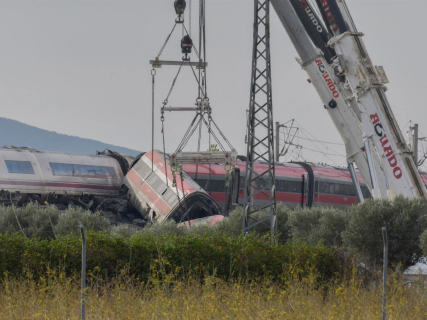

The judge who is investigating the Urda (Toledo) railway accident, in which 69 people have died, has urgently demanded that more workers be added to the removal work of the wrecked wagons to ensure that the search efforts can proceed without interruptions. The decision comes after the lack of personnel from the crane company contracted by Adif and Renfe prevented work from continuing during the night from Saturday October 31 to Sunday November 1, despite the fact that there was already a judicial requirement to keep the activity going.
According to what was reported this Sunday by the High Court of Justice of Castilla-La Mancha (TSJCLM), the magistrate, holder of position number 2 of the Civil and Investigation Section of the Court of First Instance of Orgaz, issued on Saturday an order directed at the company responsible for the cranes so that it would provide the necessary workers and organize the corresponding shifts. The objective was to keep the removal of the convoys going throughout the night and facilitate the location of the possible remains that might still be found among the accident wagons.
The order could not be complied with during the past early morning due to the insufficiency of workers, although the work resumed at 8:00 a.m. this Sunday, as published by EL ESPAÑOL. The judicial decision responds to the need to complete as soon as possible the inspection of the trains and locate the remains that might remain at the accident site in order to proceed with their delivery to the relatives.
The judge orders shifts to be organized to work without interruptions
The magistrate considers it a priority that the search and removal work of the wagons not be halted again due to lack of workers. For this reason, her order requires the crane company to mobilize the necessary personnel means to establish the shifts that allow the workers who have been working since the accident last Wednesday October 28 to be relieved.
The requirement was agreed and notified during the course of Saturday, with the intention that the teams would remain operational during the night. However, the company did not have enough staff to maintain that activity, which forced the tasks to be interrupted until the following morning. The new judicial demand seeks to prevent the situation from happening again in the coming hours, when the inspection of the area where the wrecked trains were left is still continuing.
According to the TSJCLM, the priority is to locate all possible remains that may still remain at the accident site and to facilitate their delivery to the families as soon as possible. The removal of the carriages constitutes an essential part of these works, as it makes it possible to access spaces that still must be checked. These operations are being carried out in an area subject to judicial and police control, where the relevant elements for the investigation of the causes of the disaster must also be preserved.
Forbidden to disseminate images and information of the victims and their families
Along with the requirement to reinforce the work, the investigating judge has issued an order prohibiting obtaining, disseminating or publishing information or images related to the victims of the railway accident and their relatives. The resolution aims to protect their privacy, integrity and dignity, in addition to preventing them from suffering new situations of public exposure during the days following the tragedy.
The prohibition establishes an exception for the dissemination of those data that are necessary for the purposes of identifying the victims. In this way, the magistrate seeks to reconcile the protection of the affected persons with the essential actions to carry out the identification work and keep the families informed.
The judicial proceedings continue under secrecy of the record, so all the details of the measures taken and the provisional conclusions of the investigators are not publicly known. The resolution on the protection of the victims is added to the measures adopted from the outset to control access to the disaster area and preserve possible clues.
The Civil Guard keeps the accident area of Urda sealed off
While the train removal operations continue, the Guardia Civil maintains a broad deployment to prevent the access of unauthorized persons and ensure the preservation of the evidence. As the armed institute spokesman, Pedro Pablo Garrido, explained to EFE, the restricted area comprises two kilometers of the Madrid-Seville high-speed line in both directions from the accident site.
The operation includes surveillance drones, mounted officers, citizen security patrols and personnel specialized in the control of nearby roads and paths. Canine units are also taking part, continuing to search for biological remains among the elements of the accident. Access is limited to security forces personnel and those with the corresponding judicial authorization.
The judge had already ordered on the day of the accident to prevent the entry of people unrelated to the investigation and to avoid the unauthorized removal of materials that could constitute evidence. On Saturday, officers detected a private drone recording images in the restricted area and identified its owner, according to the Guardia Civil. The surveillance seeks to avoid interference in the search work and ensure that investigators can reconstruct the circumstances of what happened.
The Guardia Civil finishes collecting the belongings of the passengers
In parallel, the Guardia Civil has concluded the collection of belongings of the travelers on the AVE and Iryo trains involved in the accident in Urda, according to sources from the armed institute confirmed to EFE. A total of 525 people were traveling on both convoys, of whom 69 died in the railway tragedy last Wednesday.
The recovered belongings will be handed over to their owners through the railway companies responsible for the services, which will be in charge of the corresponding return process. This action is being carried out independently of the search for remains and the proceedings aimed at clarifying the causes of the collision.
Early this Sunday, around fifty Guardia Civil officers were still deployed in the zero zone, where five wagons had already been removed from the tracks, although they remained in the vicinity of the accident. The removal of the trains is being carried out progressively and under the restrictions established to preserve the clues that may be relevant to the judicial investigation.
The judge's demand to add more workers puts the focus on the need to continue the work over the next few hours without new interruptions. The priority remains to complete the search, facilitate the delivery of the remains to the families, and ensure that the progress of the wagon removal tasks is compatible with the preservation of the evidence that will make it possible to clarify what happened in Urda.