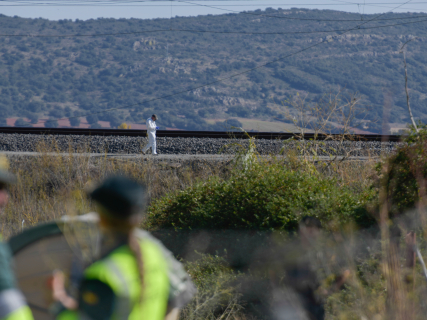

Renfe and Iryo have put the mechanisms in place to advance the first financial compensations to the victims and families of the Urda (Toledo) railway accident, which occurred last Wednesday, October 28, and which has left a provisional toll of 69 dead. The operators have begun processing the advances with the backing of the insurers QBE and Intact Insurance, which participate in the civil liability coverages related to the trains involved in the accident. The measure seeks to provide financial support to the affected people before the investigations conclude and it is determined what final compensations correspond for the damages suffered.
According to the information reported by Expansión and confirmed to Europa Press by company sources, the procedure to request the first payments is already available, although this does not mean that all the families have received the money. European regulations oblige railway companies to pay, in the event of death, an advance of at least 21,000 euros per passenger, while Iryo has announced that it will raise that amount to 35,000 euros per deceased person. The difference between these payments and the final compensation is fundamental: the advance seeks to cover urgent needs, but it does not determine the total compensation nor does it mean that the railway company acknowledges having been responsible for the accident.
How much money can the victims of the Urda accident receive
Article 15 of Regulation (EU) 2021/782, which regulates the rights of rail passengers, establishes that companies must pay advances to meet the immediate financial needs of the victims and their families. In cases of death, the amount cannot be less than 21,000 euros per passenger, while for injured people the amount must be proportional to the damages suffered and their needs.
The rule also sets a maximum period of 15 days from when the person entitled to receive the compensation has been identified. This detail is especially relevant in a tragedy like that of Urda, where the identification tasks of the victims are still conditioning the processing of the files. The period does not necessarily begin on the day of the accident, but when it is determined who is entitled to the advance.
Iryo has decided to go beyond the legal minimum and pay 35,000 euros for each deceased passenger, according to what it has officially communicated to its customers. The company has also confirmed that it will offer advance amounts to the injured, although in these cases it has not set a single figure, since it will depend on the severity of the injuries and the circumstances of each affected person.
As for Renfe, the public operator has confirmed that it has assistance mechanisms and the corresponding coverages activated, although it has not announced a specific additional amount equivalent to the 35,000 euros communicated by Iryo. The applicable amount must be adjusted, as a minimum, to the obligations established by the European regulation.
What is the difference between an advance and a final compensation
The main difference lies in the purpose of the payment and the moment in which it is made. The advance is an amount that is delivered so that the affected persons can face immediate expenses without having to wait for the result of an investigation that may last for months. Its purpose is to cover urgent needs, especially when a person has died, has suffered serious injuries, or has temporarily lost their ability to work.
The final compensation, on the other hand, is calculated taking into account the total of the damages proven and the liabilities that correspond. Depending on each case, it may include medical expenses, rehabilitation, physical and psychological sequelae, loss of income, material damages, moral damages, and other economic consequences derived from the accident.
The European regulation clarifies that the payment of an advance does not constitute an acknowledgment of responsibility on the part of the railway company. This means that Renfe or Iryo can provide money to the affected persons before the technical and judicial investigations determine what happened and who is responsible for its consequences.
It also establishes that the amounts advanced may be deducted from the compensations that are subsequently paid under that regulation. Therefore, the 35,000 euros announced by Iryo should not automatically be interpreted as an additional amount that will be added in full to any future compensation, but as an advance payment that may be taken into account in the final settlement.
Nevertheless, the collection of that money does not imply, in itself, that the victim or their relatives waive claiming other amounts. European regulation also limits the cases in which the return of the advance may be demanded, which include certain cases of fault by the traveler or payment to a person who was not entitled to receive it.
What insurance intervenes in the compensations of Urda
In the management of the compensations, different types of insurance participate, which it is advisable to distinguish in order to understand the rights of travelers. One of the main coverages is the Compulsory Travelers Insurance (SOV), included in the train ticket and regulated by Royal Decree 1575/1989. This insurance protects passengers against the bodily consequences of a railway accident and provides for financial benefits in the event of death, temporary or permanent incapacity, as well as medical assistance under the conditions provided.
The SOV should not be confused with the civil liability insurance, which covers the financial obligations that may arise from damage caused to third parties when there is compensable liability. Civil liability compensations can cover different concepts and require analyzing the circumstances of the accident, the harms suffered, and the situation of each victim.
QBE is among the civil liability insurers of Renfe and Adif and also participates in part of Iryo's coverage. For its part, Intact Insurance provides civil liability coverage to Iryo and has confirmed that it maintains contact with the operator to coordinate the procedures related to the victims. The insurer has specified that direct communication with those affected and the processing of claims correspond to the railway company.
In the case of Renfe, the Compulsory Travelers Insurance is contracted with Everest Insurance, while its civil liability coverage constitutes an additional mechanism. The operator has indicated that the insurance policies and the victim care teams were activated from the very first moment of the accident.
This distinction is also important because the SOV and civil liability claims have different grounds. The regulations of the Mandatory Traveler Insurance expressly establish that its benefits do not reduce the amounts that may correspond for civil liability. By contrast, the advances regulated by European regulation can be deducted from subsequent payments made under that same regulation.
How to request the advances from Renfe and Iryo and what documentation is needed
The railway companies have enabled specific channels to facilitate the procedures for victims and their relatives. Iryo has published an economic assistance statement in which it details the different benefits available and the procedure to access them. To request an advance for death or injuries, interested parties can write to buzonafectados6076@iryo.eu, where these requests are handled.
The company also has the free phone number 900 001 403 and a specific form for the benefits of the Mandatory Traveler Insurance. In addition, it has announced the reimbursement of the full amount of the ticket and certain justified expenses for transport, accommodation and meals, depending on the circumstances of each affected person.
For its part, Renfe keeps active the victim and family assistance phone number 900 10 10 20, in addition to its network of assistance centers. To process the benefits of the Mandatory Traveler Insurance, those affected can fill out the accident notification form available at stations, at family assistance centers or through the operator's website. They can also request it by email seguros@renfe.es.
In any case, it is important to keep the ticket, medical reports, proof of travel and accommodation, invoices and any documentation that allows the damages and expenses suffered to be proven. In the event of death, it will also be necessary to prove the identity and relationship with the victim, as well as provide the additional documents required by the procedure.
Consumer organizations also recommend carefully reviewing any settlement proposal or compensation agreement before signing it, to check whether it is only an advance or whether it includes conditions that may affect future claims.
Immediate aid does not replace claims for damages
The implementation of the advances constitutes an initial economic response, but it does not resolve the compensation process for the victims of the railway accident. To calculate the final compensation, it will be necessary to determine the extent of the damage, the medical progress of the injured, and the possible responsibilities of the companies or entities involved.
The investigation into the accident remains open and must clarify the circumstances in which an AVE train of Renfe collided with a convoy of Iryo in the vicinity of Urda. The technical conclusions and any judicial rulings will be relevant for establishing the responsibilities that apply, although the families do not have to wait for that outcome to access the advances provided for in European regulations.
It is also advisable to distinguish these payments from the extraordinary public aid that the Government may approve. The state measures approved at the beginning of 2026 for the victims of the Adamuz and Gelida accidents responded to a specific regulation and should not be automatically considered applicable to Urda without a provision establishing this.
The immediate priority of Renfe, Iryo and their insurers is to facilitate the first economic resources while the procedures for identification and assessment of damage advance. For the victims and their relatives, the essential issue is to understand that receiving an advance does not mean collecting the final compensation: these are two different moments in a process that may include several coverages and whose outcome will depend on the particular circumstances of each case.