
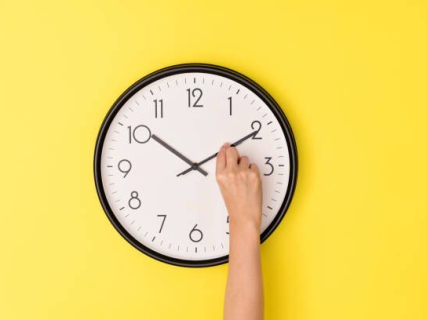
Spain has changed the time during the early morning of this Sunday, October 25, 2026, starting the winter time. At 03:00 hours, the clocks have been set back to 02:00 in the Peninsula, Balearic Islands, Ceuta, and Melilla, while in the Canary Islands the change occurred at 02:00, when it became 01:00 again. This adjustment, scheduled in the official calendar published in the Official State Gazette (BOE), means that Sunday will have 25 hours instead of the usual 24 and that, from now on, it will dawn and dusk an hour earlier according to the clock.
The time change has generated one of the most common questions at this time of year: what time is it really in Spain now and how to know if the mobile phone has updated correctly? Most current devices, both Android and iPhone, make the adjustment automatically as long as the date, time, and time zone options are activated. However, some devices may keep the previous time if synchronization is disabled, have connection problems, or use a manual setting.
What time is it now in Spain and the Canary Islands
Since the early morning of this Sunday, mainland Spain, the Balearic Islands, Ceuta, and Melilla are in the UTC+1 time zone, while the Canary Islands use UTC+0, so the archipelago is one hour behind the rest of the country. As a reference, when it is 10:00 in Madrid, Barcelona, Valencia, or Seville, it is 09:00 in Las Palmas de Gran Canaria and Santa Cruz de Tenerife.
To check that the clock shows the correct time, citizens can consult the official Spanish time from the Royal Institute and Observatory of the Navy, an agency dependent on the Ministry of Defense that maintains the national time reference. It is also possible to compare the phone's time with other devices that are connected to the internet and have automatic synchronization enabled.
The change to winter time does not modify the actual elapsed time, but the time reference used. Therefore, if a mobile phone continues to show summer time, it will mark one hour more than it corresponds, which can cause confusion when checking transport schedules, attending appointments, or setting alarms.
How to check if your iPhone has changed the time automatically
iPhone users can easily verify that their device has adapted to the new schedule. Apple allows you to automatically set both the time and the time zone through an option included in the system settings.
To check it, you need to follow these steps:
-
Open the Settings app on the iPhone.
-
Access the General section.
-
Select Date & Time.
-
Check that the "Set Automatically" option is enabled.
-
Review that the time zone corresponds to the device's location.
If the phone continues to show an incorrect time, Apple recommends checking the internet connection and updating the operating system. It is also possible to temporarily disable the automatic setting to manually set the time and time zone, although this alternative should only be used when synchronization does not work properly.
How to know if an Android phone has updated to winter time
On Android phones, the settings may vary slightly depending on the manufacturer and the version of the operating system. However, most devices allow you to check the update from the settings menu.
The usual procedure consists of accessing Settings, System, and Date & Time, although on some models, such as those from Samsung, this option may be found under General Management. Once the section is located, it is necessary to check that the "Automatic date and time" and "Automatic time zone" functions are enabled.
Google also allows access to these options from the Clock app, by entering its settings and selecting the section intended to change the date and time. If the device continues to show the previous time, it is recommended to check the network connection, review the time zone, and restart the device to facilitate a new synchronization.
If the automatic setting does not work, the corresponding time zone can be set manually, although it will be advisable to reactivate synchronization when the problem is resolved.
What happens with alarms and clocks that do not change by themselves
The transition to winter time can also affect certain electronic devices. Although mobile phones, computers, and smartwatches usually update automatically, other devices, such as wall clocks, traditional alarm clocks, ovens, microwaves, or systems in some vehicles, may require a manual adjustment.
In the case of phone alarms, it is usual for them to continue functioning at the scheduled local time after the change. However, it is advisable to check alarms and reminders, especially if they were set during the early morning in which the time change occurred, since the time period between 02:00 and 03:00 has repeated.
It is also recommended to check the time indicated on train, plane, and other transportation tickets, as the official departure and arrival times are generally expressed in the local time corresponding to each station or airport.
Will this be the last time change in Spain?
The change on this October 25, 2026 is listed as the last of the five-year calendar published in the BOE in March 2022, although that does not mean that Spain will stop changing the time from now on. The current regulations contemplate the continuity of seasonal adjustments unless a European decision is made to eliminate them.
The European Commission proposed in 2018 to abolish time changes and the European Parliament subsequently supported a proposal to end this practice. However, the member states have still not reached the necessary agreement to implement the reform, so the current system remains in effect.
For now, Spain has launched this Sunday the winter schedule and will maintain one hour less difference compared to universal time on the Peninsula than during the summer. To avoid errors, the main recommendation is to check that electronic devices have automatic synchronization activated and to compare their time with an official source.