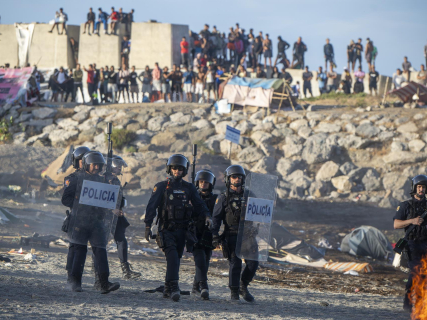
Defense authorizes the military to use weapons in Ceuta: there will only be one loaded rifle per patrol

The deployed personnel will be able to use their firearms in case of self-defense. In the patrols formed by four or five military personnel, only one will initially carry the weapon with ammunition.

1 minute

fotonoticia 20260901145608 1920

fotonoticia 20260901145608 1920

Add DEMÓCRATA to Google

Ask FREN

Published

Last updated

1 minute

Most read

The military deployed in Ceuta will be able to use their firearms in case of self-defense during the patrols they carry out in the autonomous city. However, the arrangement contemplates that, in general, only one out of every four or five personnel forming a patrol will carry a loaded rifle.

The measure is framed within the rules of action established for the military deployment after the incidents recorded during the migration crisis in Ceuta and several attacks against members of the Armed Forces.

One armed soldier per patrol

According to the information published this Tuesday by El Español, soldiers will have weapons during their duties, but the ammunition will be limited.

In a patrol made up of four or five personnel, one of them will carry the loaded weapon. The use of the weapon is restricted to self-defense situations.

The Association of Troops and Spanish Marines has demanded that all deployed personnel be able to have weapons with ammunition during the patrols.

The debate arises while the Armed Forces maintain their presence in Ceuta within the deployment established after the massive entry of migrants at the end of July.

What it means to be able to use the weapon in self-defense

The authorization does not imply that the military can use their weapons in any incident. The use of force is subject to the rules established for the operation and to the principles of necessity and proportionality.

The issue has gained special relevance after the incidents suffered by some patrols, including stone-throwing and other objects.

More key points, information and questions with FREN

AI-GENERATED CONTENT

What legal requirements regulate the use of weapons by the military on national territory according to Spanish legislation?

The use of weapons by military personnel on Spanish territory is strongly conditioned by the Constitution and a set of organic laws and regulations that establish under what circumstances they may use force and with what guarantees. In normal times, the Security Forces and Corps are the ordinary holders of citizen security, and the Armed Forces only act in support or in very limited cases; in any case, the military are subject to strict limits of legality, necessity, proportionality, and respect for fundamental rights.

1. Basic constitutional framework
  • The Constitution, through Article 8 (cited in the Organic Law 5/2005, on National Defense), assigns the Armed Forces the mission of guaranteeing the sovereignty and independence of Spain, defending its territorial integrity and the constitutional order; it does not grant them a general police function.
  • Fundamental rights (life, physical integrity, freedom, inviolability of the home, etc.) and their criminal protection are developed in the Penal Code (Organic Law 10/1995), which provides for legitimate defense and the state of necessity, but also punishes torture, inhuman treatment, illegal detentions, illegal searches, and other abuses of authority committed by officials, including military personnel.
  • Article 116 of the Constitution is developed in the Organic Law 4/1981, on states of alarm, exception, and siege, which sets the framework for restrictions on rights in exceptional situations, always under the control of the Congress and with judicial guarantees.
2. Missions and employment of the Armed Forces on national territory

The Organic Law 5/2005, on National Defense, specifies the internal use of the Armed Forces:

  • It defines that defense policy protects the Constitution, rights and freedoms, and territorial integrity, and frames the use of military force under the direction of the Government and, ultimately, the President of the Government.
  • It establishes that the Armed Forces contribute to security and defense, and that, together with other institutions, they must preserve citizen security and welfare in cases of serious risk, catastrophe, or calamity. This function is articulated, among others, through the Military Emergency Unit (UME) and the National Civil Protection System (Law 17/2015).
  • It foresees operations for maritime and airspace surveillance and support to the State Security Forces and Corps, which opens the door to their internal use, but always subordinated to the competent civil authority and current legislation.
3. Rules of conduct and use of force by the military

The Organic Law 9/2011, on the rights and duties of members of the Armed Forces, is key because it sets the statute of the military and their rules of conduct:

  • It declares that military personnel hold fundamental rights like any citizen, with only the strictly necessary limitations for their missions.
  • It reiterates that the military is a “holder of force” and must be prepared to use it “under the orders of the Government,” but it includes essential rules of conduct:
    • Respect for the dignity and inviolable rights of persons.
    • In the “legitimate use of force,” gradual and proportionate use, according to the rules of engagement issued for each operation.
    • Prohibition to obey orders that constitute a crime, especially against the Constitution or against persons and property protected in armed conflict; in such cases, the military must refuse to comply and report it to the superior command.

These rules connect with the Military Penal Code (Organic Law 14/2015), which typifies as crimes abuse of authority, excess in command exercise, violations of fundamental rights, and other illicit behaviors committed by military personnel, even in security operations.

4. Exceptional states and citizen security operations

The Organic Law 4/1981 regulates states of alarm, exception, and siege. In them:

  • The Government may assume reinforced powers to maintain public order (prolonged detentions, searches without ordinary authorization, circulation restrictions…), always with temporal limits and under authorization or control of the Congress.
  • The intervention of the Armed Forces in these situations is carried out under governmental authority and without removing judicial controls over detentions, searches, and other interferences.

In normal times, the Organic Law 4/2015, on the protection of citizen security, mainly regulates the actions of the Security Forces and Corps, but sets principles that also bind the military when acting as agents of authority: legality, proportionality, minimal interference, and non-discrimination, especially in identifications, searches, evictions, and public road controls.

5. Technical and internal security regulations

At a more operational level, the Royal Decree 194/2010, on security rules in the Armed Forces, regulates the security of installations and the actions of the military, naval, and air police, including the custody of armaments and measures to protect personnel and assets. Although it is an internal regulation, it reinforces that weapon handling is governed by strict security protocols and by the responsibility of the unit commander.

In summary, Spanish legislation requires that the use of weapons by the military on national territory:

  • Be based on a legal authorization and competent command (Government and chain of command).
  • Always respect fundamental rights, with only the restrictions allowed by the Constitution.
  • Observe the principles of necessity and proportionality and the established rules of engagement.
  • Be subject to criminal, military, and disciplinary control in case of any abuse or illegitimate use of force.

What are the competencies of the Ministry of Defense in authorizing the use of force by the Armed Forces in crisis situations?

In the Spanish constitutional system, the Ministry of Defense plays a key role in the planning, administrative direction, and operational execution of the employment of the Armed Forces, but it does not solely hold the competence to “authorize” the use of force. That decision is shared among several constitutional bodies: the King (as supreme commander), the President of the Government, the Council of Ministers, and, in certain cases, the General Courts.

General framework: who decides the use of force

The Constitution establishes that the King is the supreme commander of the Armed Forces, but the effective exercise of decision-making power corresponds to the Government (President and Council of Ministers), politically responsible before the Courts. The ultimate authorization for the use of force in crisis situations therefore responds to a political decision of the Government, subject to parliamentary control, which is executed through the Ministry of Defense and the military chain of command.

Specific competencies of the Ministry of Defense

The Ministry of Defense is the department responsible for defense policy and the preparation and employment of the Armed Forces. Its core functions, in relation to the use of force, are essentially the following:

  • Advising the President and the Council of Ministers: the Defense minister formulates proposals on military options, rules of engagement, risks, and necessary means for the different possible responses in a crisis (both internal and external).
  • Strategic planning and conduct: once the political decision is adopted by the Government, Defense translates that decision into operation plans, orders, and directives to the Defense Staff (EMAD) and operational commands.
  • Allocation of resources: determines which units, capabilities, and resources are made available for a specific operation, both on national territory and abroad, and under what employment conditions.
  • Administrative and logistical direction: guarantees the sustainment, supply, transport, health, and logistical support of deployed forces, as well as coordination with other involved ministries (Interior, Foreign Affairs, etc.).
  • Relations with allies and international organizations: leads, on the military level, participation in structures such as NATO or the EU, proposing the Spanish contribution to collective defense or crisis management operations.
  • Supervision of compliance with the legal framework: ensures that the rules of engagement, international humanitarian law, and internal regulations are integrated into doctrine and orders to the troops.

Types of crisis situations

In missions abroad (collective defense, peace operations, or crisis management), the Ministry of Defense proposes military options and executes the decisions of the Government and the Courts (when parliamentary authorization or control is required), ensuring the integration of the Spanish force into the corresponding international command.

In support to civil authority on national territory (catastrophes, serious emergencies, protection of critical infrastructures), Defense plans and executes the military deployment at the Government’s request, usually in coordination with Interior and other departments. The use of armed force is strictly limited to what the constitutional and legal framework authorizes, and usually focuses on logistical support, protection, and technical tasks.

In states of alarm, exception, or siege, the initiative and declaration correspond to the Government and the Courts, but the Ministry of Defense is responsible for organizing and conducting the employment of the Armed Forces according to the adopted measures (for example, assuming public order functions in a state of siege).

Differences with other constitutional bodies

  • President of the Government: directs the Government’s action and holds the highest political responsibility in the decision to employ force. Defense advises and executes his decisions but does not replace them.
  • Council of Ministers: collectively adopts agreements involving the use of force, participation in operations abroad, or proposals for exceptional states. The Ministry of Defense proposes and develops measures, but the principle decision corresponds to the Council.
  • General Courts: exercise functions of authorization and control, especially in operations abroad and in states of alarm, exception, and siege. The Ministry of Defense provides the necessary technical-military information for that control but cannot replace it.
  • His Majesty the King’s Household: the King is the supreme commander of the Armed Forces but always acts according to the Government’s decisions, which is politically responsible. The Ministry of Defense articulates the military chain of command linking that supreme leadership with operational commands.

In summary, the Ministry of Defense does not “authorize” the use of force by itself, but operationalizes and leads the decisions of the Government and the Courts, integrating the military dimension within a political and legal framework strictly defined by the Constitution and laws.

Which political parties have requested changes in the rules of engagement for the military in Ceuta following the migration crisis?

Based on information available in the press and statements from the parties themselves, those who have most clearly proposed changes in the rules of action — and, in some cases, in the “rules of engagement” — for the military deployed in Ceuta following the recent migration crisis are primarily Vox and the People's Party (PP). Their proposals aim to toughen the border response and provide the Armed Forces with a broader legal framework to use force and act in public order incidents.

Vox

Vox is the party that explicitly demands “rules of engagement” for the military in Ceuta and Melilla. According to the newspaper Demócrata, the party presents in Congress a proposal to deploy Army units and Navy ships at the borders of both autonomous cities “to repel new massive entries of migrants,” demanding that military personnel and agents be provided with “clear and lawful rules of engagement” to prevent irregular immigration entry and guarantee Spain’s territorial integrity (Demócrata news).

This initiative is formulated directly “after the events recorded in Ceuta” and justified by the party as a response to an “unprecedented national security crisis,” emphasizing the risk of the presence of criminals, prisoners, or even possible jihadists among the migrants who entered the city. The declared objective is for the Armed Forces to have the margin to prevent and repel new attempts to “violate” the border, both for its deterrent effect and for the operational reaction that the new rules would allow.

Additionally, Vox has proposed the need to “militarize the border” of Ceuta and Melilla, reinforce human, material, and legal means, and deploy the Army permanently in future crises, as reflected in various Demócrata chronicles about their parliamentary interventions and press conferences, where they insist on tougher border control and stable deployment of military units (another Demócrata piece).

People's Party (PP)

The PP, for its part, has focused its demands on providing the military with a clearer and broader legal and operational framework to act in Ceuta, which, without always using the expression “rules of engagement,” practically means requesting changes in the rules governing their actions.

In an official note, the PP itself details that its Parliamentary Group has registered in Congress a Non-Legislative Proposal asking the Government to grant the military deployed in Ceuta the status of agents of authority, along with “means” and “clear orders,” so they can defend themselves and perform their work “with all guarantees.” Spokesperson Ester Muñoz emphasizes that there is regulation that would allow giving them that status and providing a legal framework that also protects their physical integrity (PP statement).

In parallel, other popular leaders – such as Borja Sémper – have explained that the PP has presented a PNL so that the Government gives the necessary orders to the Armed Forces so the Army can “defend itself and pursue crime” in Ceuta, associating that request with the need to restore public order in the city (another PP note).

Although the PP does not systematically use the technical terminology of “rules of engagement,” its approach points to a toughening and clarification of the military’s rules of action: expanding their capacity to intervene in aggressions, status as authority, and normative and operational reinforcement to respond to security incidents linked to the migration crisis.

Other parties

In the consulted documentation, positions from other formations (such as PSOE or nationalist options) appear, but mainly focused on the political assessment of the crisis, the Government’s management, or the rejection of violence and the “militarization” of the border, rather than concrete proposals to modify the military’s rules of engagement.

The PSOE, for example, has issued a note supporting the Government’s actions and condemning both attacks against military and civil guards and attacks on migrants, but without proposing specific changes in the Armed Forces’ rules of action in Ceuta (Demócrata news).

In summary, with the available information, the parties that have explicitly demanded modifications or toughening of the military’s rules of action in Ceuta are mainly Vox — with the demand for “clear rules of engagement” and reinforced militarization of the border — and the People's Party, which has requested granting the military the status of agents of authority, clear orders, and a broader legal framework to intervene in the autonomous city following the migration crisis.

Play

Test your knowledge with FREN!

How much do you know about this topic? Answer the following 3 questions.

How many soldiers in a patrol will carry a loaded rifle according to the measure approved in Ceuta?

Question 1 of 3

What is the only circumstance in which soldiers can use firearms in Ceuta according to the new rules?

Question 2 of 3

Which association has demanded that all personnel have armed weapons with ammunition in the patrols of Ceuta?

Question 3 of 3

Hola, soy Fren. ¿Cómo te ayudo?