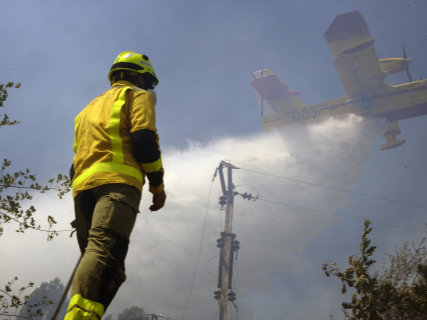

The wildfires that are affecting these days the Community of Madrid and the province of Ávila have forced the evacuation of hundreds of neighbors to ensure their safety. These orders raise a common question among the population: who decides an evacuation due to fire, at what moment it is adopted, and if the authorities can legally force someone to leave a home.
The answer lies in the legislation of Civil Protection and in the special plans against wildfires of each autonomous community. The priority of these protocols is to preserve the lives of people, even if it means evacuating homes before the flames reach them.
The evacuation is ordered by the emergency director
The decision to evacuate a population does not directly correspond to the mayor, the Civil Guard, or the firefighters working on the ground.
The order is adopted by the emergency director or the director of the civil protection plan that is activated at that moment, based on the technical information provided by the fire extinction director and the other operational leaders.
When the fire remains under the management of the autonomous community, the direction corresponds to the person designated by the autonomous wildfire plan. However, if a national interest emergency (level 3) is declared, as has occurred in the fires of Madrid and Ávila, the superior direction passes to the Ministry of the Interior, which coordinates all the resources of the different administrations.
There is no minimum distance to order an evacuation
An evacuation is not decided because the fire has reached a certain number of hectares or because the flames are at a specific distance from the homes.
The emergency services carry out a constant risk assessment taking into account factors such as the speed of fire propagation, the direction and strength of the wind, the topography of the terrain, the proximity of the front to inhabited areas, the weather forecasts, or the possibility that the roads may be blocked by smoke or fire.
On many occasions, evacuations are ordered preventively, even before the flames reach the homes, to prevent neighbors from having to leave the area when the evacuation routes are no longer safe.
Can they force you to leave your home?
Yes. Spanish legislation on civil protection allows authorities to take the necessary measures to protect the population during an emergency, including the mandatory evacuation of areas threatened by a forest fire.
These orders aim to prevent personal harm and facilitate the work of firefighting services. Staying in a home located in a risk area can not only endanger those who remain in it but also the rescue teams that may be forced to intervene later.
For this reason, authorities insist that all affected individuals follow the instructions of emergency services and leave the area when required.
Return is only authorized when the risk disappears
Just as evacuation is the responsibility of those in charge of the emergency, the return of residents does not depend on an individual decision either.
Returning to homes is only authorized when technicians consider that the fire no longer poses a threat to the population and that there are sufficient safety conditions. To this end, it is verified that the main front is controlled, that there are no nearby reactivations, that roads can be used normally, and that basic supplies, such as water, electricity, or gas, can be restored safely.
For this reason, it is common for some developments to remain evacuated for hours or even several days after the fire has been stabilized.
The case of the fires in Madrid and Ávila
The declaration of national interest emergency due to the fires affecting the Community of Madrid and the province of Ávila has meant that the coordination of the emergency has passed to the Ministry of the Interior, although on the ground the regional services, the Military Emergency Unit (UME), the Civil Guard, the Security Forces and Corps, and the rest of the involved agencies continue to act jointly.
In these types of situations, evacuation orders are part of the civil protection protocols designed to minimize risk to the population and ensure that firefighting teams can carry out their work with the highest safety guarantees.