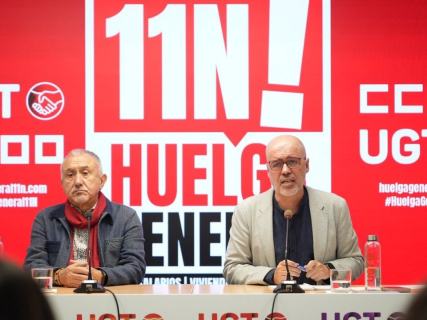
11N strike: how much they deduct from your payroll if you join the strike

The discount includes the salary for the time not worked and the proportional parts of certain concepts, even though there is no single formula for all templates

fotonoticia 20261104165246 1920

fotonoticia 20261104165246 1920

Add DEMÓCRATA to Google

Ask FREN

Published

Last updated

2 minutes

Most read

Elecciones 29N · Encuestas

La media de las encuestas

Media a 10 de noviembre de 2026 · 14 institutos

  • PP31,4 %
  • PSOE26,7 %
  • Vox19,1 %
  • Frente Amplio6,3 %
  • ERC2,5 %
01020304050ene 2024jul 2024ene 2025jul 2025ene 2026jul 2026

Media del último estudio de cada instituto en 30 días y su evolución semanal desde el 23J. Partidos con al menos un 2 %.

Todas las encuestas

Elecciones generales del 29 de noviembre · Demócrata

Supporting the general strike of November 11 will have a direct effect on the payroll of the workers who decide not to report to their workplace. The company may deduct the corresponding compensation for the time not worked, but the amount does not have to be limited to the salary for that day: it can also include certain amounts linked to weekly rest and the extra payments.

The calculation does not respond to a single formula established by law. The case law of the Supreme Court has set out the concepts that may be deducted and the limits of the deduction, while the specific method depends on the distribution of the working hours and on the salary structure of each worker.

The deduction includes the salary corresponding to the day or hours not worked and the proportional part of the compensation for weekly rest generated during the strike period. It can also affect the extraordinary gratifications and the profit-sharing payments, in accordance with their accrual period.

The Supreme Court Ruling of March 13, 2001 sets out this doctrine and specifies that public holidays can only be affected when they are included within the strike period. The company also cannot reduce vacation days or their compensation for taking part in the strike.

How to calculate how much money they deduct from you

For a regular workday, the calculation starts from the salary corresponding to the day not worked. If the ordinary monthly compensation is 1,500 euros, for example, the daily amount for that concept would be 50 euros, by dividing it by 30. To that amount, when applicable, must be added the proportional concepts recognized by case law, such as weekly rest and the extra payments.

In a workday distributed in an irregular manner, the calculation must be carried out by hours so that the deduction matches the time of work that should have been performed. The National Audience and various higher courts have applied methods that start from the annual salary, deduct the vacation periods, public holidays and rest periods that do not correspond to the strike, and divide the result by the effective working hours of the year.

Therefore, an identical amount cannot be set for all workers who support the call. The collective agreement, the annual workday, the supplements, and the payment system for gratifications can modify the result.

When the extra payments are deducted

If the extra payments are paid at specific times during the year, the company cannot, in the ordinary payroll, anticipate the corresponding reduction for a bonus that has not yet been paid. The proportional portion generated during the strike is deducted when the time comes to pay that bonus.

When the bonuses are prorated across the twelve payrolls, the proportional reduction can be reflected in the corresponding monthly payslip. The company must prevent the same concept from being deducted twice.

What happens with contributions to Social Security

Article 6.3 of Royal Decree-law 17/1977 establishes that workers who take part in a legal strike remain in a special high status, with the obligation to contribute being suspended for both the company and the employee during the period of stoppage.

In full-day strikes, that day does not generate contributions. If the stoppage affects only a few hours, the worker remains in ordinary high status and the contributions are adjusted to the remuneration actually received during that workday.

Social Security contemplates the possibility of subscribing to a special agreement to complete certain contribution bases during periods of legal strike. The procedure must be requested within 90 days following the end of the stoppage and allows coverage of contingencies such as retirement or permanent incapacity.

More key points, information and questions with FREN

AI-GENERATED CONTENT

What parliamentary procedures would be necessary to modify the regulations on salary deductions in case of a strike?

To modify the legal rules on salary deductions for strikes, a law-level reform processed in the General Courts would be necessary. The usual process would be to submit an initiative, debate and vote on its amendments in the Congress, submit it to the Senate, and complete its approval. The decisive distinction is between adjusting the economic consequences of the strike and directly developing the content of the fundamental right, as this conditions the ordinary or organic nature of the reform.

1. Define what is to be changed

The reform should specify whether it modifies the calculation of the deduction, the affected remuneration concepts, or the guarantees against undue deductions. As a material reference, STC 189/1993 explains that deducting more than proportional to the inactivity may constitute a sanction contrary to the right to strike.

Not all regulations related to a fundamental right require an organic law. If the text enters matters reserved for it, the Congress must give it that classification and require a absolute majority in a final overall vote. For an ordinary reform, the general rule is a simple majority: more favorable votes than opposing.

2. Submit the initiative
  • Government bill: it is sent to Congress with a statement of reasons and background. The Board orders its publication, sends it to the competent committee, and opens the amendment period. It does not require a prior vote for consideration.
  • Parliamentary bill: it can be submitted by a group through its spokesperson or a deputy with fourteen other signatures. It is published and sent to the Government to know its opinion and, when appropriate, its budgetary conformity. Then, the Plenary votes on taking it into consideration, that is, whether to start processing it. If accepted, it goes to committee and the amendment period opens.

If the proposal or its amendments increase credits or reduce budget revenues, the Government's conformity provided by regulations comes into play. This issue may be relevant when public remunerations are affected.

3. Negotiate and vote on changes in Congress

The ordinary period to submit amendments is fifteen working days, extendable. They can delete, modify, or add provisions: this is the main moment to specify calculation formulas, guarantees, and transitional rules.

In government bills, total amendments are also allowed: to return the text or replace it with another. If the return is approved, the initiative is rejected. Parliamentary bills taken into consideration in Congress do not allow such return.

Then, a working group prepares a report and the committee debates and votes on the articles. Transactional agreements between proposals and technical corrections may be admitted in committee. If a final debate in the Plenary is appropriate, previously rejected amendments can be defended; new transactions have stricter requirements. In delegable ordinary laws, the committee can approve the text without that final plenary vote.

4. Pass through the Senate and finalize approval

The approved text is sent to the Senate, which can accept it, amend it, or veto it. If it introduces changes, Congress decides by simple majority which to incorporate. If it vetoes an ordinary law, Congress can override the veto by absolute majority or, after two months, by simple majority. Organic laws maintain special absolute majority requirements.

Amendments must have material connection with the initiative: it is not enough to use any law in process to introduce a reform unrelated to its object, according to STC 149/2023. Urgency can shorten deadlines but does not eliminate the required majorities. The details of these phases are in the Congress Regulations.

What powers does the Ministry of Labor have in regulating strikes and payroll deductions?

The Ministry of Labor and Social Economy can promote legal changes regarding strikes and exercise certain labor authority functions, but it does not decide alone on the entire regime. Salary deductions for participating in a strike are applied by the employer according to regulations: they do not require individual authorization from the Ministry and can be challenged in courts.

1. What the Ministry can regulate

The strike is a fundamental right recognized in article 28.2 of the Constitution. Its development is subject to organic law reservation and must respect its essential content. The general regime continues to rely on Royal Decree-Law 17/1977, interpreted according to the Constitution and constitutional jurisprudence.

The Ministry can prepare regulatory proposals, promote dialogue with unions and business organizations, and propose a reform to the Government. However, it cannot redefine by ministerial order who can call a strike, prohibit it generally, or alter its fundamental guarantees. Law approval corresponds to the General Courts; regulations can only develop the law within its limits.

2. The Ministry's role during a conflict

The labor authority receives the strike communication under legally established terms and can carry out mediation actions. This does not turn the communication into a permission request: a strike does not need prior administrative authorization.

It is also not always the Ministry's responsibility to act. Many labor executive functions are transferred to autonomous communities. The competent authority depends on the territorial and material scope of the conflict. Additionally, public conciliation and mediation services and autonomous conflict resolution systems have their own functions.

The Labor Inspectorate can investigate breaches, such as employer actions violating the right to strike. However, it does not replace courts when there is a dispute over wages or fundamental rights.

3. Minimum services and compulsory arbitration

In essential community services, guarantees may be established to maintain their operation. Minimum services correspond to the competent governmental authority, which may be state or regional and not necessarily the Ministry of Labor. They must be justified and proportionate: they cannot empty the right to strike.

This intervention must also be distinguished from compulsory arbitration provided for exceptional circumstances. It is not an ordinary Ministry power to resolve any strike: it requires legal conditions and a Government decision, with corresponding guarantees.

4. Who applies payroll deductions

During the strike, the employment contract is suspended and there is no right to salary for the time not worked. Therefore, the employer can make the deduction without requesting permission from the Ministry. It is not a sanction, but a consequence of suspending the obligations to work and pay.

The calculation must relate to the effective duration of participation. It may affect the salary for the period and proportional parts of certain concepts, such as extra payments and weekly rest, depending on their nature and applicable jurisprudence. It does not authorize imposing additional penalties or reducing annual vacations for having legitimately exercised this right.

5. What to do in case of an incorrect deduction

The Ministry does not set or individually review each payroll. The affected person can request the employer a breakdown of the calculation and claim improperly deducted amounts through conciliation channels and social jurisdiction. If there are signs of retaliation or discrimination for supporting the strike, judicial protection of the fundamental right can be requested, in addition to reporting the facts to the Inspectorate.

In public employment, labor staff and civil or statutory staff must be distinguished: their rules and claim procedures are not necessarily the same.

What have been the results of the latest union elections in the main sectors affected by the strike?

Localized results show different majorities depending on the company, public service, and territory; they do not allow establishing a single winner in all sectors. Also, your question does not identify which strike it is, so it would not be accurate to state that transport, education, health, or industry are affected by that specific call. With that caveat, these are the results that can be detailed, distinguishing complete figures from partial references.

General overview: a reference, not a sectoral result

In the balance of the process closed in December 2023, published by CCOO on April 9, 2024, this organization reported 104,206 representatives, 34.98% of the total. CCOO and UGT together accounted for 67.01% of the representation. These are joint figures from private companies and public administrations: they should not be used to attribute the same presence in each sector nor presented as updated results as of November 2026. The balance published by CCOO can be consulted.

Specific results and scope of each data
  • Telecommunications: Telefónica Móviles. This is the most complete company distribution located. According to information published by Demócrata on October 22, 2025, UGT obtained 48 delegates, 55.8%; Sumados, 21, 24.4%; and CCOO, 17, 19.8%. The inter-center committee was configured with three UGT members, one Sumados, and one CCOO. These results correspond to Telefónica Móviles, not the entire group or sector. The cited date is the news publication date. Results in Demócrata.
  • Food industry: ElPozo Alimentación. The elections on October 1, 2026 elected a committee of 33 representatives. CCOO obtained 16 seats, being the list with the most representatives but without an absolute majority alone. The census was 5,915 workers and participation exceeded 50%. The complete distribution of the other 17 seats among remaining lists is not recorded in the consulted information. ElPozo results.
  • Passenger transport. UGT reported an absolute majority in ALSA and a victory in Unauto, concessionaire of urban transport in Toledo. However, the located references do not sufficiently specify dates or delegate distribution. Therefore, they serve as company precedents but not to state who won the latest Spanish transport elections. UGT Castilla-La Mancha information.
  • Public health. CCOO reports 180 delegates in the Andalusian Health Service, a 17% increase and fourth position in the Sectoral Board. References also appear to other processes, with 153 delegates in Andalusia and 38 in Extremadura. Since years and complete distribution are not unequivocally identified, they should not be mixed or presented as the latest comparable results. Results published by CCOO.
  • Education and public employment. A complete national distribution of the latest educational elections has not been located. A document from the Community of Madrid dated May 27, 2024 records, for a specific body of 33 seats, CCOO 10, CSIT-UP 7, CGT 6, and UGT 4. That distribution is partial and does not prove the overall education or public employment result. Madrid results document.

The practical conclusion is that there are precise company results, but the strike must be identified to select the truly affected areas. Electoral representation also does not equate to a measurement of strike participation.

Play

Test your knowledge with FREN!

How much do you know about this topic? Answer the following 3 questions.

What concepts can be deducted from the payroll when a worker participates in a strike?

Question 1 of 3

How is the payroll deduction calculated for an irregularly distributed workday during a strike?

Question 2 of 3

What happens with Social Security contributions during a full-day strike?

Question 3 of 3