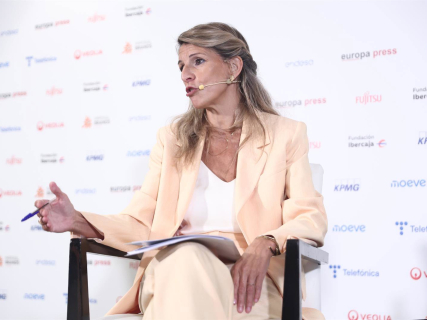

The second vice president of the Government and Minister of Labour, Yolanda Díaz, has said that if, next Monday, she is elected as the Director-General of the International Labour Organization (ILO), she will work to “recover” the institution. Against “continuism,” she proposes a stage of renewal that strengthens social dialogue, regulates the impact of artificial intelligence, and safeguards labour rights on a global scale.
“There are four days left to recover the ILO,” Díaz said in a message published on Bluesky, where she highlighted that the world of work needs a “strong” organization that takes up the leadership of social dialogue and defends the rights of the working class. “On Monday we have a historic opportunity. We are prepared. We are going to make it,” she said.
In a video circulated along with that message, the minister insists that “continuism is not an option” and calls for the role played by the ILO since the Second World War, considering that the organization is once again essential in the face of today’s employment challenges. Díaz explains that during this week she has been in contact with governments, companies, unions, and internal staff at the organization, and that many agree that “this way you cannot continue.”
Among the main lines of her proposal, she places regulation of artificial intelligence, warning that this technology already determines who gets access to a job, how much they earn, and who is dismissed. She also calls for accelerating rules on supply chains, without waiting until 2031, applying the convention on digital platforms, and combating labour informality, which, she said, affects more than half of the working people on the planet.
Díaz defends an ILO “in motion,” with social dialogue as its core and with real capacity to protect workers in all regions, along with more effective management that makes it possible to overcome the economic crisis the organization is going through. “On Monday the Governing Body decides. We are prepared, that’s why we are going to recover the ILO. We are going to win,” she concluded.
First woman and first Spaniard at the head of the ILO
The ILO, created in 1919 and the first specialized agency of the United Nations, brings together governments, business organizations and trade unions from its 187 member states. With its tripartite structure, it has been consolidated as the central forum for the development of labor standards, the promotion of employment, social protection and the strengthening of social dialogue.
From Moncloa they point out that Díaz, as second vice president and Minister of Labour and Social Economy, has led some of the most relevant labor and social reforms of recent years, all of them articulated through social dialogue and concluded in 30 agreements.
In particular, they note that in this time she has driven forward the labor reform agreed with unions and employers’ associations, the platform law, and the largest increase in the interprofessional minimum wage in the democracy.
The Executive considers that, with this candidacy, Spain seeks to reinforce “a key institution for addressing the challenges of the labor market” in a context of “deep economic, technological and environmental transformations”, consolidating the role of the ILO as “a global reference point in the defense of decent work and social justice”.
Spain is the country that has signed the most agreements with the ILO, with a total of 141. If she is elected, Yolanda Díaz would become the first Spaniard and the first woman to take charge of the organization.
The secret ballot to designate the new person who will occupy the post of Director-General will take place on November 16. The term of the new person in charge will begin on October 1, 2027.
Díaz would be competing in these elections, for now, against the Togolese Gilbert F. Houngbo, current Director-General since 2022, and against the former Peruvian minister Javier González-Olaechea.
The term as Director-General of the ILO is five years. To be elected, the candidacy must obtain the support of more than half of the members of the board of directors entitled to vote.