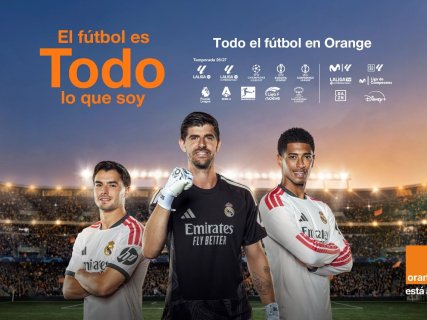
Orange: football without limits and your favorite entertainment in one package for the 26/27

Enjoy LALIGA EA SPORTS, Champions and more with Orange's 5G+ connectivity and Wi-Fi 7

2 minutes

orange futbolo

orange futbolo

Add DEMÓCRATA to Google

Ask FREN

Published

Last updated

2 minutes

Most read

The new football season will arrive accompanied by a renewed commitment from Orange to sports content and entertainment. The premium brand of MasOrange will once again offer its customers access to the main national and international football competitions, along with an offer that integrates streaming platforms, television, next-generation connectivity, and digital services in a single package.

Orange's proposal for the 2026-2027 campaign brings together some of the most followed competitions on the football calendar. Orange TV customers will be able to access LALIGA EA SPORTS, LALIGA HYPERMOTION, the UEFA Champions League, the UEFA Europa League, and the UEFA Conference League, in addition to other tournaments included in its audiovisual offer thanks to agreements reached by the company with different content operators.

Television, connectivity, and entertainment

Beyond sports programming, the operator maintains a strategy aimed at combining television, connectivity, and entertainment into a single experience. Orange TV offers more than 90 channels and allows the incorporation of platforms such as Netflix, Prime Video, Disney+, HBO Max, or SkyShowtime, so that each user can configure the combination of content that best suits their preferences.

The television experience also incorporates different functionalities designed for sports fans, such as access to real-time statistics, the ability to pause or rewind live broadcasts, consult the most notable plays, or enjoy a broadcast with low latency to follow the matches with the least possible delay. This is complemented by the TV 4K HDR decoder and the connectivity of the 5G+ network, along with Wi-Fi 7 technology.

Rates

Orange markets its offer with all the football from 109 euros per month. This modality includes fiber optics, a mobile line with unlimited data, Orange TV with more than 90 channels, SkyShowtime, and a streaming platform to choose from Netflix, Prime Video, Disney+, or HBO Max.

For those who prioritize entertainment over sports competitions, the company has other options starting from 73 euros per month with 600 Mb fiber, unlimited mobile lines, Orange TV, SkyShowtime, and a content platform to choose from. It also offers a modality starting from 65 euros per month with 600 Mb fiber, mobile lines with 60 GB, and Orange TV along with an included streaming service.

The offer is completed with the possibility of acquiring financed devices without interest. Among them is the LG Smart TV 65-inch NU85 4K, available from 0 euros with certain tariffs, an option aimed at those looking to enjoy sports content in large format.

In addition to football, Orange incorporates other content related to cinema, series, documentaries, and different sports competitions, along with additional services such as cybersecurity solutions, Google Artificial Intelligence plans, 5G Fast Track technology to optimize connectivity at events with a large influx of public, and home products such as energy, insurance, and alarms.

As explained by Jacobo Gálvez, general director of Marketing at MasOrange, the company's goal is to maintain a proposal that combines content, technology, and services in an integrated experience for customers interested in both sports and entertainment.

More key points, information and questions with FREN

AI-GENERATED CONTENT

What is the current status of the absorption of subsidiaries by MasOrange and what are the next steps in the integration process?

The absorption of subsidiaries by MasOrange is in the internal execution phase, already communicated to the unions and with a clear schedule: the merger by absorption of several group companies must take legal effect on October 1, 2026, once registered in the Commercial Registry. This move comes after Orange took full control of MasOrange, which since June 2026 is already a 100% subsidiary of the French group and has ceased to operate as a joint venture with MásMóvil. In parallel, Orange has begun fully consolidating MasOrange's results and has announced a roadmap for refinancing its debt and possible asset reorganization in the coming years.

Current status of the absorption of subsidiaries

According to information provided by the newspaper Demócrata, MasOrange has formally notified CCOO of the start of an intragroup merger by absorption process to "optimize costs and maximize operational efficiency." In this scheme:

  • Xtra Telecom will be integrated into Xfera Móviles.
  • MásMóvil Ibercom will be absorbed by MasOrange Telecom Bidco, the group's holding company.

The news details that the operation is designed so that the restructuring "is formalized after its registration in the Commercial Registry" with effect from October 1, 2026, which clearly sets the legal horizon of the process, although operational and systems integration may occur progressively. This situation is covered in the Demócrata piece about the absorption of four subsidiaries and aligns with the corporate information from Europa Press.

According to these sources, MasOrange has emphasized to worker representatives that the operation keeps "human resources intact" and that the absorbing companies will assume all labor rights and obligations of the affected personnel. This employment protection approach fits with the labor arrangement process already completed after the Orange–MásMóvil merger, materialized in the group's first collective agreement, covered by Demócrata in the information about the labor agreement between MasOrange and the unions (collective agreement).

Context: from Orange's full control to internal integration

The absorption process occurs just after Orange bought the 50% of MasOrange still held by Lorca (a vehicle of KKR, Cinven, and Providence) for 4.25 billion euros, an operation announced in December 2025 and detailed by Demócrata in this economic report, and also covered in specialized media such as Cinco Días, Orange's corporate note ([link]) or Reuters. With this, MasOrange goes from being a 50/50 joint venture to becoming a wholly controlled subsidiary in which Spain is the second most relevant market for the French group, as noted both in MasOrange's corporate profile ([link]) and in the historical merger documentation ([link], [link]).

The operation has received authorization from the Council of Ministers and the Ministry of Economy, within the framework of foreign investment control, as well as approval from the Directorate-General for Competition of the European Commission, similarly to other major sector operations, such as Zegona's entry into Vodafone authorized by the CNMC ([link]). This political-regulatory endorsement explains why Orange is already fully consolidating MasOrange's results in its accounts and has announced its intention to progressively refinance the debt inherited from the former joint venture.

Next steps in the integration

From now on, the most relevant milestones of the integration process can be summarized in three areas:

  • Legal closure of the intragroup merger: the key date is October 1, 2026, when the absorption of Xtra Telecom and MásMóvil Ibercom will be fully effective after their registration, according to the documentation sent to CCOO and covered by Demócrata and Europa Press.
  • Operational and systems integration: although sources do not detail a technical timeline, the logic of the operation is to simplify the corporate structure to better exploit network, brand, and systems synergies already described in analyses of MasOrange's impact on the Spanish economy ([link]).
  • Financial reorganization and possible asset sales: the economic press places in the horizon of the second half of 2027 the possibility that Orange or MasOrange study selective divestments (including, according to some analyses, low-cost brands like Lowi) always within competition limits and prior social and regulatory dialogue ([link], [link]).

In parallel, MasOrange continues deploying network investments (advanced 5G, wholesale agreements, etc.), as reported by various Demócrata articles (rural 5G coverage, wholesale agreements), indicating that corporate and financial integration is combined with a strategy to strengthen competitiveness in the Spanish market.

What specific labor impact could this absorption of subsidiaries have on the workforces of Xtra Telecom, Xfera Móviles, and MásMóvil Ibercom? What role have the Spanish Government and the European Commission played in authorizing Orange's full control of MasOrange? How might this internal reorganization of MasOrange affect competition in the Spanish market against Telefónica, Vodafone, and Digi?

What are the competencies and functions of the general marketing director of MasOrange according to the company's organizational chart?

I do not have specific information, from political, institutional, or parliamentary press sources, about the internal competencies of the general marketing director of MasOrange according to its corporate organizational chart, and furthermore my scope is limited to political, regulatory, and socioeconomic current affairs, not detailed descriptions of private job positions. Therefore, I cannot provide you with an official and complete breakdown of the functions of that role. I can situate MasOrange in the Spanish political and regulatory context (telecoms, competition, connectivity, taxation…), but not precisely enter the internal organization of its marketing department.

Why I cannot detail that position

I am designed to work on Spanish (and linked European) politics, parliamentary and executive activity, and economic news with regulatory or institutional impact. The job description of the general marketing director of a private company like MasOrange is part of its internal human resources organizational chart, not of the political or regulatory documentation I access.

Although economic news mentions marketing executives in various business groups, such information usually focuses on appointments or the company's impact on the economy and regulation, not on the technical details of their job description. In MasOrange's specific case, journalistic pieces affecting it — for example, about 5G, fiber, network regulation, or taxation — do not develop the formal catalog of competencies of its general marketing director.

What I can provide about MasOrange in a political-regulatory key

MasOrange frequently appears in the newspaper Demócrata and economic press as one of the key players in the telecommunications sector in Spain, which has a strong regulatory and public policy component:

  • Its deployment of advanced 5G and connectivity in Spain, covered in articles such as about 5G Advanced or 5G coverage in small municipalities, is framed within territorial cohesion objectives and compliance with coverage obligations set by the State and the EU.
  • Its position in network and duct competition debates, as reflected in the controversy over Telefónica's ducts, links directly to competition policy, the CNMC, and regulation of essential infrastructures.
  • The relationship between Orange and MasOrange, including the full control acquisition or board reconfiguration, is addressed in terms of corporate governance and regulatory supervision in texts such as purchase of 50% of MasOrange or MasOrange board reconfiguration.
  • Its sustainability strategy and ESG standards, covered in MasOrange's ESG rating, connect with European regulation on corporate sustainability and non-financial reporting.

In such content, the CEO Meinrad Spenger and other company executives are often mentioned in their relations with the Government or regulators; for example, the Moncloa agenda includes a meeting of the Presidential Cabinet Director with MasOrange's CEO, recorded in the official Government Presidency agenda: Moncloa agenda. The weight of Spain within the Orange group and Spenger's role in its executive committee are also discussed, as Demócrata reports in this piece on Orange's executive committee and in this event at Nueva Economía Fórum.

What kind of questions I can answer

From this context, I can help you with issues such as:

  • How the Orange–MásMóvil (MasOrange) integration affects competition in telecommunications and the role played by the Government and CNMC.
  • What political and regulatory implications the deployment of 5G and 5G Advanced has for the rural digital divide in Spain, using information such as rural 5G coverage or the alliance with Ericsson described in agreement with Ericsson.
  • How its investments in cybersecurity and regulatory compliance fit within the European framework (NIS2, DORA…), based on news like Quantum Safe project with Nokia or the extension of secure APIs covered in network improvements with APIs.
  • The fiscal and jurisdictional consequences of cases like the IAE refund to Orange, explained in IAE ruling, which affect the entire sector.

In summary, I cannot provide the internal list of competencies of MasOrange's general marketing director nor confirm how that position is defined in its corporate organizational chart. However, I can analyze MasOrange's role as a regulated actor within Spanish economic and digital policy, using public news and documents — especially from the newspaper Demócrata — that address its strategy, governance, and relationship with the Government and regulators.

Other relevant links cited in the research

Below I group other links that have appeared in the research and illustrate the type of political, regulatory, and economic content I can work with:

If you are interested, I can use these and other materials to analyze MasOrange from the perspective of telecommunications policy, competition, or digital regulation in Spain.

How has the creation of MasOrange influenced competition in the telecommunications market in Spain and what role have the CNMC and the European Commission played? What regulatory implications does MasOrange's deployment of 5G and 5G Advanced have for rural coverage and reducing the digital divide in Spain? What role does MasOrange play in debates about telecommunications sector taxation, for example regarding the IAE and other tax figures?

What legal requirements must an operator meet to offer convergent telecommunications and audiovisual content packages in Spain?

An operator wishing to offer convergent packages in Spain (fixed/mobile telephony, broadband, etc.) along with pay TV or other audiovisual content must comply, at least, with two major regulatory blocks: Law 11/2022, General Telecommunications Law, which regulates electronic communications networks and services, and Law 13/2022, General Audiovisual Communication Law, along with its regulatory development on the State Registry and prior notification. Added to this are sectoral rules (CNMC), audiovisual taxation, and horizontal consumer and data protection regulations. These pieces establish an authorization/prior notification regime, registration, competition obligations, and user protection applicable to both residential and business customers.

1. Telecommunications framework: Law 11/2022

The Law 11/2022, General Telecommunications Law establishes that the supply of networks and provision of electronic communications services is carried out under a liberalized regime, with a general authorization. No individual license is needed, but:

  • Prior notification to the CNMC's Operator Registry, which "authorizes exercising the rights established in this law" and simultaneously requires compliance with all associated burdens and obligations (universal service, access, etc.).
  • Rights associated with the notification: deploying networks, providing public services, obtaining rights to use public radio spectrum, numbering, interconnection, and, if applicable, being designated for universal service (according to the law's preamble).
  • Obligations: compliance with specific obligations that the CNMC may impose regarding wholesale access and interconnection, universal service, and market analysis (articles developed in the fragments on market analysis, specific obligations, and functional separation).

The law reinforces, according to its preamble, the rights of end users, with special attention to transparency and regulation of packaged contracts (convergent packages), which must provide clear information about included services, prices, duration, penalties, and portability conditions.

For operators with special rights in other sectors, Law 11/2022 requires accounting or structural separation of electronic communications activities when operating networks or providing public services (window 60000‑67500). It also foresees that if access obligations are insufficient, the CNMC may impose functional separation measures of access networks (window 118000‑125500).

This framework is complemented by previous regulations still partly in force, such as Royal Decree 1517/2018 on universal service and user protection, and Order IET/1090/2014 on service quality, as well as CNMC Circular 1/2023, interpreting article 66.1.b) of Law 11/2022, and CNMC Circular 4/2025 on subscriber data supply procedures.

2. Audiovisual framework: Law 13/2022 and State Registry

The Law 13/2022, General Audiovisual Communication Law regulates providers of audiovisual communication services (linear TV, on-demand, radio, etc.) and video-sharing and aggregator services. The regime is also liberalized:

  • For most services (e.g., pay TV via IPTV or cable), a prior reliable notification to the competent audiovisual authority suffices, authorizing the start of activity.
  • Licenses granted by tender are only required for TV or radio services using terrestrial hertzian waves (DTT/FM), as developed in Royal Decree 1138/2023.

The same Royal Decree 1138/2023 regulates the State Registry of audiovisual providers and establishes the obligation to register for:

  • Providers of national audiovisual television and radio communication services.
  • Providers of on-demand services, video-sharing platforms, and audiovisual service aggregators.
  • Users of special relevance of video platforms.

The regulation details the information to be supplied to the Registry to ensure transparency towards users (identity of the responsible party, contact data, etc.) and refers data protection to Regulation (EU) 2016/679 and Organic Law 3/2018, expressly cited in its preamble.

Regarding European work financing and contribution to RTVE, Royal Decree 988/2015 (advance financing of European works) and Order HFP/309/2023, which approves forms 792 and 793 for economic contributions from audiovisual providers and video platforms, are relevant.

3. Common and specific obligations of convergent packages

Besides sectoral requirements, the operator must comply with:

  • Consumer and user regulations, integrated with the enhanced protection of telecommunications users provided in Law 11/2022 (specific rights of end users, including contractual transparency and complaint management).
  • Data protection (GDPR and Organic Law 3/2018, cited in Royal Decree 1138/2023), especially regarding traffic data, billing, marketing, and third-party transfers.
  • Portability and operator switching in electronic communications services, under Law 11/2022 and its implementing regulation (including numbering management and CNMC-supervised procedures).
  • Conditions of packaged contracts: Law 11/2022 indicates that user rights are reinforced by "regulating packaged contracts," meaning the operator must ensure the user retains their rights (e.g., termination and portability of each package component) even if marketed jointly.

Finally, on the competition side, Law 11/2022 grants the CNMC broad powers for market analysis, imposition of wholesale obligations (access, interconnection, cost accounting, functional separation), and supervision of coinvestment agreements, which is key when a dominant operator packages connectivity and audiovisual content.

All this must be coordinated, where applicable, with other sectoral rules cited in the sources (such as Law 3/2013 creating the CNMC, Order PRE/2516/2015 on audiovisual functions, or Resolution of April 17, 2015 on DTT license tenders), depending on the specific type of network and content integrated into the convergent package.

What specific transparency and permanence obligations apply to packaged contracts under Law 11/2022? What practical steps must I follow to register as an audiovisual provider in the State Registry regulated by Royal Decree 1138/2023? How can the CNMC intervene if a market-power operator packages connectivity and television in a way that affects competition?

Play

Test your knowledge with FREN!

How much do you know about this topic? Answer the following 3 questions.

Which streaming platforms can be incorporated into the Orange TV offer?

Question 1 of 3

From what monthly price can the Orange option that includes all football be contracted?

Question 2 of 3

What technology does Orange offer to optimize connectivity at events with large crowds?

Question 3 of 3

Hola, soy Fren. ¿Cómo te ayudo?