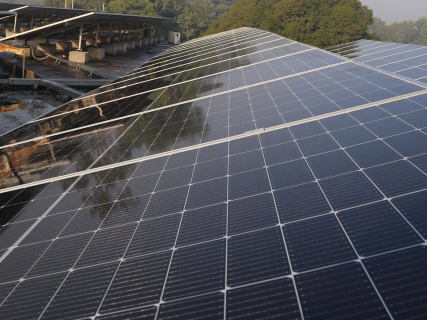

EsadeGeo calls for rapid progress on measures for administrative simplification, improvement of access to the electrical grid, management of surpluses, promotion of energy storage, and strengthening of territorial governance, in order to accelerate industrial self-consumption as a key tool to bolster competitiveness and strategic autonomy in Europe.
In a report by EsadeGeo, prepared with the support of Amazon, it is emphasized that the decarbonization of industry constitutes one of the most pressing challenges of the energy transition in the European Union, given that fossil fuels currently account for almost half of the final energy consumption in industry in the European Union.
In contrast, the document highlights that renewable energies barely represent 11.3% of this consumption, placing industrial self-consumption with renewable generation as a major transformation lever.
Among the main benefits of deploying self-consumption in the business fabric, Esade emphasizes the direct and verifiable reduction of greenhouse gas emissions. Furthermore, it values that it provides greater predictability to energy costs, reinforces resilience against market volatility, and actively helps to balance the electrical system.
In this way, the study emphasizes that industrial self-consumption generates positive externalities that transcend the strictly business realm, which supports the intervention of public authorities.
In particular, it notes that it reduces losses in the grid, takes advantage of already urbanized spaces such as rooftops and industrial land, and provides superior operational flexibility.
Regarding the situation in Spain, the report states that the country has consolidated in recent years as one of the member states with the most favorable regulatory framework for this technology.
Thus, by the end of 2025, the country had approximately 9 gigawatts (GW) of installed photovoltaic self-consumption, although there is still room to achieve the target of 19 GW set in the Integrated National Energy and Climate Plan (PNIEC) for 2030.
Despite the regulatory progress made, Esade warns that the industrial segment continues to face structural barriers of a regulatory, operational, and governance nature that hinder its full deployment.
For this reason, to overcome these obstacles, it proposes to implement measures based on the European principle of recognizing the superior public interest of renewable facilities.
Proposals articulated in six priority axes
The report organizes its recommendations into six priority axes, starting with administrative processing and municipal governance. Among the proposed actions are the simplification of permits, the alignment of urban planning, and the recognition of public utility for direct connection lines.
Likewise, the proposals emphasize the importance of reinforcing participation and social acceptance through incentives and direct economic returns for the territories that host these facilities.
Additionally, the development of specific methodologies for access and connection to the grid is demanded, which adapt transportation and distribution infrastructures to a smart and distributed model.
In the area of economic management of the system, Esade advocates simplifying the regime applicable to the sale of surpluses. It also proposes optimizing the energy produced through proper sizing of plants, the integration of storage systems, and leveraging the flexibility of self-consumers.
Finally, the document concludes that the way in which different regions promote this technology will be decisive in attracting investments and local employment. With this objective, it urges defining appropriate incentives that correctly allocate costs, avoid cross-subsidies, and eliminate unnecessary regulatory burdens.