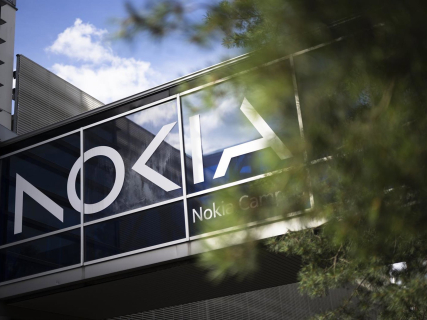

Nokia is once again among the major companies of the Euro Stoxx 50, but the company that has returned to the main benchmark index of the eurozone has little in common with the one that dominated the global mobile phone market at the beginning of the century. Its shares have accumulated an increase of nearly 70% so far in 2026, driven by the expectation that a significant part of the gigantic global investment in artificial intelligence will also flow through its networks. Since September 21, the Finnish technology company also occupies in the Euro Stoxx 50 the position left by Volkswagen, while the French Engie has replaced Wolters Kluwer.
The change summarizes two very different business stories. Nokia went from manufacturing some of the most recognizable phones of the late nineties and early 2000s to practically disappearing from the device market after the emergence of the iPhone and Android. Now it tries to take advantage of another technological revolution, but from a less visible place for the consumer: the networks that enable the movement of the enormous amounts of information necessary to train and use artificial intelligence models.
From the Nokia 3310 to selling the mobile business to Microsoft
For years, saying Nokia meant immediately thinking of a phone. In the year 2000, the company controlled approximately a quarter of the global market and launched the Nokia 3310, one of the most popular models in history. The problem came with the leap to smartphones: Apple introduced the iPhone in 2007, Android began to spread, and Nokia failed to maintain its leadership in an industry that stopped revolving around hardware to increasingly revolve around operating systems, applications, and digital ecosystems.
The company tried to react by allying with Microsoft and using Windows Phone, but the move did not manage to stop the decline. In April 2014 it sold practically all its Devices and Services business to Microsoft for an initially announced price of 5.440 billion euros. Nokia thus ceased to be fundamentally a phone manufacturer to focus on telecommunications infrastructure, patents, and network technology.
The transformation continued with the acquisition of Alcatel-Lucent, completed in 2016, which reinforced its position in fixed, mobile, and optical technology networks. More recently, Nokia moved again with the purchase of Infinera, closed in February 2025 for about 2.5 billion euros, an operation aimed precisely at gaining scale in optical networks and increasing its presence among large North American data centers.
AI needs much more than Nvidia chips
The explosion of artificial intelligence is often associated with Nvidia processors or the enormous data centers built by Microsoft, Google, Amazon, or Meta. However, those facilities need to be connected to each other and move gigantic amounts of information at an ever-increasing speed. That is where Nokia wants to occupy a relevant position.
One of its main businesses is optical networks, which use fiber to transport enormous volumes of data between processing centers. It also manufactures routers, switches, and IP systems necessary inside and outside those centers. The more AI models are trained and the more services run in the cloud, the more important the ability to connect servers, buildings, and entire regions with very high speeds and reduced latency becomes.
In March, Nokia presented a new generation of optical solutions specifically aimed at the demands of AI. The company is already working on 800 gigabits per second connections and architectures capable of considerably increasing the amount of information circulating between data centers. A recent example is the agreement with Telxius to deploy 800G optical technology in networks across Europe, the United States, and Latin America with the aim of responding to the growth of the cloud, data centers, and artificial intelligence.
Sales to AI and cloud customers double
The first results of the bet are starting to appear in the accounts. In the second quarter of 2026, Nokia raised its sales by 9% year-on-year at constant exchange rates. Its Network Infrastructure division grew by 12%, with a 20% increase in optical networks and a 16% increase in IP networks. Even more striking was the behavior of customers linked to artificial intelligence and the cloud: sales to this group increased by 105% compared to the same period last year.
The company also received 2.8 billion euros in orders from AI and cloud customers during the quarter and estimates that approximately half will convert into revenue over the next twelve months. Nokia has raised its forecast for the Network Infrastructure business and expects it to grow between 12% and 14% during 2026, while the IP and optical network areas together could advance between 18% and 20%.
The contrast with the old business is evident. Nokia no longer needs to convince millions of consumers to buy its next phone: its customers are operators, large cloud providers, data center companies, and companies that need networks of enormous capacity.
Nvidia puts 1 billion on the table
The strategic shift received a particularly important boost in October 2025, when Nvidia announced a 1 billion dollar investment in Nokia. The operation was linked to an alliance to develop mobile networks prepared for artificial intelligence and accelerate the transition to 6G.
The idea is known as AI-RAN: to use artificial intelligence and accelerated computing capabilities within the telecommunications networks themselves. Nokia and Nvidia are working to evolve the infrastructure that currently serves to provide 5G into platforms capable of automatically optimizing network performance and, in the future, supporting new workloads related to AI.
During 2026, operators such as BT, Elisa, NTT Docomo, and Vodafone have joined various tests and developments related to this technology. Nokia expects to move from initial validations to commercial deployments while paving the way for 6G networks designed from the outset with artificial intelligence integrated into their architecture.
Microsoft also boosts the latest rise
The stock market revaluation has received new stimuli in September. Nokia announced on the 17th an expansion of its collaboration with Microsoft to integrate Nokia Data Suite with Microsoft Fabric. The goal is for operators to be able to gather data from different parts of their networks and quickly make it available to artificial intelligence systems capable of analyzing it and performing certain tasks automatically.
The announcement caused a rise of around 6% in Nokia's shares and brought its accumulated advance during 2026 to approximately 70%. The alliance aims to reduce the time needed to prepare certain network data for AI systems from weeks to minutes and facilitate the use of autonomous agents for tasks such as detecting coverage issues or anticipating failures.
The company has reinforced this strategy with a specialized laboratory in networks for artificial intelligence in California, designed to work with manufacturers of servers, chips, and storage. Among the first partners are AMD, Lenovo, and Supermicro, in addition to other technology companies.
A Nokia organized around two major businesses
Since January 2026, Nokia has simplified its structure around two major divisions. Network Infrastructure encompasses optical, IP, and fixed networks and is the area that aims to directly capture the growth of data centers and the cloud. Mobile Infrastructure groups radio networks, telecommunications core software, and the standards and licensing business, with a focus on 5G, AI-RAN, and later 6G.
The change is led by Justin Hotard, CEO since 2025 and former head of Intel's data center and artificial intelligence business. Nokia has defined the current expansion of AI as a "supercycle" and estimates that the market it can target within artificial intelligence and cloud will grow at a compound annual rate of 27% between 2025 and 2028, well above its previous estimates.
That does not mean that traditional telecommunications have ceased to matter. Mobile infrastructure continues to represent an essential part of the business, and Nokia remains one of the main competitors of Ericsson and Huawei in operator networks. What has changed is where it expects to find the fastest growth.
The return to the Euro Stoxx 50
The market has rewarded that transformation. With shares near 9.13 euros at the close on September 25 in Helsinki, the stock maintains a strong rise during 2026 despite the volatility recorded in recent weeks.
This increase has allowed Nokia to once again meet the requirements to be part of the Euro Stoxx 50, the index that groups together around fifty of the main listed companies in the eurozone. STOXX announced the change on September 1, and it became effective with the market opening on the 21st. Nokia replaced Volkswagen, while Engie took the place of Wolters Kluwer.
Entering the index also has practical effects. Numerous investment funds and ETFs automatically replicate its composition, so they must buy shares of the companies that enter and sell those that exit. It does not guarantee that Nokia will continue to rise, but it does confirm the significant increase in its market weight.
Nokia survives again by changing business
The history of Nokia is marked by reinventions long before the mobile phone. Founded in 1865 around a paper mill, throughout its existence it has gone through sectors as diverse as rubber, cables, electronics, and telecommunications. Its withdrawal from mobile phones seemed just over a decade ago to be the end of one of the great European tech brands; in reality, it ended up becoming the beginning of another company.
The new Nokia does not manufacture the phone that the consumer carries in their pocket. It manufactures a part of the infrastructure that remains behind applications, mobile networks, the cloud, and, increasingly, artificial intelligence. The same company that lost the smartphone revolution is now trying not to be left out of the AI one. And, for the moment, investors are buying that story: nearly a 70% stock increase in 2026, triple-digit growth among AI and cloud customers, and a recovered seat among the 50 largest companies in the eurozone.