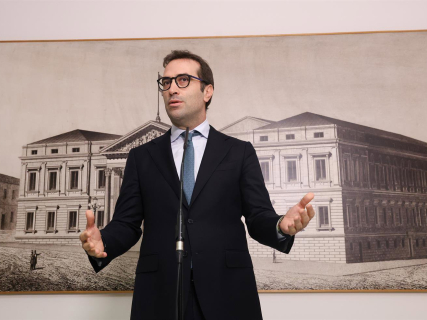
The output of Puente and of the president of Adif leaves in the air the continuity of the rail network dome

Carlos Cuerpo has already met with those responsible for the sector and with the train drivers, who are maintaining their mobilizations and demanding changes in railway safety

fotonoticia 20261104213230 1920

fotonoticia 20261104213230 1920

Add DEMÓCRATA to Google

Ask FREN

Published

Last updated

3 minutes

Most read

Elecciones 29N · Encuestas

La media de las encuestas

Media a 6 de noviembre de 2026 · 13 institutos

  • PP30,9 %
  • PSOE26,2 %
  • Vox19,5 %
  • Frente Amplio6,6 %
  • ERC2,5 %
  • SALF2,3 %
  • Podemos2,2 %
01020304050ene 2024jul 2024ene 2025jul 2025ene 2026jul 2026

Media del último estudio de cada instituto en 30 días y su evolución semanal desde el 23J. Partidos con al menos un 2 %.

Todas las encuestas

Elecciones generales del 29 de noviembre · Demócrata

The railway crisis that has been caused by the resignation of Óscar Puente and the departure of the president of Adif has not been closed with those two moves. Carlos Cuerpo has temporarily taken over the Transport competences and has started a round of talks with those responsible for the sector and the trade union organizations, while the demands concerning safety and maintenance of the network remain pending. In this scenario, further changes in the management teams of the railway companies and of the Ministry cannot be ruled out.

The first departure was that of Puente, who submitted his resignation as minister after the railway accident in Urda (Toledo), in which 69 people died. At that time, the Prime Minister, Pedro Sánchez, tasked Cuerpo, the First Vice President and Minister of Economy, Trade and Enterprise, with handling Transport affairs on a temporary basis.

The following day, the president of Adif, Luis Pedro Marco de la Peña, also submitted his resignation during a meeting with Cuerpo. The new person in charge of Transport confirmed that he had accepted it and described the decision as "the right one." As he explained in an interview on TVE, Marco de la Peña had cited reasons similar to those put forward by Puente. The executive had been in charge of the infrastructure manager since September 2024.

Cuerpo's first meetings with the railway leadership

One of Cuerpo's first decisions after taking over the competences was to convene the main heads of the rail area. On November 4, he met with Marco de la Peña and with the Secretary of State for Transport, José Antonio Santano. The meeting ended with the resignation of the president of Adif.

The next day, the new person in charge of Transport held a meeting with the president of Renfe, Álvaro Fernández Heredia, Santano, and representatives of the Spanish Rail Drivers' Union (Semaf). It was the first contact with the representatives of the drivers since the change at the head of the Ministry and it was framed within efforts to draw closer in order to address the labor conflict and demands for safety.

The meeting did not result in progress. Semaf defined it as a first round of contact and assured that it had conveyed to Cuerpo the workers' discontent and their demands for a structural change in railway safety. The union announced that the Ministry had convened a new meeting for this Friday, November 6.

Train drivers keep strikes and demand changes in safety

The lack of progress keeps the conflict with the train drivers open. Semaf retains the strike calls at Renfe for November 10 and 12 and has also announced a work stoppage on the 17th for drivers of different railway operators. The organization argues that the mobilizations respond to the delay in meeting the safety commitments reached with the Ministry and public companies after the Adamuz accident.

The union calls for cross-cutting measures for the entire sector, which make it possible to put safety before the companies’ commercial and operational interests. Among its demands is the implementation of the commitments agreed on February 9, which included working groups to review and develop safety procedures and rules. Semaf maintains that these efforts have not advanced at the agreed pace.

Pressure does not come only from the train drivers. Adif’s general works committee unanimously agreed to call a 24-hour strike for November 17, in addition to a rally in front of the Congress on the 16th. UGT has pointed out that the Urda accident has once again highlighted the need to address structural deficiencies and not to limit the analysis of responsibilities to the last link in the railway chain.

The crisis goes beyond changes in leadership

The departures of Puente and Marco de la Peña occur after two fatal accidents in high-speed rail within less than a year: that of Adamuz, in Córdoba, which left 46 deaths, and that of Urda, with 69 fatalities. The succession of tragedies has placed pressure on the management of infrastructure, maintenance, safety protocols, and the organization of railway work.

Cuerpo has stated that its priority is to restore confidence in the railway network and has defended that measures had already been adopted in operational, technological, protocol, and maintenance-related resources. It has also highlighted the increase in the investment planned by Adif for the coming years.

However, meetings with the unions have not closed the conflict and the strike calls remain on the table. The new phase of Transport begins, therefore, with two vacancies or first-level replacements already produced, an open labor negotiation, and the demand for changes in how the system operates. The continuity of the current heads of Renfe and of the State Secretariat thus remains within the uncertainties that Cuerpo will have to clear up at the head of the Department.

More key points, information and questions with FREN

AI-GENERATED CONTENT

What is the status of the processing of the railway safety measures demanded by the unions after the recent accidents?

The railway safety measures are in a mixed situation: there are agreed commitments, approved regulations, and reforms still pending. As of November 6, 2026, it is not recorded that the package demanded by the unions has been fully implemented. The main conflict is the delay they report in the execution of the February agreement, reactivated after the Urda accident.

1. The union agreement exists, but does not equate to full execution

Transport published on February 10 an agreement with Semaf, UGT, and CCOO that allowed the cancellation of pending strike days. It includes 1.8 billion euros additional for maintenance and 3,650 jobs, as well as regulatory and organizational changes. Its development requires different actions, not the approval of a single law. The official agreement specifies these commitments:

  • Financing: processing agreements with Adif and Adif Alta Velocidad for 2026-2030. For Adif, 861 million euros in maintenance are planned for 2026, reaching 1.179 billion in 2030. The sources consulted do not confirm the full execution of the increase.
  • Staff: 2,400 additional positions in Adif until 2030, 1,200 contracts in Renfe, and 50 structural positions in the State Railway Safety Agency. These are commitments for progressive incorporation; it is not recorded that all are filled.
  • Means and own maintenance: progressive expansion of 300 road vehicles for maintenance, renewal of track vehicles, and internalization of certain tasks in Renfe. The agreement alone does not confirm their realization.
2. Operational changes: agreed, without full application confirmed

It was agreed to modify Royal Decree 929/2020 to count as effective driving the stops of drivers shorter than 45 minutes. The sources consulted do not confirm the approval of that modification: it remains a regulatory commitment whose completion is not confirmed.

A coordinated risk notification system, a shared safety management committee, and groups on temporary speed limits and weather alerts were also agreed upon. For the committee and the joint monitoring commission, a one-month deadline was set. That agreed deadline does not prove that they have been established or that their work has concluded.

3. What regulatory processing is confirmed
  • The new Railway Sector Regulation has been in public consultation from September 25 until November 12, 2026. It is still a draft, not a current regulation. Its preparation began before Urda and should not be automatically identified with all union demands. It can be consulted in the Transport public consultation.
  • The statute of the Independent Accident Investigation Authority was approved by Royal Decree 141/2026, published on February 27. It is an effective regulatory advance, although it alone does not confirm the full operation of the body.
  • The Order TRM/535/2026, on authorization of auxiliary material, and the technical resolution of August on rolling stock, effective since September 11, have already been published. It is not recorded that they resolve the pending union claims.
4. After Urda: open negotiation

The Council of Ministers examined on November 3 a report of actions. Binding meteorological protocols, operational coordination, signage review, and a possible audit still lack a complete calendar of approval and deployment confirmed.

According to Demócrata, this November 6, there was a new meeting convened and Semaf maintained strikes for the 10th, 12th, and 17th. Renfe, for its part, claims to have fulfilled its commitments. The balance is partial development and disputed compliance, not a closed package.

What are the powers and functions of the First Vice President of the Government and the Minister of Economy in Spain?

The First Vice President of the Government performs support, coordination, and substitution functions for the president, while the Minister of Economy leads a department specialized in economic policy. Both positions can be held by the same person, but their powers are different: the vice presidency does not automatically make its holder the hierarchical superior of all ministers nor does it grant all economic decisions.

Powers of the First Vice President

The vice presidency is a position with flexible configuration. Its specific responsibilities depend on the functions entrusted by the president and the provisions organizing the Government. Therefore, the title of First Vice President does not by itself describe a closed material portfolio.

  • Support the president: collaborate in the political direction of the Executive and carry out the tasks assigned by the president.
  • Coordinate government areas: promote shared actions among ministries when entrusted with such coordination. Coordination does not mean replacing the own powers of each minister.
  • Substitute the president: occupy the first place among vice presidents in the order of substitution when appropriate due to vacancy, absence, or illness. This function ensures Government continuity; it does not equate to a definitive succession in the Presidency.
  • Participate in collective decisions: intervene as a Government member in the deliberations and agreements of the Council of Ministers.
  • Exercise additional responsibilities: lead a ministry if also appointed minister, or assume other formally assigned tasks.

The word first expresses precedence over other vice presidencies. It does not grant, by itself, a general power to review decisions of other departments.

Functions of the Minister of Economy

The minister directs their department and is politically responsible for its management. Their appointment corresponds to the King, at the proposal of the president of the Government, according to article 100 of the Constitution and article 12 of the Government Law. The exact content of their portfolio depends on the current ministerial organization: Economy may also include areas such as Commerce and Business.

Functionally, their activity revolves around these tasks:

  • Economic policy: prepare proposals, analyze economic evolution, and promote measures within the matters attributed to their department.
  • Administrative direction: establish priorities, lead dependent bodies of the ministry, and supervise the execution of their actions.
  • Normative initiative: draft proposals for laws and regulations within their scope and submit to the Council of Ministers decisions requiring collective approval.
  • Institutional economic relations: represent the department before other bodies and participate in European and international coordination corresponding to their portfolio.
  • Parliamentary control: explain their management, appear, and respond to questions and other control instruments of the chambers.

Economy should not be confused with Treasury: directing economic policy does not automatically imply assuming all powers over taxes, budgets, or public spending. Nor does it allow directing decisions corresponding to independent authorities.

When one person holds both positions

They accumulate two differentiated responsibilities: as vice president, they fulfill transversal and substitution functions; as minister, they lead their department. They do not have two votes in the Council of Ministers. Additionally, they may temporarily receive the office of another ministry: according to the consulted Vinces note, that assignment is a substitution and does not make them the holder of the second portfolio.

In short, to determine who can make a specific decision, one must distinguish between the political coordination of the vice presidency, the powers of the ministry, and the decisions reserved for the president or the Council of Ministers.

What legal requirements exist in Spain for a minister to temporarily assume the powers of another department?

In Spain, a minister can temporarily assume the affairs of another department through a substitution agreed by royal decree of the president of the Government. The central rule is article 13.2 of Law 50/1997, of the Government: the assignment must fall on another member of the Executive, state its cause and nature, and refer to the ordinary dispatch of the ministry's affairs.

1. Legal basis and circumstances that justify it

Article 98.2 of the Spanish Constitution attributes to the president the direction of the Government's action and coordination of its members, without eliminating the direct competence and responsibility of each minister. The specific regulation appears in article 13.2 of the Government Law:

"The substitution of Ministers, for the ordinary dispatch of the affairs of their competence, shall be determined by Royal Decree of the President of the Government, and must in any case fall on another member of the Government. The Royal Decree shall state, among other matters, the cause and nature of the substitution."

This figure allows attending situations such as a vacancy, absence, or illness. Its purpose is to ensure the continuity of the department, not to permanently change the distribution of powers among ministries.

2. Personal and formal requirements
  • Already be a member of the Government. The substitution can be assumed by another minister or a vice president. Being a secretary of state, undersecretary, or other senior official is not enough: they cannot substitute the minister through this figure.
  • Decision of the president. An informal agreement between the affected ministers or a unilateral decision of the substitute is not sufficient. The law requires a royal decree from the president of the Government.
  • Identification of the assignment. The royal decree must indicate who assumes the affairs, which department is affected, and expressly the cause and nature of the substitution.
  • Formalization and publicity. The assignment is published in the BOE. Attention must be paid to what the royal decree itself provides about its effects and scope.

No individual investiture or prior parliamentary authorization is required for this substitution. Nor does it imply the appointment of the substitute as the new head of the department.

3. Scope and duration

The material limit expressly established by article 13.2 is the ordinary dispatch. Therefore, it should not be described as an unlimited authorization to redefine the ministry's policy. The substitute attends to its affairs within the assigned mandate and respecting the rules applicable to each decision.

The provision does not set a maximum term in days or months. The substitution is temporary: it can end with the return of the holder, with the appointment of a new one, or according to the conditions of the royal decree. The substitute retains their original position; assuming another dispatch does not grant them a second status as a member of the Council of Ministers.

4. Differences with other figures

Appointment of a minister: article 100 of the Constitution provides that Government members are appointed and removed by the King, at the proposal of the president. That appointment makes the person the head of the department; substitution does not.

Delegation: article 20 of the Government Law regulates the delegation of powers, with its own recipients and limits. It does not equate to temporarily substituting the holder of an entire ministry.

Government in functions: it is a different situation, regulated in article 21. It affects the Executive after its dismissal, while substitution can affect only one department. Both regimes should not be confused.

Play

Test your knowledge with FREN!

How much do you know about this topic? Answer the following 3 questions.

What accident prompted the resignation of Minister Óscar Puente?

Question 1 of 3

Which union has maintained strike calls at Renfe after the recent accidents?

Question 2 of 3

What position did Carlos Cuerpo assume temporarily after the crisis in Transport?

Question 3 of 3