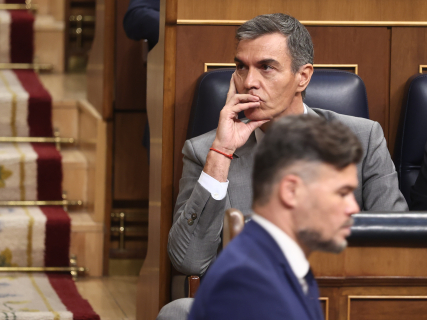
Sánchez reflects again: this is how the hidden tensions that divide the PSOE are.

The rejection of the housing decrees opens another period of reflection for the president of the Government, Pedro Sánchez, with socialist leaders who want to take advantage of the mobilization from the streets and other sectors that prefer to exhaust the legislature. Meanwhile, Alberto Núñez Feijóo has accused Sánchez of seeking a pretext to bring forward the elections. In his appearance before the media, the leader of the opposition has once again presented his housing plan, based on more supply and tax cuts.

7 minutes

EuropaPress 7815414 presidente gobierno pedro sanchez sesion plenaria congreso diputados

EuropaPress 7815414 presidente gobierno pedro sanchez sesion plenaria congreso diputados

Add DEMÓCRATA to Google

Ask FREN

Published

Last updated

7 minutes

Most read

Pedro Sánchez enters a period of reflection again. The rejection of the two housing decrees in Congress has opened a new question about the future of the legislature and has placed the president before a decision in which different interests converge both inside and outside the PSOE.

In public, Moncloa maintains that no decision has been made. Sánchez has given himself the weekend to assess the scenario and listen to reactions before deciding. In private, however, there are socialist leaders and members of the Government who believe that the parliamentary defeat could become the moment to go to the polls and, above all, that the Executive must take advantage of the mobilization that exists on the street around housing. This position is reflected in several reports published this Friday.

At the same time, there are other political and institutional voices that do not consider an electoral advance inevitable and who advocate keeping the legislature open. And a third space, formed by advisors and strategists, analyzes the consequences of an immediate call before Sánchez makes a decision.

The question that arises now is what will weigh more in that reflection: the difficulty of maintaining a parliamentary majority, the absence of budgets, the pressure from socialist leaders, the mobilization for housing, or the possibility of turning this issue into the axis of a potential electoral campaign.

Two rejected decrees and a defeat with political consequences

Congress has rejected this Friday the two royal decree-laws on housing approved by the Government this week.

The first, aimed at protecting the social function of housing and expanding the supply of affordable housing, was rejected by 178 votes against 172. The second, regarding the stability of rental contracts for habitual housing, fell by 184 votes against 166. PP, Vox, and Junts voted against.

Junts had demanded that the Government withdraw the texts and open a new negotiation. Sánchez decided, however, to keep them on the agenda despite knowing that he did not have enough votes.

The defeat acquires a greater political dimension because the decrees had been converted by the Executive into a response to the housing crisis and, in particular, to the problem of evictions. The proposed measures included the extension of protection against evictions, extraordinary extensions of contracts, regulation of seasonal rentals and rooms, and new tax incentives linked to affordable housing.

The parliamentary debate took place while mobilizations for housing were spreading across different cities and the encampment at Puerta del Sol had become one of the focal points of the protest.

The PSOE sector that wants to take advantage of the street

That scenario is precisely what some socialist leaders believe Sánchez should take advantage of.

Even before the vote, PSOE and Government leaders suggested that if PP, Vox, and Junts overturned the decrees, the left could go to the polls with housing as one of the main issues of the campaign. The reasoning conveyed by these sources is that parliamentary rejection would allow presenting the vote as a confrontation between the measures promoted by the Government and the position of the parties that have rejected them.

In that interpretation, housing would displace other issues that have so far conditioned the legislature and would allow the PSOE to focus the electoral debate on one of the problems that is most present on the street.

There are socialist leaders who have expressed this explicitly. The president of Castilla-La Mancha, Emiliano García-Page, has defended the call for elections. And other territorial voices consulted by national media have argued that if the decrees fell, "there is no other choice" but to go to the polls.

Not all socialists share this position. There lies one of the keys to Sánchez's period of reflection.
The other voices: resist until 2027

Against the sector that sees in the mobilization for housing an opportunity to go to the polls, other positions within the political and institutional environment of the Government prefer not to hasten a call.

The thesis of those who advocate continuing is that a parliamentary defeat does not legally compel the dissolution of the Cortes and that there is still room to negotiate new initiatives, rebuild agreements, and keep the legislature open.

This is joined by the position of advisors and strategists who consider that a decision of this caliber requires evaluating not only the result of the vote but also the scenario that would open up afterward.

Sánchez raises the tone in Congress

Sánchez's own speech during the Plenary has contributed to placing housing at the center of political confrontation.

The president asked PP, Vox, and Junts to choose between being "with the social majority or with the speculators" and assured that his Government would not take "a step back" on housing matters. He also urged the deputies to be "brave" and "consistent" in the face of a situation he described as an emergency.

Sánchez defended the decrees as "ambitious," "necessary," "reasonable," and "balanced" measures and warned that their rejection would cause "immense damage."

The president ended his speech with a particularly forceful phrase directed at the groups that would vote against: "History will judge you sooner than you think and with more force than you imagine."

This tone has reinforced the reading of those within the PSOE who believe that the Executive has turned housing into the main ground of political confrontation and that, after the defeat, it could maintain this axis if it ultimately decides to go to the polls.
EuropaPress 7814541 presidente gobierno pedro sanchez ministra vivienda agenda urbana isabel
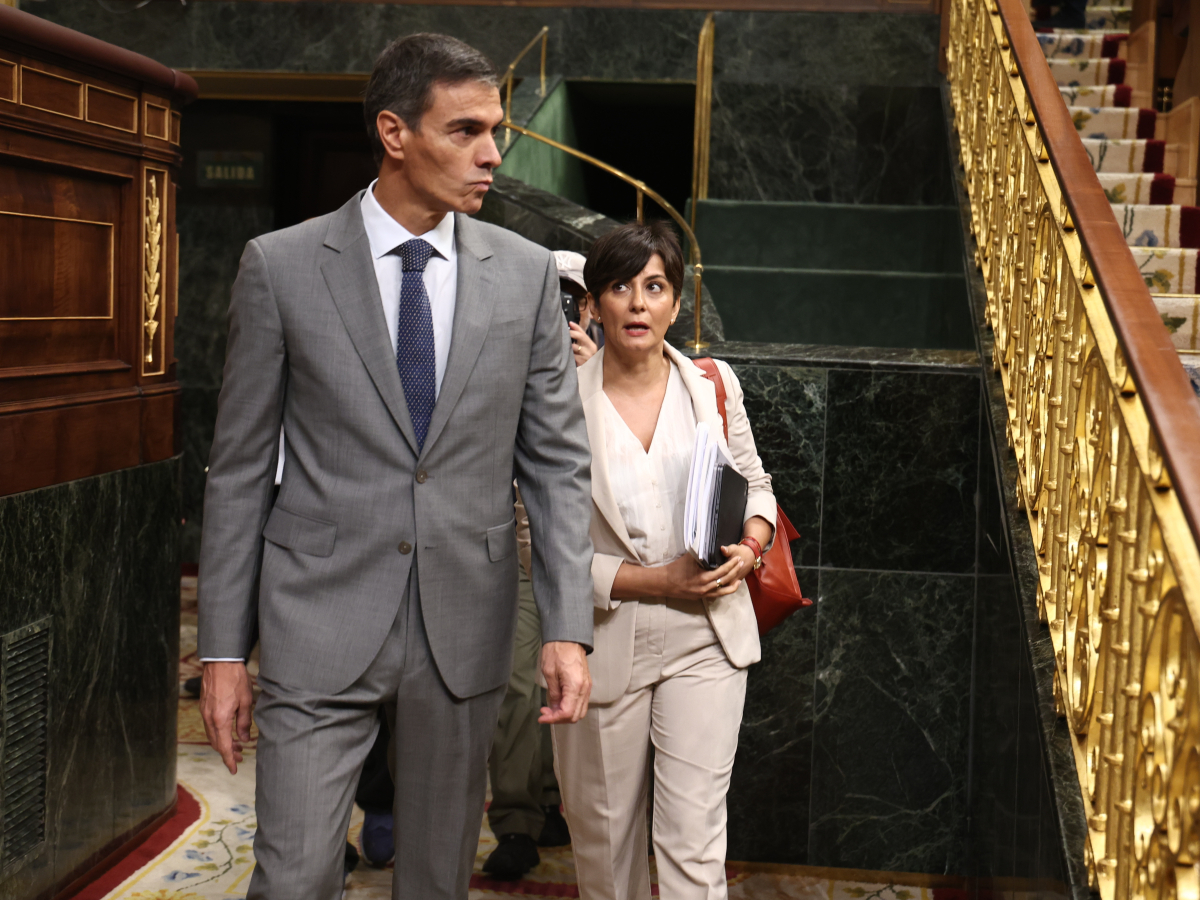
The president of the Government, Pedro Sánchez, alongside the Minister of Housing, Isabel Rodríguez, upon entering Congress. Photo: Europa Press.

Feijóo sees an electoral excuse

Alberto Núñez Feijóo interprets the day from the opposite extreme. For the leader of the PP, Sánchez has not brought the decrees to Congress solely because he is concerned about housing. He believes that the president has constructed a political narrative that could serve as an excuse to bring forward the elections.

The PP maintains that Sánchez has used the Plenary to shift the responsibility for a problem that the Government has not managed to resolve onto the opposition. The popular parliamentary spokesperson, Ester Muñoz, even defined the vote as a "covert vote of confidence" and demanded that the president call elections if he does not have a majority to govern.

Feijóo's accusation goes further: he believes that the president is trying to construct an electoral framework in which housing appears as a problem caused or worsened by the opposition and in which the PSOE can present itself to the public as the party that has tried to respond to it.

Feijóo has also extended this criticism to other crises of the legislature, including the blackout and the railway accident in Adamuz, episodes in which the PP has demanded accountability from the Government. In the view of the popular party, Sánchez would be trying to shift the political responsibility for problems whose management corresponds to the Executive onto his adversaries.

Feijóo's plan for housing: more supply and less taxes

Against the decrees that Congress has just rejected, Feijóo counters with a policy based on increasing the supply of housing and reducing the tax burden, especially for young people.

The PP aims to build one million homes and mobilize available land to accelerate construction. His plan includes a new Land Law, collaboration between administrations, greater funding for autonomous communities and municipalities that facilitate housing, reduction of bureaucracy, and application of positive administrative silence to expedite licenses.

In fiscal matters, the popular plan includes a reduction of VAT from 10% to 4% for young people buying new homes, bonuses in personal income tax (IRPF), and a so-called "Young Home Fund." Feijóo has also proposed public guarantees that could reach 95% or 100% of the financing and tax reductions of up to 60% in certain cases.

The PP argues that the fundamental problem is the insufficiency of supply and that intervention measures on rent can further reduce the number of available homes. Therefore, their proposal combines construction, land, legal security, and fiscal measures.

Feijóo has estimated the existing deficit at around 700,000 homes and has proposed covering a deficit of one million houses during the next legislature. The PP also links its housing strategy to tax reduction, administrative streamlining, and legal security for property owners.

The absence of Budgets adds pressure

Housing is not the only problem that Sánchez will have to assess.

The Government has also not yet presented in Congress the project of General State Budgets for 2027. The accounts remain extended and the Executive has not managed to register new accounts within the expected timeframe.

The Government did approve in June the order to begin the preparation of the 2027 Budgets, but that procedure does not equate to presenting the bill before the Cortes.

For the socialist leaders who defend the elections, the combination of the defeat of the decrees and the absence of new accounts reinforces the difficulty of maintaining a legislature in which each initiative needs to negotiate parliamentary support.

On November 29, if Sánchez takes the step

While the president reflects, the electoral calendar is already calculated.

If Sánchez decided to dissolve the Cortes immediately, November 29 would be the first possible date to hold the general elections. The legislation establishes a period of 54 days between the call and the election day.

In that case, the decree would have to be processed on Monday, October 5, and published in the BOE on Tuesday, October 6. That is the calendar that would open if the president finally opts for the call.

For now, there is no call. Moncloa insists that Sánchez has given himself the weekend to reflect and that there is no closed decision.

Sánchez now has the whole weekend to decide what weight to give to each of those positions. And, on Monday the uncertainty may be cleared: if the president opts to resist until 2027, he will have to rebuild a parliamentary majority that has just failed him in two votes; if he decides to dissolve the Cortes, housing - the issue that the Government has placed at the center of the debate - will also be one of the main arguments he will have to present to the citizens.

More key points, information and questions with FREN

AI-GENERATED CONTENT

What are the parliamentary procedures that would follow if the Government decided to present a new housing initiative after the rejection of the decrees?

If the Government wants to reopen the housing agenda after the rejection of some royal decree-laws, it basically has two parliamentary paths: to go through the ordinary route of a bill or to use a royal decree-law again. In both cases, the focus is the Congress of Deputies, with the Senate playing a secondary reading role.

(A) Ordinary route: housing bill

1. Drafting and approval in the Council of Ministers
The Government drafts a housing bill (with its memorandum, reports, etc.) and approves it in the Council of Ministers. From that moment it becomes a legislative initiative of the Government.

2. Submission to Congress and admission for processing
The text is sent to Congress. The Board of Congress qualifies and admits it for processing (or, exceptionally, it could be rejected if it fails formal requirements). Once admitted:

  • It is published in the Official Bulletin of the General Courts.
  • A first period for total amendments is opened, usually 15 days extendable.

3. General debate in the Plenary of Congress
In the Plenary, a general debate is held, in which groups can:

  • Defend return amendments (complete rejection of the text, returning it to the Government), or
  • Defend alternative text amendments (entirely replacing the bill), or
  • Limit themselves to taking a position without total amendments.

For the bill to continue, a simple majority rejecting the return or alternative text amendments is enough. If a return amendment passes, the bill fails; if an alternative text amendment passes, that new text is taken as the basis.

4. Committee work: partial amendments and report
Once the general debate is passed, a new period for article-by-article amendments opens. The competent committee (in this case, the one linked to housing) discusses and votes on the amendments and approves a report. Most transactions and fine adjustments of the text are woven in this phase.

5. Congress Plenary: debate and final vote
The committee's report is submitted to the Plenary. There:

  • “Live amendments” (those not incorporated by the committee) are debated and voted on.
  • The whole text is voted on.

Again, a simple majority is required to approve the housing law in Congress.

6. Second reading in the Senate
Once approved in Congress, the text is sent to the Senate. A similar scheme is repeated there:

  • Amendment period.
  • Committee work and report.
  • Debate and vote in the Senate Plenary.

The Senate can:

  • Approve the text without changes (the law is ready for promulgation).
  • Approve it with amendments (the text returns to Congress to decide whether to accept them or not, by simple majority).
  • Approve a veto (global rejection). Congress can override this veto with an absolute majority in a first vote or, after two months, by simple majority.

7. Sanction, promulgation, and publication
Once the final text has been approved, it is sent to the King for sanction and promulgation (maximum period of 15 days) and published in the Official State Gazette (BOE). The law comes into force on the date it establishes or, by default, after 20 days.

(B) Exceptional route: new royal decree-law on housing

If the Government resorts again to a royal decree-law, the sequence changes:

  • The Council of Ministers approves the royal decree-law, justifying the extraordinary and urgent need.
  • It is published in the BOE and comes into force immediately.
  • Congress must ratify or repeal it within a maximum of 30 days from its promulgation, in a single ratification debate.

A simple majority is enough in the ratification vote. If Congress ratifies it, it remains in force; if it repeals it, the decree-law ceases to have effect (without prejudice to legal effects already produced, which must be resolved as provided).

Additionally, Congress can agree in that same debate that the decree-law be processed as a bill by the urgent procedure. In that case:

  • The text of the decree-law is projected as an ordinary housing law.
  • The amendment phase, committee, Plenary, and subsequent Senate step open, but with shortened deadlines typical of the urgent procedure.

In summary, after the rejection of previous decrees, the most “stable” and negotiation-friendly route is a new housing bill, with the full ordinary parliamentary process; the new decree-law route reintroduces urgency and immediate entry into force but again subjects the Government to the political risk of ratification and, eventually, a new processing as a bill.

Could you explain with practical examples how a relevant housing law has recently been processed following these steps? What margin does the Senate have to deeply modify a future housing law and how can Congress respond to those changes? What political and legal risks would the Government face by opting again for a royal decree-law on housing instead of an ordinary bill?

What powers does the Spanish Prime Minister have in dissolving the Cortes and calling early elections?

The Spanish Prime Minister has a central power in the early dissolution of the General Courts and in calling elections, but it is not an absolute or unlimited discretionary power. It is framed within the Constitution, requires the intervention of other bodies, and is subject to very precise temporal and material rules.

1. Constitutional basis and general scope of the power

The power to dissolve the Cortes and call early elections is fundamentally based on Article 115 of the Spanish Constitution. According to this provision, the King can dissolve the Congress, the Senate, or the General Courts, but always at the proposal of the Prime Minister, after deliberation of the Council of Ministers. That proposal from the Prime Minister is the decisive political element: without it, the King cannot dissolve on his own initiative.

The decree of dissolution and election call is issued by the King but is countersigned by the Prime Minister, who assumes the political and legal responsibility of the act. Thus, the effective “power” to trigger an early dissolution lies with the Prime Minister, who activates the constitutional mechanism and sets the electoral calendar within the margins established by the Constitution and the Organic Law of the General Electoral Regime (LOREG).

2. Requirements and limits on the Prime Minister's initiative

The Prime Minister's power to propose dissolution is subject to several explicit limits:

  • Prior deliberation of the Council of Ministers: the Prime Minister cannot act alone. The proposal to the King must come after the Council of Ministers has debated the decision. It is not legally a “binding approval” in the parliamentary sense, but it is a guarantee of collegiality and an essential formality.
  • Non-existence of a motion of no confidence in process: while a motion of no confidence is being processed in Congress, the Prime Minister cannot propose dissolution. This prevents the Government from blocking a key parliamentary control instrument by immediately calling elections.
  • One-year temporal limit: a new dissolution cannot be proposed before one year has passed since the previous early dissolution under Article 115. This is to prevent abusive use of repeated elections to unblock majorities.
  • Exceptional states: during states of exception and siege, the Cortes cannot be dissolved; if they were already dissolved, they are automatically convened. De facto, the Prime Minister loses the option of early dissolution at those times.

Additionally, the Prime Minister must respect the electoral temporal framework set by the Constitution and LOREG: the decree determines the election date within the margins of days indicated between dissolution and voting and between voting and the constitution of the new Chambers.

3. Types of dissolution and the Prime Minister's role

It is useful to distinguish three scenarios:

  • “Ordinary” early dissolution (art. 115 CE): this depends directly on the political initiative of the Prime Minister. He decides when it is convenient to go to the polls (for example, to strengthen a weakened majority or unblock a political deadlock), promotes the Council of Ministers' deliberation, and formally proposes it to the King.
  • Dissolution due to investiture failure (art. 99.5 CE): if two months pass from the first investiture vote without any candidate obtaining Congress's confidence, the Cortes are dissolved and elections are automatically called. Here the initiative is not the Prime Minister's but the King dissolves with the countersignature of the President of Congress. It is a mechanism to end institutional deadlock, unrelated to the Executive's will.
  • Ordinary end of the legislature (mandate expiration)

When the maximum four-year mandate expires, the Chambers must be renewed. The dissolution is “mandatory” due to time elapsed but is also formalized by a Royal decree, usually countersigned by the Prime Minister, who sets the election and constitution dates of the new Cortes. Here the Prime Minister's political margin is smaller (he cannot extend the legislature beyond the limit) but retains the ability to set the exact date within the legal range.

4. Dissolution decree and effects on Cortes and Government

In all cases where the Prime Minister intervenes (early dissolution or end of legislature), the decision is formalized in a dissolution and election call decree that:

  • Dissolves the Congress, the Senate, or both Chambers.
  • Calls general elections setting the voting date.
  • Determines the date for the constitution of the new Chambers after the elections.

Dissolution produces two main effects:

  • The Cortes cease their ordinary activity, except for the Permanent Deputation of each Chamber, which remains for control functions and to assume certain powers until the Plenary is reconstituted.
  • The Government enters a caretaker status after the elections, from the moment it ceases when the new Cortes are constituted or after a motion of no confidence or failed investiture. Until the new Executive takes office, the Prime Minister and ministers continue “in functions,” with limited powers, especially in general policy decisions and appointments.

In summary, the Prime Minister is the key actor who can activate early dissolution and election calls, but does so under constitutional-legal control, with the involvement of the King, the Council of Ministers, and Congress itself, and subject to temporal and material limits that prevent arbitrary use of this power.

Can you explain with recent historical examples when early dissolution of the Cortes was used at the Prime Minister's initiative? What practical differences are there between a Government in full functions and a caretaker Government after the dissolution of the Cortes? How is the dissolution of the General Courts coordinated with possible regional or municipal elections that fall on nearby dates?

What is the political career and party of Emiliano García-Page, president of Castilla-La Mancha?

Emiliano García-Page Sánchez is a politician from the Spanish Socialist Workers' Party (PSOE) and since 2015 has been president of the Junta of Communities of Castilla-La Mancha. His career has been almost entirely developed in the Castilian-Manchegan territorial sphere, combining municipal positions in Toledo, responsibilities in the regional Government, presence in the regional Cortes, and a Senate seat by autonomous designation. Since 2012 he has also been secretary general of the PSOE of Castilla-La Mancha, making him the main organic reference of socialism in the region.

Political origin and socialist membership

García-Page was born in Toledo in 1968 and joined political activity very young. According to biographies collected by sources such as Nueva Economía Fórum and various media, he has been a member of the PSOE since he was 18 years old and was trained in grassroots structures: local and provincial committees and the regional executive commission. Before reaching the main regional positions, he rose in the organization until being appointed provincial secretary of the PSOE in Toledo in 1997, consolidating a profile as a territorial leader with strong roots in the regional capital.

First positions: councilor and deputy mayor in Toledo

His institutional career begins in the Toledo City Council:

  • 1987-1991: councilor of the Toledo City Council.
  • 1991-1993: deputy mayor and responsible for municipal areas such as Festivities, Youth, and Finance.

These early years positioned him as one of the young cadres of the Toledo PSOE, with direct experience in municipal management and proximity to urban problems of the regional capital.

Regional projection: counselor and government spokesperson

In the early 1990s, he jumped to the Government of Castilla-La Mancha under socialist presidencies, holding several ministries:

  • 1993-1997: government spokesperson of the Junta of Communities of Castilla-La Mancha.
  • 1997-1999: minister of Public Works.
  • 1999-2000: minister of Social Welfare.

In parallel, he also consolidated in the regional parliamentary sphere:

  • 2000-2004: president of the Socialist Parliamentary Group in the Cortes of Castilla-La Mancha.

Later, he returned to the regional Executive as minister of Institutional Relations (2004-2005). This period gave him broad knowledge of the regional administrative structure and internal dynamics of the PSOE in Castilla-La Mancha.

Stage as mayor of Toledo and senator

The next phase of his career refocuses on the local sphere but with national projection:

  • 2007: he was designated PSOE candidate for Mayor of Toledo.
  • 2007-2015: mayor of Toledo, revalidating the position in 2011. He is the first socialist mayor to repeat a term in the city.
  • 2011-2015: combined the mayoralty with the position of senator by designation of the Cortes of Castilla-La Mancha.

From the mayoralty, he consolidated a profile as an urban manager and strengthened his public visibility, while his presence in the Senate inserted him into state politics, although always with a very defined territorial anchor.

Leadership of the Castilian-Manchegan PSOE

In 2012 he was elected secretary general of the PSOE of Castilla-La Mancha, a key milestone in his career. From then on, García-Page embodied the organic leadership of regional socialism, coordinated opposition to the regional PP government in the 2011-2015 legislature, and became the visible head of the socialist project to recover the Junta.

President of Castilla-La Mancha

After the 2015 regional elections, García-Page was invested president of the Junta of Communities of Castilla-La Mancha. Since then, he has renewed the position twice:

  • 2015: first investiture as president, after an agreement with Podemos in the regional Cortes.
  • 2019: re-election with a reinforced majority.
  • 2023: new term, this time with absolute majority in the Cortes of Castilla-La Mancha.

According to various political chronicles and polling analyses, he is considered a figure with high citizen approval in his community and one of the few socialist barons governing with an absolute majority. His political line is characterized by a discourse of moderate autonomism, insistence on regional financing, and defense of public services — especially healthcare — along with an internal positioning often critical of the federal PSOE leadership, although without breaking with the party.

Summary: party and political profile

In summary, Emiliano García-Page is a PSOE leader whose career follows a classic sequence in Spanish territorial politics: early membership, municipal management, regional responsibility as minister and spokesperson, organic leadership, and finally presidency of an autonomous community. His party affiliation has always been PSOE, without changes of label or splits, and his public image combines the role of regional baron with internal weight in socialism and that of a long-term manager at the head of Castilla-La Mancha.

Could you make me a schematic timeline with the key dates of García-Page's political career? What political differences does García-Page maintain with the federal PSOE leadership and with Pedro Sánchez? How have the PSOE's electoral results in Castilla-La Mancha been under García-Page's leadership since 2015?

Play

Test your knowledge with FREN!

How much do you know about this topic? Answer the following 3 questions.

What immediate political consequence has the rejection of the two housing decrees in Congress had?

Question 1 of 3

What measures did the housing decrees rejected by Congress include?

Question 2 of 3

What argument does the PP use to criticize Sánchez's management regarding the housing decrees?

Question 3 of 3