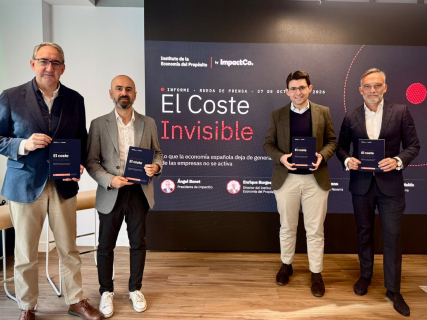

Spain assumes each year an opportunity cost of 44.5 billion euros, 2.6% of GDP, for not effectively implementing the corporate purpose. This is concluded in the report "The Invisible Cost" by ImpactCo, which examines the gap between proclaiming a corporate purpose and actually applying it in daily management.
According to the study, presented this Tuesday, if Spanish companies truly activated their purpose and turned that potential into tangible results, public coffers could receive nearly 19.6 billion euros additional per year, without resorting to tax increases, deficit increases, or new debt issuance.
The document presents the corporate purpose as a driver to raise productivity, retain talent, stimulate innovation, and generate shared value. To achieve this, it proposes moving from mere declaration to action, integrating the purpose into management indicators, investment decisions, compensation policy, relationships with suppliers, and the evaluation of social and environmental impact.
During the presentation, the president of ImpactCo, Ángel Bonet, stated that the current economic model "is exhausted" and causes two major imbalances: one related to the environment and another to inequalities between social classes.
Spain closed 2025 with a gross domestic product (GDP) of 1.69 trillion euros and a growth of 2.8%. However, the report emphasizes that 34.8% of minors in the country, more than 2.7 million children and adolescents, were at risk of poverty or social exclusion, the second highest rate in the European Union. Additionally, the top 10% with the highest wealth concentrated 57.2% of national wealth in 2025.
For the authors of the study, these figures highlight one of the central paradoxes of the report: economic growth does not automatically translate into shared well-being. The key question is not only how much value the economy generates, but "how it is distributed and to what extent it contributes to the progress of society."
Bonet pointed out that this gap could be narrowed if the corporate purpose were applied in a real way. "Inequality is a productivity trap: very unequal economies grow more slowly," he stated.
In this line, he defended that internalizing costs, improving working conditions, and increasing training would favor a more sustainable and inclusive growth and support the consolidation of a broader middle class.
Real application of the purpose
The report detects a clear distance between the formulation of the purpose and its effective incorporation into the organization. Although 70% of Spanish companies claim to have a purpose, 39% confuse it with the mission and vision. This gap is also manifested in employee commitment: "engagement in Spain was at 10% in 2025, compared to 18% ten years ago."
The director of the Institute of Purpose Economy, Enrique Burgos, warned that this low level of commitment can negatively affect productivity, absenteeism, and talent turnover.
According to the report, the cost of replacing a worker varies depending on the position and can reach up to 400% of the annual salary in managerial positions and highly specialized profiles.
Absenteeism is identified as another relevant source of economic impact. The study's estimates place its cost in Spain at 29.114 billion euros in 2024. If replacement costs and unrecovered production are added, the total impact could rise to 128.668 billion euros.
"All this highlights that companies must have a real and implemented purpose that maximizes shared value, that is, economic benefits as well as social ones," emphasized Bonet.
Connecting companies and workers
The director of the Chair of Purpose-Driven Companies at the University of Navarra (UNAV), Álvaro Lleó, explained that the purpose can be understood in multiple ways: as the DNA of the company, its reason for being, its essence, or its philosophy. For organizations to define it accurately, he pointed out, it is essential that they have a clear vision of what makes them unique.
Lleó also highlighted that the purpose can become a tool to "draw strength to overcome obstacles," in addition to being a factor that "inspires and energizes." He also detailed that the purpose has three dimensions: it is formulated from the company's identity, provides the sense on which it is based, and is concretized in its mission.
According to Álvaro Lleó, this perspective allows addressing both the internal challenges of companies and their interaction with the environment. At an internal level, the purpose can help attract and retain talent and strengthen the ties between organizations and their employees. Facing outward, it can contribute to "generating trust, improving the reputation and legitimacy of companies, and responding to social demands and investor expectations."
Based on the research
The Vice Dean of Faculty of Economic and Business Sciences at the University of Navarra, Javier Arellano, highlighted the rigor and scientific solidity of the report, which combines microeconomic and mesoeconomic data to offer a macroeconomic reading. In its preparation, 80 companies, more than 40,000 employees, and 6,000 executives have participated.
Arellano added that initiatives aimed at reinforcing corporate purpose can be more effective than purely economic incentives, as they generate fewer unwanted effects and stronger and more lasting bonds.
"The Invisible Cost" also becomes a starting point for the next lines of research of the Chair of Purpose-Driven Companies at the University of Navarra, with the goal of deepening the connection between business management, value creation, and economic and social progress.