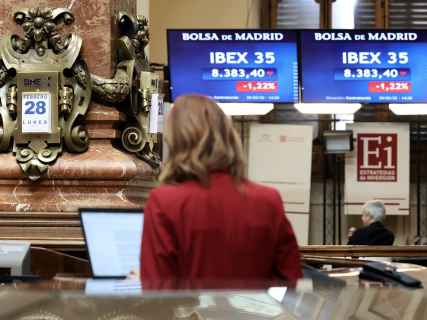

The Ibex 35 has started this Thursday, July 23, with the brakes on. During the first hour of trading, the main index of the Spanish Stock Exchange fell by 0.42%, to 19,488.8 points, after having closed on Wednesday at 19,571.3 points, with an increase close to 1%.
The movement represents a contained profit-taking after two consecutive sessions of increases. The index maintains a revaluation of over 13% since January and remains relatively close to its maximum of the last 52 weeks, located at 19,879.1 points.
Oil returns to dictate the agenda
The main concern of the market does not come this time from corporate results, but from the Middle East. Brent oil, a benchmark in Europe, rises more than 4% and approaches 98 dollars per barrel, a six-week high.
The attacks on oil tankers in the Red Sea and the escalation between the United States and Iran have reignited fears that some of the main global energy supply routes may be interrupted. The immediate reaction is a rise in crude oil; the potential consequence, a new increase in fuel prices, transportation, and industrial production.
For Spanish households, the risk is double. More expensive oil can be passed on to gas stations and hinder the moderation of inflation. At the same time, that pressure on prices reduces the margin of the European Central Bank to ease the cost of mortgages and financing.
The ECB, again attentive to energy
The Governing Council of the ECB is holding its monetary policy meeting this Thursday. The decision will be known at 14:15 hours and Christine Lagarde will appear half an hour later.
The market consensus expects the institution to keep the deposit facility rate unchanged at 2.25%, after raising it by 25 basis points in June in response to inflationary pressures caused by the conflict in the Middle East. The key will therefore be less in the immediate decision than in the signals about a possible new increase in September.
The rise in crude oil returns the ECB to an uncomfortable position: to combat inflation with high rates, even at the risk of cooling the economy, or to wait to see if the energy price increase is temporary. This dilemma will condition the Euribor, corporate credit, and European equities in the coming weeks.
Repsol turns the energy crisis into stock market gains
The main exception to the negative tone is Repsol. The oil company rose by 3.84%, up to 26.46 euros per share, and became one of the major supports of the Ibex.
The company obtained a net profit of 2.201 billion euros during the first half, compared to 603 million in the same period of the previous year. A significant part of the improvement comes from the revaluation of its oil inventories, which contributed a positive effect of 823 million. Its adjusted net result, which more directly reflects the evolution of the businesses, reached 2.711 billion.
For its numerous small shareholders, the reading is favorable in the short term: the more oil and energy margins rise, the better the company's revenue expectations are. But that same rise that benefits Repsol acts as an indirect tax for families and energy-consuming companies.
Indra accelerates in the heat of public spending on defense
Indra led the advances with a rise slightly above 4%. The technology company has reported a net profit of 219 million euros in the first half, 2.1% more, while its revenues grew by nearly 30%, up to 3.179 billion.
The most significant data is its order book, which has doubled to 20.533 billion euros. A large part of that jump is linked to the Special Modernization Programs promoted by the Spanish Government and the widespread increase in European defense spending.
Indra's behavior shows how budgetary and geopolitical decisions are directly translating to the Stock Exchange. The increase in public investment in defense boosts the company's business expectations, although it also opens the debate on the State's spending priorities and on the Spanish industrial capacity to execute those contracts.
Santander and Iberdrola weigh among the most popular stocks
Among the companies with a larger base of retail shareholders, the opening leaves an uneven performance.
Banco Santander fell by 1.20%, BBVA dropped by 0.47% and Iberdrola lost 1.22%. Bankinter traded almost flat despite announcing a 12% increase in profit, up to 605 million euros, while CaixaBank advanced slightly by 0.07%.
Telefónica, on the other hand, rose by 0.66%, and Inditex remained practically unchanged.
The joint decline of Santander and Iberdrola is particularly relevant due to their significant weight within the index. Their losses offset a good part of the push from Repsol and Indra and explain why the Ibex remains negative despite having two stocks that advance more than 4%.
Tourism and consumption suffer from the rise in crude oil prices
The largest losses corresponded to Puig, with a drop of 2.44%; IAG, which fell 1.74%; and Grifols, with a decrease of 1.70%.
The punishment of IAG has a direct explanation: a prolonged rise in oil increases the cost of fuel for airlines and can reduce their margins. It can also cool consumption and raise travel costs, a threat to one of the main engines of the Spanish economy during the tourist season.
Puig and Grifols reflect, for their part, a greater caution from investors regarding consumer and health stocks on a day when money is shifting towards energy companies, defense, and other businesses considered better protected against inflation.
Europe falls more than Madrid
The behavior of the Ibex is negative, but more resilient than that of much of Europe. The German Dax and the French Cac lose around 0.8%, the Italian Mib falls more than 1%, and the British Ftse retreats nearly 0.3%.
The composition of the Spanish market acts again as a buffer. The high weight of energy and the good performance of Repsol allow the Ibex to limit losses, although the weakness of the banking sector and Iberdrola prevents the index from returning to positive territory.
The session will now depend on two variables. First, on the evolution of oil and news from the Middle East. Then, on the ECB's message regarding interest rates. The decision from Frankfurt will determine whether the opening correction is a simple pause after the recent rises or the beginning of a more complicated day for European stock markets.