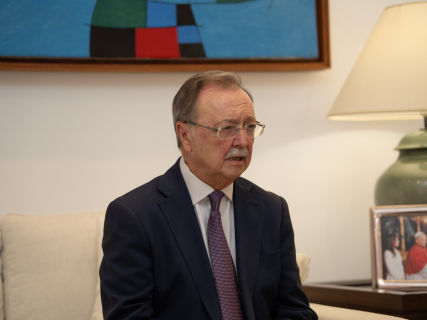
Vivas demands from Brussels to "shield" the border of Ceuta to avoid another migration crisis

The president of the autonomous city demands expulsions, more resources for the border, and the deployment of Frontex, Europol, and the European Asylum Agency during his speech before the European Parliament.

3 minutes

EuropaPress 7703677 presidente ceuta juan jesus vivas reunion presidenta gobierno islas

EuropaPress 7703677 presidente ceuta juan jesus vivas reunion presidenta gobierno islas

Add DEMÓCRATA to Google

Ask FREN

Published

Last updated

3 minutes

Most read

The president of Ceuta, Juan Jesús Vivas, has claimed this Thursday a greater involvement of the European Union and the "shielding" of its border so that the autonomous city can regain normality after the migratory crisis of last week and prevent a similar situation from happening again.

He has done so electronically during the extraordinary meeting of the Committee on Civil Liberties, Justice and Home Affairs (LIBE) of the European Parliament, convened to analyze the massive entry of migrants recorded in the autonomous city.

The session, driven by the Popular Party, has included the participation of the European Commissioner for Home Affairs and Migration, Magnus Brunner, while the Minister of the Interior, Fernando Grande-Marlaska, and the Minister of Inclusion, Social Security and Migration, Elma Saiz, ultimately did not intervene after declining the invitation.

"One of the most difficult moments in the recent history of Ceuta"

During his speech, Vivas thanked the holding of this extraordinary debate and defined the situation experienced as "one of the most difficult moments in the recent history of Ceuta".

The Ceuta president has maintained that "what happened a week ago is not a typical migratory crisis", but an episode that, in his opinion, "has jeopardized the integrity of Ceuta, Spain, and Europe" in the face of the "precariousness of resources" at European borders.

"The city has not regained normality"

Although he has acknowledged that the majority of the people who entered irregularly have already returned to Morocco and has recalled that, according to data from the Ministry of the Interior, 72,000 people have returned, Vivas has warned that Ceuta is still far from regaining normality.

As he explained, about 6,000 people still remain in the city, while the reception centers for adults and minors continue to be saturated.

The president has also focused on the social impact that the crisis has left among the Ceuta population. "Our population feels sad, powerless, restless, fearful, and worried", he stated.

In this context, he has warned that the situation has evidenced the vulnerability of Ceuta and has pointed out that the security of the city depends, to a large extent, on the actions of "a third country that does not recognize our sovereignty".

Expulsions, more security, and European support

Vivas has argued that regaining normality involves adopting a series of immediate and structural measures.

Among them, she has prioritized the expulsion of Moroccan immigrants who remain in an irregular situation in Ceuta, as well as a permanent response to the migratory pressure derived from the city's condition as the land border of the European Union in Africa.

Likewise, she has demanded to strengthen the personnel and resources of the State Security Forces and Corps and Defense, execute new border protection infrastructures, and increase the involvement of community institutions.

In this regard, she has requested the deployment of Frontex, Europol, and the European Asylum Agency, in addition to new resources to alleviate the collapse that the reception centers are experiencing.

The Ceuta president has also proposed the development of a specific plan to regain confidence in Ceuta's economic future and compensate for the consequences that the crisis has had on the city.

Memory for the victims

At the end of her speech, Vivas wanted to remember the human cost of the migratory crisis and expressed her sorrow for the hundred deceased that, she pointed out, has resulted from the avalanche recorded at the border.

Despite the seriousness of the situation, she has conveyed her confidence in European institutions and has called for greater involvement from the European Union to help Ceuta overcome the crisis and strengthen the protection of the external community border.

More key points, information and questions with FREN

AI-GENERATED CONTENT

What is the current status of the parliamentary processing of proposals to strengthen the Ceuta border in the Congress of Deputies?

At this moment, there is no single “law to reinforce the Ceuta border” in an advanced stage in Congress, but rather a set of scattered initiatives (mainly from the PP and Vox) that address Ceuta within broader packages on immigration, borders, and sovereignty. The only initiative with the rank of law specifically linked to the Ceuta border is the PP's bill to reform the Immigration Law and extend border rejection also to entries by sea in Ceuta and Melilla, registered on July 16, 2026, and still pending effective processing. Alongside it, there are several non-legislative proposals (PNL) and motions requesting reinforcement of human and material resources at the border, many of which have already been rejected or merely politically urge the Government. The July-August 2026 migration crisis has multiplied control initiatives (appearances, questions, extraordinary plenaries), but so far no specific regulatory reform on the fence or perimeter of Ceuta has been approved.

1. PP's bill on Immigration Law (main axis)

According to the newspaper Demócrata, the Popular Group has registered in Congress an organic bill to modify the tenth additional provision of the Immigration Law and allow the application of the border rejection regime also to those entering by sea in Ceuta and Melilla. The initiative was publicly presented by deputy Sofía Acedo and is justified by the recent Supreme Court ruling that limits immediate rejection to those who overcome physical containment elements, such as the fence, excluding those who arrive swimming or bypassing breakwaters, as explained in Demócrata's report on the popular proposal here.

Various reports from Demócrata indicate that the PP demands this reform be processed urgently and by single reading, so that the Plenary can shorten the ordinary deadlines to the maximum (article on Feijóo's plan; extension of the same discourse). However, there is no record that Congress has yet held the debate on taking it into consideration nor that such single reading has been formally agreed. As of August 6, 2026, therefore, the bill is registered and admitted, but in an initial processing phase, pending the Board and the Plenary to decide how and when it will be debated.

2. Non-legislative proposals and motions on Ceuta and the border

In the realm of political impetus initiatives (without the rank of law), there are several direct references to strengthening the Ceuta border:

  • The PNL 162/000288 from the Popular Group, related to the control of irregular migratory flows, includes among its points “resolving the deficiencies currently existing in the SIVE teams and in the technical means installed at the land borders and the perimeter fence of the cities of Ceuta and Melilla.” It is in the state “Pending (publication of the initiative)”, that is, still not debated or voted in committee. The text can be consulted in the Official Bulletin of the Cortes.
  • A very similar earlier version, PNL 162/000284, was finally withdrawn on September 20, 2024, after being published in the Bulletin on August 30 (see the latest bulletin and the initial publication at this link).
  • Vox has promoted more political PNLs on the defense of the sovereignty and territorial integrity of Ceuta and Melilla, demanding to provide the Security Forces and Corps “with sufficient logistical and personnel resources for the defense of our borders.” One of them, 161/001736, was rejected: the rejection text was published on June 4, 2025 (bulletin). Another earlier PNL, registered as 162/000034, generically urging to protect the sovereignty of Ceuta and Melilla, was approved by the Plenary, with official publication on June 25, 2025 (bulletin and later summary in this document).
  • In a motion following an urgent interpellation on crime (173/000094), Vox expressly proposed “significantly reinforcing the allocations of the State Security Forces and Corps in Ceuta, Melilla, and the Canary Islands.” The initiative ended with rejection, as recorded in the bulletin of May 14, 2025 (text of the motion and rejection).

3. Control initiatives linked to the 2026 crisis

After the migration crisis at the end of July 2026, the PP launched a parliamentary offensive demanding an extraordinary Plenary, appearances by the Prime Minister and several ministers, and the enabling of August in Congress and Senate to address the Ceuta situation. The newspaper Demócrata details this strategy in a specific analysis on the request for plenary and extraordinary committees (article on the PP offensive).

These initiatives (appearances, Standing Committee, written questions) do not themselves generate regulations to physically reinforce the border, but they do pressure the Government to act and to accelerate the processing of the Immigration reform and other measures. The PP has expressly linked this control agenda with its bill on border rejection, insisting it must be approved “right now” and by single reading to “shield” Ceuta and Melilla.

4. Summary: a cross-cutting issue, without a “great Ceuta border law”

Overall, institutional sources and Demócrata's monitoring show that reinforcing the Ceuta border is today a cross-cutting issue that appears in PNLs, motions, broader bills (Immigration, National Security, migratory cooperation), and control debates, but there is no single “Ceuta border law” in a final processing phase. The piece with the most direct regulatory potential is the Immigration Law reform promoted by the PP, still in an initial phase. The rest of the specific initiatives on Ceuta that have been voted on are mostly PNLs or impetus motions whose legal effect is limited and have had mixed results (some approved, others rejected or withdrawn).

To know at any time the exact status of a specific file, it is necessary to consult the Congress initiative search engine and the Official Bulletin of the General Courts, filtering by terms such as “Ceuta,” “border,” or “perimeter fence,” and cross-check that information with parliamentary coverage from media like the newspaper Demócrata.

What are the powers and functions of the President of Ceuta according to the Statute of Autonomy?

According to the Statute of Autonomy of Ceuta, the President of the City is simultaneously the highest institutional representative of the Autonomous City, president of the Assembly, and head of the Government Council. He exercises functions of direction and coordination of government action, as well as appointment and dismissal of councilors, with the capacity to delegate part of his executive functions. Additionally, he holds the status of mayor, and his election corresponds to the Assembly of Ceuta, which elects him from among its members and whose confidence he needs to remain in office. All this is set out in Organic Law 1/1995, of March 13, of the Statute of Autonomy of Ceuta.

Institutional position of the President of Ceuta

The Statute establishes that the institutional bodies of the city are the Assembly of Ceuta, the President, and the Government Council. Within this framework, the President occupies a central position because:

  • He presides over the Assembly of Ceuta, which is the representative body of the City. The Assembly's Board is composed of the City President, who presides over it, and two vice presidents elected by the Assembly itself.
  • He presides over the Government Council, whose activity he directs and coordinates. The Government Council is the collegiate body that holds the executive and administrative functions of the City.
  • He holds the supreme representation of the City, which places him as the main political and institutional authority of Ceuta vis-à-vis the State and third parties.
  • He also holds the status of mayor, integrating in a single figure the functions proper to an autonomous president and a municipal mayor.

Executive and government organization functions

In the governmental and administrative sphere, the Statute assigns the President several key competencies:

  • Appoint and dismiss the councilors who make up the Government Council. The members of the Council are freely appointed and dismissed by the President, with the obligation to report to the Assembly.
  • Direct and coordinate the activity of the Government Council, assuming the leadership of the executive and administrative action of the City, without prejudice to the competencies reserved to the Assembly.
  • Temporarily delegate his own executive functions to some members of the Council. This faculty allows him to internally organize the distribution of responsibilities within the executive.

Although the Government Council has executive and administrative functions collegially attributed, the Statute makes clear that the general political direction corresponds to the Council under the presidency and coordination of the President, who is the key figure in that structure.

Relationship with the Assembly and political confidence

The relationship of the President with the Assembly of Ceuta is twofold: on one hand, he presides over it; on the other, he depends on its political confidence.

Regarding investiture, the Statute provides that:

  • The President is elected by the Assembly of Ceuta from among its members and appointed by the King.
  • The election must be made among the members of the Assembly who head any of the electoral lists that have obtained seats.
  • The election is made by absolute majority. If no candidate obtains that majority, the President is designated as the one who heads the list that obtained the highest number of votes.

From the perspective of political stability, the Statute contemplates several mechanisms:

  • The Government Council, presided over by the President, is politically accountable to the Assembly solidarily, which implies parliamentary control over the executive's action.
  • The Government Council ceases, among other cases, by approval by the Assembly of a motion of censure or by the denial of confidence requested, which directly affects the President as head of the executive.
  • The President may raise a question of confidence on his program or a general policy declaration, after deliberation of the Government Council. Confidence is understood to be granted when a simple majority of the Assembly members vote in favor.

If the Assembly denies confidence, the Statute itself establishes that the President must resign and a new election process opens, reinforcing the parliamentary nature of the City's government system.

Summary of essential competencies

In summary, according to the Statute of Autonomy of Ceuta, the main functions of the City President are:

  • Institutional representation: supreme representation of the Autonomous City and status as mayor.
  • Political direction: presidency, direction, and coordination of the Government Council.
  • Executive organization: appointment and dismissal of councilors and temporary delegation of executive functions.
  • Relationship with the Assembly: presidency of the Chamber, dependence on its confidence, capacity to raise questions of confidence, and submission to the Assembly's political control.

These competencies configure the President as the central piece of Ceuta's institutional system, articulating the City's representation, government direction, and connection with the parliamentary majority that supports him.

How is the President of Ceuta legally differentiated from a regional president of an ordinary autonomous community? What procedure and requirements does the Statute of Autonomy of Ceuta establish for a motion of censure against the President? What specific competencies does the Government Council of Ceuta have and how are they coordinated with those of the President according to the Statute?

What have been the results of the latest regional elections in Ceuta and how many seats does each party have in the Assembly?

The available sources do not record the numerical results of the latest elections to the Assembly of Ceuta (neither in votes nor in seats per party), so it is not possible to rigorously offer the exact distribution of deputies by party. It is known, from recent information, which parties are present in the Assembly and participate in its Board of Spokespersons, but not the number of seats each holds. Therefore, there is no complete official data on the distribution of seats in the legislature resulting from the latest regional elections in the city.

What information does appear about the Assembly of Ceuta

Although there is no specific piece on electoral results, several news items allow identifying the political actors currently in the Ceuta Chamber. A report on the migration crisis explains that the Board of Spokespersons of the Assembly includes PP, PSOE, Vox, MDyC, and Ceuta Ya!, who acted in a coordinated manner to demand from the central Government the declaration of national emergency and other exceptional measures, as detailed by the newspaper Demócrata in its coverage of that extraordinary Chamber meeting (article on the Board of Spokespersons).

In parallel, several current political and migration crisis reports place the Assembly as the institutional axis of the city: for example, the piece describing the unanimous agreement of the entire Assembly demanding aid from the Government and the declaration of national emergency (report on the chaos in Ceuta), or news about Vox's positions in the city (Vox event in Ceuta; Abascal's statements; Buxadé's intervention).

Other news focus on the relationship between the central Government and Ceuta's institutions, such as the dismissal and appointment of the Government delegate in the city, where it is recalled that the previous delegate had been vice president of the Assembly's Governing Board (Government delegation in Ceuta). Institutional visits to the Ceuta Assembly Palace are also recorded in La Moncloa's official agendas (visit of Elma Saiz; visit of Ángel Víctor Torres and meeting with Juan Jesús Vivas).

Limits of the available information

In the consulted documentation – including political press databases like Demócrata and official notes on electoral processes in Spain – the scrutiny record or a “seats by party” table specific to Ceuta does not appear, unlike what happens for other territories in recent elections (for example, Andalusia or Aragon). Among others, detailed analyses of results and seat distribution have been found in:

In contrast, nothing equivalent appears for Ceuta's regional elections: neither the Ministry of the Interior nor the Electoral Board are cited in the texts as sources of a specific Ceuta table (unlike, for example, the European elections, whose results are published in the BOE with territorial breakdowns: Central Electoral Board agreement). There is also no “Ceuta results special” in Demócrata similar to those of Andalusia, Aragon, or Extremadura.

Conclusion and ways to obtain the exact data

With the available information, it is not possible to precisely answer how many seats each party currently holds in the Assembly of Ceuta after the latest elections. We do know, from parliamentary and migration crisis news, that the Chamber is composed at least of PP, PSOE, Vox, MDyC, and Ceuta Ya!, and that these groups operate in a coordinated manner in the Board of Spokespersons and in institutional relations with the central Government. To obtain the exact seat distribution by party, one would have to consult the official scrutiny of Ceuta's regional elections (Ministry of the Interior portal or corresponding publication in the Official Bulletin), information not found in the collected pieces.

If you wish, I can help you interpret that official results table – once you have it – in terms of majorities, possible government pacts, and blocking or opposition capacity, in line with analyses made for other autonomous communities.

Other political and electoral context contents mentioned in the research, although they do not provide data on Ceuta, include: analyses of polls and general results (Target Point, Hamalgama, Sigma Dos, GESOP, Sigma Dos July 2026, Sociométrica 2025, investiture block), institutional guides and glossaries (electoral glossary, note on Congress, explanation of constituencies), as well as parliamentary memory and comparative politics pieces (Zapatero's investiture, Suárez's last debate, 1977 Amnesty Law, seat transfers, Ceuta in the Senate and its technical versions, relations with Morocco, or international electoral coverage such as Iraq, Algeria, Bangladesh, or Palestine: Iraq, preliminary data in Iraq, election of the Iraqi Parliament president, Algerian legislative, Bangladesh, Palestinian municipal elections and Palestinian Authority reaction).

In what year were the latest elections to the Assembly of Ceuta held exactly and which parties ran? What government pacts or investiture agreements have been closed in the Assembly of Ceuta after those elections? How does the current balance of forces in the Assembly of Ceuta affect the management of the migration crisis with Morocco?

Play

Test your knowledge with FREN!

How much do you know about this topic? Answer the following 3 questions.

Which European agency has Juan Jesús Vivas requested to deploy its forces in Ceuta?

Question 1 of 3

What is the estimated number of people who, according to Vivas, remain in Ceuta after the massive crossings at the end of July?

Question 2 of 3

What has Vivas regretted regarding the return of minors to Morocco according to current regulations?

Question 3 of 3

Hola, soy Fren. ¿Cómo te ayudo?