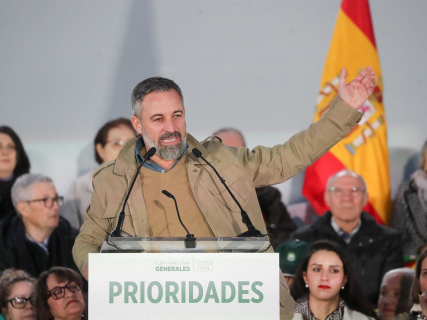

The president of Vox and candidate for the Presidency of the Government, Santiago Abascal, has defended that the expulsions of immigrants proposed by his party should be carried out individually and respecting legal procedures. In a interview granted to La Vanguardia, published this Sunday, October 25, the leader has placed immigration, tax reduction, and economic deregulation among his priorities for the general elections on November 29, while reiterating that his goal is to reach the Moncloa and not to become vice president of a possible government led by Alberto Núñez Feijóo.
The interview, conducted by journalists Lola García and Cristina Sen in Mallorca, takes place in the midst of the electoral pre-campaign, marked by contacts between PP and Vox to explore possible agreements and by the incidents recorded during some events of Abascal's party. The leader has assured that he considers the political cycle of Pedro Sánchez exhausted, although he has called for caution regarding electoral expectations and has reminded what happened in the 2023 general elections, when the results deviated from the forecasts of a good part of the polls. In this context, he has accused the Executive of resorting to possible maneuvers to remain in power, statements that he has not accompanied with conclusive evidence about the existence of electoral fraud.
Abascal defends "remigration" and assures that expulsions will be individual
Migration policy has occupied one of the main blocks of the interview. Abascal has reiterated his intention to promote repatriations of people in irregular situations, expulsions of foreigners convicted of crimes, and measures to favor the return of immigrants who do not work and receive social benefits. The leader of Vox has defended that these actions should be developed continuously and through individual procedures, rejecting the image of indiscriminate collective expulsions.
"Spain is a rule of law", Abascal has stated, who has acknowledged that his proposal could require modifications to Spanish and European legislation. The leader believes that the current migration model generates excessive pressure on public services, housing, and the education system, although he has not specified how many people could be affected by the measures nor how their application would be guaranteed in each case.
Asked about the possibility that the countries of origin do not accept expelled persons, Abascal has directed his criticisms against Morocco, which he has accused of using migratory flows as an instrument of political and economic pressure on Spain and European institutions. He has also attributed to Sánchez's Government an interest in maintaining irregular immigration, an accusation made by the Vox candidate that has not been substantiated.
The leader of Vox points to Islamism as a threat to Catalan identity
Another of the issues addressed in the conversation with La Vanguardia has been the political and social situation in Catalonia, where Abascal has defended that Catalan identity is not threatened by Spain, but by what he considers a process of Islamization resulting from immigration from predominantly Muslim countries. The president of Vox has maintained that the migratory issue must be prioritized over the territorial debate and has used the expression "Islamic caliphate" to refer to the threat that, according to his interpretation, Catalonia faces.
The leader has acknowledged the existence of a distinct Catalan identity, although he has directly linked it to the Spanish one, and has defended more restrictive measures in immigration matters. His statements come in a context of political competition with Aliança Catalana, a formation led by Sílvia Orriols, with which Vox shares some positions on immigration and security, despite their differences in territorial matters.
In this sense, Abascal has opened the door to collaborate with Aliança Catalana on certain issues related to citizen security and immigration, although he has ruled out adopting other proposals from the independentist formation. He has also defended the freedom to choose language in education and has criticized the linguistic policies promoted by the Catalan and Basque institutions.
Vox opens the door to agreements with Feijóo and to a coordinated candidacy for the Senate
In relation to the scenario after 29N, Abascal has insisted that Vox is running for election with the intention of governing and has rejected anticipating a distribution of ministries with the Partido Popular. The leader has pointed out that it will be the result of the ballots that determines the role of his party in the next legislature and has expressed his concern that the PP focuses its strategy on competing with Vox, instead of expanding its support among voters dissatisfied with the PSOE.
The leader of Vox has also confirmed that there are possibilities of reaching an agreement with the popular party to coordinate the candidacies for the Senate, although he has avoided revealing the details of the conversations. Abascal considers it necessary that a possible change of Government in Congress can also count on support in the Upper House, where he fears that a socialist majority could hinder the reforms of the new Executive.
Regarding a possible reform of the Constitution, Abascal has ruled out placing it among the priorities of the next legislature, despite the fact that Vox maintains in its ideology proposals for the recentralization of autonomous competencies. The leader has acknowledged that these changes would require reinforced parliamentary majorities and has defended initially concentrating efforts on immigration, taxation, and economic regulation.
Abascal promises to lower taxes and guarantees the payment of pensions
The economy has also occupied a good part of the interview. Abascal has defended a widespread reduction of taxes for workers, self-employed, and small businesses, accompanied by a decrease in public spending that he considers unnecessary. Among the items he proposes to review are subsidies to political parties, unions, business organizations, and entities linked to certain environmental and equality policies. The candidate has claimed the economic theories of Arthur Laffer to argue that lower tax pressure can favor economic activity and increase revenue in the long term, although he has acknowledged that these effects would not be immediate. The interview does not include a detailed estimate of the cost of the tax cuts or the budget savings that would allow financing them.
In terms of pensions, the president of Vox has denied that his party intends to privatize the system and has guaranteed that the acquired rights of retirees will be respected. However, he has acknowledged that the aging population and the imbalance between contributors and pensioners pose difficulties for its financing. Abascal has defended that benefits must be maintained and that his formation will seek formulas to guarantee their sustainability, although he has admitted that he still does not have a closed technical proposal to solve the problem.
Housing and health: liberalization of land and review of immigrant care
Regarding the housing access crisis, Abascal has refused to commit to a specific number of new properties, in contrast to Feijóo's promise to promote the construction of a million homes during the next legislature. The Vox leader bets on reducing taxes related to construction, facilitating the activity of developers, and liberalizing land that is not protected for environmental reasons, arguing that increasing supply would help reduce prices. He has also linked the rising cost of housing to immigration and has included "remigration" measures among the responses he proposes to alleviate demand.
In the health sector, the candidate has questioned the capacity of the public system to care for the entire population and has defended reviewing the access conditions for foreigners in irregular situations. Abascal has differentiated emergency care, which he does not propose to eliminate, from comprehensive health care, whose universal provision he considers difficult to sustain. His statements once again place immigration at the center of his proposals regarding public services.
Abascal accuses Sánchez of fostering violence against Vox
The president of Vox has also denounced the incidents recorded during some of his pre-campaign events, especially those that occurred in Menorca, and has accused the socialist government of fostering a climate of hostility against his party. In the interview with La Vanguardia, Abascal has assured that he has asked his militants to remain calm and avoid any response to provocations, while questioning whether protest gatherings are authorized at a short distance from Vox's rallies.
The leader has come to refer to "Sánchez's militias" as certain groups that participate in protests against his party and has accused some minors of Maghreb origin of intervening in violent episodes. These statements constitute accusations from the leader of Vox and do not prove that there is an organized action by the Government against his political acts. Abascal has also compared the Spanish situation with the disturbances recently recorded in France, although he has acknowledged that the intensity of the violence in both countries is different.
Morocco, Ceuta, and abortion, among the issues that Vox places in the electoral debate
In foreign policy, Abascal has defended prioritizing relations with Western countries and has pointed to Giorgia Meloni and Marine Le Pen as two of the international references with whom he maintains closer political contact. He has also claimed his relationship with the Argentine president, Javier Milei, although he has acknowledged that the economic and political circumstances of both countries are different.
Regarding Morocco, he has demanded a bilateral relationship based on respect for Spanish sovereignty and has criticized Moroccan territorial claims over Ceuta and Melilla. Abascal has defended that Spain must maintain a firm position against any questioning of its territorial integrity, although he has assured that his party does not seek a confrontational relationship with Rabat.
Finally, the leader of Vox has also spoken out about the right to abortion, after Feijóo proposed reopening the debate on parental consent for young people aged 16 and 17. Abascal has reiterated his opposition to abortion and has defended promoting policies to support motherhood, although he has admitted that his position is minority within Spanish society and that it is not part of the issues he intends to address with greater urgency after the elections.
With November 29 getting closer, the interview reflects the priorities with which Vox faces the final stretch of the pre-campaign: tightening immigration policy, reducing taxes, and increasing its influence in a possible change of Government, without currently closing the conditions for a possible agreement with the Popular Party.