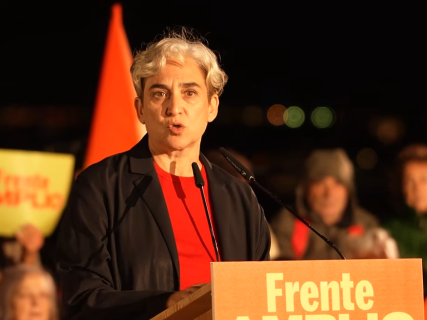
Colau acknowledges as an error of the left having been "too moralizing": "We have to confront ideas, not tell people how they have to live"

The Frente Amplio candidate encourages "entering difficult terrain" with "humility": "From moralism we are not going to win"

Ada Colau durante el mitin de campaña en Vallecas.

Ada Colau durante el mitin de campaña en Vallecas.

Add DEMÓCRATA to Google

Ask FREN

Published

Last updated

1 minute

Most read

Elecciones 29N · Encuestas

La media de las encuestas

Media a 13 de noviembre de 2026 · 15 institutos

  • PP31,4 %
  • PSOE26,8 %
  • Vox19,1 %
  • Frente Amplio6,3 %
  • ERC2,4 %
01020304050ene 2024jul 2024ene 2025jul 2025ene 2026jul 2026

Media del último estudio de cada instituto en 30 días y su evolución semanal desde el 23J. Partidos con al menos un 2 %.

Todas las encuestas

Elecciones generales del 29 de noviembre · Demócrata

The candidate of Frente Amplio, Ada Colau, believes that one of the left’s mistakes in recent years has been having been “too moralistic” in the ideological struggle, a strategy she considers misguided: “From moralism we are not going to win,” she has said in her interview on The Wild Project, the video podcast with the content creator known as Jordi Wild.

“No one is superior to anyone. What you have to do is confront ideas, proposals, but not not be moralistic. Don’t tell people how they have to live their lives, how they have to think,” the former mayor of Barcelona has said.

The candidate for President of the Government made these statements in the final minutes of an interview lasting more than two hours, when Wild offered her the chance to make a final reflection before saying goodbye.

Colau then defended that she believes it is necessary for left-wing people to decide to confront things “face to face, from respect,” and to “go into difficult terrain.” “To review” that supposed superiority and “place yourself on a level of humility,” something that, she has acknowledged, is what has led her to accept the interview with Jordi Wild himself.

More key points, information and questions with FREN

AI-GENERATED CONTENT

What is the current status of Ada Colau's candidacy processing for the Broad Front and what are the next steps in the electoral process?

As of November 13, 2026, Ada Colau's candidacy for the Broad Front has passed the internal election and the presentation of lists: she appears as the lead candidate for Barcelona of Comuns-Front Ampli. The published information places her proclamation in the candidacies released on November 3. Therefore, the next step is not another political ratification, but to continue the electoral process until the vote on November 29.

Completed procedures

It is advisable to distinguish three moments, because the news from October described a candidacy still under construction and do not by themselves reflect its current situation:

  • Political designation, October 12. Movement Sumar, Comuns, Más Madrid, and IU agreed to propose Colau as a candidate for the Presidency of the Government. At that time, there were still territorial and list composition issues to resolve. (Demócrata, October 12).
  • Approval of the Barcelona list. The Comuns approved the candidacies with 66% favorable votes and 34% against, plus 20 blank votes. Colau was placed first and Ernest Urtasun second. That internal vote should not be confused with the subsequent electoral proclamation. (Demócrata, October 22).
  • Electoral publication. Demócrata includes the list among the candidacies published in the BOE on October 28; later, the consulted information about the proclaimed lists places that publication on November 3. These are two different milestones: presenting a candidacy and proclaiming it. (Presented lists; Information about the proclamation).
Are there any pending incidents?

No challenge or judicial ruling suspending or modifying the candidacy is recorded in the consulted sources. This conclusion should be understood with that scope: it does not equate to a certification of the non-existence of any appeal, but there is also no basis to present the candidacy as blocked.

Previous disagreements with Podemos belonged to the political negotiation of alliances, not to a judicial procedure against Colau. The result was that Broad Front ran separately in Catalonia, while Podemos agreed to incorporate representatives into ERC's lists. That disagreement does not appear as a pending procedure to validate Colau's list. (Demócrata, alliance map).

What comes next

The process has moved from configuring and formalizing candidacies to the campaign and voting phase. These are the next relevant milestones:

  • Electoral campaign. Colau already held a launch event in Vallecas on November 12, hours before the official start of the campaign. Her public activity, therefore, no longer corresponds to a negotiation to accept the candidacy. (Demócrata, campaign start).
  • Voting on November 29. This will be the moment when the candidacy competes to obtain representation. The proclamation allows participation; it does not anticipate the result nor guarantee a seat.
  • Results and representation. After voting, it will be necessary to distinguish electoral results from any negotiation to form a Government. Being the lead candidate for Barcelona and being politically presented as a candidate for the Presidency are different dimensions.

In short, it is not pending to decide if Colau leads the candidacy: that phase is overcome. What is pending is the election and, afterwards, the parliamentary and political consequences of its results.

What are the powers and functions of the Presidency of the Government of Spain according to the Constitution?

The Spanish Constitution does not use the expression “Presidency of the Government” in a modern organic-administrative sense, but it does regulate in considerable detail the figure of the President of the Government and his powers. These functions are grouped into three main areas: general political direction, relationship with the Cortes Generales, and relationship with the Head of State and the rest of the Government.

1. Direction of policy and Government

Article 97 CE establishes the central idea: the Government directs domestic and foreign policy, the civil and military Administration, and the defense of the State, and exercises executive function and regulatory power. Within this collegiate body, the President occupies a position of primacy:

  • Directs the action of the Government (art. 98.2 CE): sets the major political orientations, establishes priorities, and coordinates the different ministers.
  • Coordinates the functions of the other members of the Government (art. 98.2 CE): when there are conflicts between ministries or sectoral policies, it is the President who arbitrates and unifies criteria.
  • Defines the general political line that is then presented before the Cortes, both in the investiture debate and in appearances and thematic debates.
  • Promotes the normative activity of the Government: although not stated in an isolated provision, in practice he decides which bills and royal decree-laws are priorities for the Council of Ministers to approve.

Also in the international dimension, although the Government as a whole directs foreign policy, the President usually plays the role of highest political representative of the Executive in relations with other heads of Government and in international forums, according to the constitutional framework and laws.

2. Relationship with the King and appointment/dismissal of the Government

The President is the key figure in the relationship between the King and the Government:

  • Appointment of the President (art. 99 CE): the King proposes a candidate, after consulting parliamentary groups, and that candidate presents his program and requests the confidence of the Congress. Once obtained, the King formally appoints him President.
  • Appointment and dismissal of ministers (art. 100 CE): the other members of the Government are appointed and removed by the King, but always at the proposal of the President of the Government. This means that only the President chooses and reshuffles his ministerial team.
  • Dismissal of the Government (art. 101 CE): the Government ceases, among other cases, due to resignation or death of the President, or loss of parliamentary confidence. The presidential figure is, therefore, the “anchor” of the Executive's continuity.

In a broad sense, it also corresponds to the President to maintain the ordinary political relationship with the Head of State, proposing dissolution of the Chambers, calling referendums, and countersigning the acts of the King that constitutionally require the signature of the President or a responsible minister.

3. Relationship with the Cortes Generales: confidence and control

The Constitution grants the President a central role in the mechanisms of confidence and political responsibility between Government and Cortes:

  • Political responsibility before the Congress (art. 108 CE): the Government, presided over by the President, is jointly responsible for its political management before the Congress of Deputies.
  • Vote of confidence (art. 112 CE): the President may submit to the Congress a vote of confidence on his program or a general policy declaration. If not passed, he is politically obliged to resign.
  • Motion of censure (arts. 113 and 114 CE): the Congress may withdraw confidence through a motion of censure that must propose an alternative candidate for the Presidency. If approved, the outgoing President is automatically replaced by the motion's candidate.
  • Dissolution of the Cortes and calling elections (art. 115 CE): the President may propose to the King the dissolution of the Congress, the Senate, or both Chambers and the calling of general elections, with temporal and material limits. It is a power of enormous political relevance.

Additionally, the President, through the Government, participates in the legislative function (art. 87 CE), having the initiative to present bills, and may promote the approval of royal decree-laws in cases of extraordinary and urgent need (art. 86 CE), which must later be ratified by the Congress.

4. Internal organizational functions of the Government

Finally, there are more internal powers, derived both from the Constitution and development laws:

  • Configuration of the Government's structure within the margins set by law: number and denomination of ministries, assignment of state secretariats, etc.
  • Convocation and presidency of the Council of Ministers, setting the agenda and guiding deliberations.
  • Highest representation of the Government before other State institutions, such as the Senate, autonomous parliaments, or constitutional bodies.

Overall, the Presidency of the Government, personified in the President, concentrates general political direction, the capacity to articulate parliamentary majorities of support, and the faculty to organize and coordinate the Executive, always within the framework and controls provided in the 1978 Constitution.

How does the Constitution constitutionally differentiate the President of the Government from the King regarding political functions? What formal steps does the investiture of the President of the Government follow according to the Constitution and the Congress Regulations? What limits and controls exist over the President's power to propose the dissolution of the Cortes Generales?

What results did the Broad Front obtain in the last general elections and how many seats does it currently have in the Congress?

In the last general elections held in Spain, on July 23, 2023, the candidacy of Sumar, the predecessor of the current Broad Front, obtained 3,014,006 votes, 12.33%, and 31 seats. Broad Front did not run under that name in those elections. To answer how many seats it currently has, one must distinguish that electoral result from the subsequent evolution of the group: the consulted news places the Plurinational Sumar Group at 27 deputies in the legislature that has just ended, not a group elected as Broad Front.

The result of the last general elections

The electoral reference used to compare Broad Front with the previous general elections is, therefore, the Sumar candidacy of 2023. That list included Podemos, an important circumstance to correctly interpret both the 31 seats obtained and the comparisons now appearing in the media. It is not appropriate to present those deputies as a result achieved by Broad Front under its current name. (Demócrata, October 4)

In other words, there is political continuity between both candidacies, but they are not identical candidacies. The consulted sources expressly warn that their composition has changed and that some of those who ran together in 2023 now present themselves through other lists and territorial alliances. Therefore, a comparison between their results must always indicate which candidacy is being counted. (Demócrata, November 8)

The seats of the parliamentary group

Regarding representation after the elections, Demócrata reports that Sumar obtained 31 deputies in 2023 and that the plurinational group was left with 27 after the breakup with Podemos at the state level. That is the figure offered by its information of October 27, 2026, when describing the concluded legislature and the preparation of new candidacies. (Demócrata, October 27)

The same information mentions changes of members during the legislature and the move of Àgueda Micó to the Mixed Group. However, it does not provide an updated official count that allows converting that reference of 27 into an unequivocal current figure of the Broad Front. Therefore, 31 is the starting electoral result and 27 the published parliamentary reference; they should not be used as if they answered exactly the same question. (Demócrata, October 27)

Do not confuse seats with forecasts

As of November 13, 2026, the elections called for November 29 have not yet been held. The figures attributed to Broad Front in polls are estimates of what it could obtain, not deputies it has already won. For example, the latest CIS information attributes between 7 and 11 seats to its direct candidacy: that range does not describe its current parliamentary representation. (Demócrata, November 12)

In summary: the electoral response is 31 seats obtained by Sumar in 2023. The subsequent group reference is 27 deputies in the concluded legislature. No official current count of Broad Front's own seats allowing to give that second figure without this distinction is recorded in the consulted sources.

Play

Test your knowledge with FREN!

How much do you know about this topic? Answer the following 3 questions.

What mistake has Ada Colau pointed out as made by the left in recent years?

Question 1 of 3

What stance did Colau defend about migration during the interview?

Question 2 of 3

What action did Colau criticize regarding the Government's management of the Ceuta crisis?

Question 3 of 3