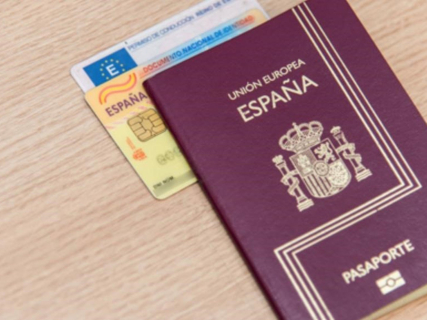

The digital DNI may be used to identify oneself before the polling stations in the general elections of next November 29, unless a judicial decision changes the situation. The Central Electoral Commission (JEC) lifted on November 5 the suspension that had been in place over the MiDNI application, after receiving guarantees from the Ministry of the Interior regarding the devices that will be used to verify voters’ QR codes.
A day later, on November 6, Iustitia Europa announced that it had filed a contentious-administrative appeal before the Third Chamber of the Supreme Court against that agreement. The party is seeking the most urgent precautionary measures to immediately halt the authorization. For the time being, the filing of the appeal does not mean that the high court has suspended the use of the digital DNI: the decision lies with the justices.
What the Central Electoral Commission has authorized
The JEC agreement of November 5, identified as 330/359, allows MiDNI to be used as a means of identification before the polling stations on 29N. The decision lifts the suspension that the body had established on March 26 for this application and MiDGT, but only with respect to the digital DNI.
The authorization comes after the Interior Ministry informed the Commission that all polling stations will have a device with a camera and browser that incorporates the official verifier of MiDNI. This device will make it possible to check the temporary QR code generated by the voter’s application.
The Ministry has announced that it will distribute more than 60,000 terminals so that the polling stations can carry out that check. The procedure requires that the voter open MiDNI in front of the members of the polling station and generate the QR code at that moment, which will be read and verified with the official device.
The authorization does not extend to MiDGT, the application that allows carrying a driver’s license on the phone, whose suspension remains in force. Citizens will be able to continue identifying themselves also through the physical documents admitted by electoral regulations.
What arguments Iustitia Europa uses
Iustitia Europa’s appeal calls into question whether the guarantees provided by the Interior Ministry are sufficient to ensure the functioning of the system during election day.
The training holds that having QR readers does not, by itself, prove that there is a complete protocol to address possible technical incidents. In particular, it raises what would happen if the internet connection fails, the phone’s battery runs out, the device on the table stops working, or the code verification cannot be completed.
It also calls for information about the procedures for replacing terminals and the instructions that the members of the tables must follow in the event of an incident. According to the party, it has not been sufficiently demonstrated how uniform action will be ensured in all polling stations.
These arguments form part of the position of the recurring organization and do not constitute a judicial conclusion about the system’s security. For its part, the JEC has considered the guarantees communicated by the Ministry of the Interior to be sufficient to lift the suspension of MiDNI.
What it asks the Supreme Court
Iustitia Europa asks the Administrative-Contentious Chamber of the Supreme Court to adopt the most urgent precautionary measures, that is, an urgent suspension that can be ordered without first hearing the Administration being sued when the legal circumstances for this are met.
In particular, it asks that the effectiveness of the JEC agreement regarding the use of MiDNI as a means of identification before the polling stations be halted. It also calls for any eventual suspension to be communicated to the Central Electoral Board, to the Ministry of the Interior, and to the regional electoral bodies.
Subsidiarily, if the court does not find reasons to adopt the most urgent precautionary measure without a prior hearing, the formation requests that an ordinary precautionary procedure be processed and that an urgent hearing be held before the elections.
The party argues that a decision issued after November 29 could lose practical effectiveness if problems arise during the identification of voters. This is the justification it puts forward to demand a judicial response before voting.
What the Supreme Court has to decide now
The first issue that the court must resolve is whether the requirements are met to suspend the authorization of MiDNI immediately. If it grants the measure, the use of the application would be paralyzed in the terms set out in the order. If it rejects it, the JEC authorization will remain in force, without prejudice to the main appeal continuing its processing.
The Supreme Court does not have to decide at this first moment whether the digital DNI is generally valid, but whether it is appropriate to provisionally suspend the agreement of the Board while the appeal is being examined. The ruling on the urgent measures also does not necessarily equate to a final judgment on the merits of the matter.
As of the date of publication, there is no ruling from the Supreme Court that has granted the requested suspension. Therefore, the current situation is the one established by the JEC: MiDNI is authorized to identify voters on 29N and MiDGT continues to be suspended.
The key in the coming days will be to check whether the high court considers that the doubts raised by Iustitia Europa justify halting the system before the elections or whether it maintains the authorization agreed by the electoral body.