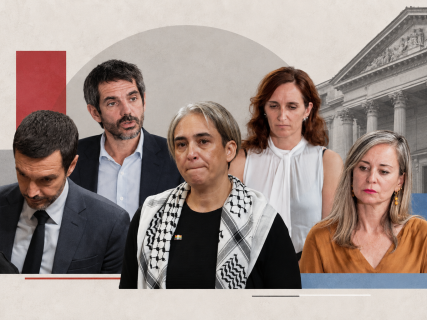

Frente Amplio accelerates negotiations to define its candidacy for the general elections on November 29, with Ada Colau and Mónica García as two of the names that have gained weight in recent hours. The four formations that initially make up the space, Movimiento Sumar, Izquierda Unida, Más Madrid, and the commons, maintain October 17 as the date to publicly present their roadmap and leadership formula.
The proposal from Más Madrid for Colau to be the candidate for the Presidency of the Government and head the list for Barcelona has reinforced the option of a collective candidacy, in which state leadership is combined with representatives from each territory.
The former mayor, who had already confirmed that she had been asked to lead the project, has not yet confirmed whether she would accept.
Colau, proposed by Más Madrid to lead from Barcelona
Más Madrid has proposed that Colau head the candidacy for Barcelona as a demonstration of territoriality, generosity, and confederal functioning. The formation argues that organizations with territorial roots must retain the capacity to configure candidacies in their respective areas.
The proposal involves moving the candidacy for the Presidency of the Government to Barcelona and avoiding a model based on a single leadership concentrated in Madrid. The formula adds to the increasingly present possibility in conversations of a shared leadership among different territorial representatives.
Mónica García maintains weight in the race
For Madrid, the formation has confirmed that Mónica García will lead the list, accompanied by Emilio Delgado, Tesh Sidi, and Eduardo Rubiño.
The leader of Más Madrid has also argued that the new space must be built from a plurality of voices, in line with the collective formula that is now gaining weight in the negotiations.
Other names that have appeared in the conversations are the ministers of Culture, Ernest Urtasun, and of Consumption, Pablo Bustinduy, as well as the spokesperson for Sumar in Congress, Verónica Barbero.
Más Madrid demands control of the Madrid list
The discussion about state leadership is linked to the territorial distribution of candidacies. Más Madrid has demanded to lead and prepare the list of Frente Amplio in Madrid, considering that organizations with territorial implantation must have the capacity to configure the ballots in their respective territories.
This claim fits with the confederal formula that defends the formation and with the model that the Comuns maintain for Catalonia. Other territorial forces, such as Compromís or Chunta Aragonesista, have also proposed having their own role in their respective territories.
Podemos maintains its proposal for primaries
The fit of Podemos continues to be one of the main pending issues. The formation of Irene Montero has proposed open primaries on October 14 and 15 to choose the candidacy of a possible alliance of the entire left.
This formula does not coincide with the mechanism that the organizations already forming the Frente Amplio defend, which advocate for an agreement among the different forces. Izquierda Unida, for its part, has defended an alliance as broad as possible and has expressly opened the door to the incorporation of Podemos.
Rufián proposes a different strategy
The territorial debate also connects with the position of Gabriel Rufián, who has argued that progressive forces should study convergence formulas province by province, instead of necessarily reproducing a single candidacy in all constituencies.
ERC, however, maintains its own electoral space and Oriol Junqueras has positioned Rufián as the candidate of the formation, unless another candidacy appears that forces the holding of primaries. Therefore, his role in this process is fundamentally related to the debate on the territorial formula of the left and not with his incorporation into the Frente Amplio.