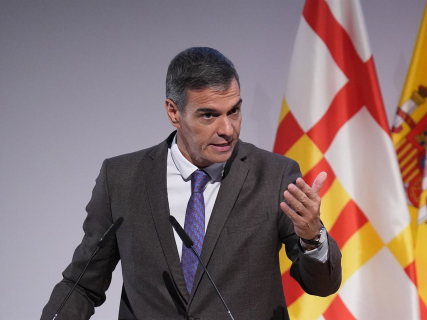
Sánchez will appear after the Council of Ministers

The president of the Government will hold a press conference at 12:30, after the Executive re-approves the two housing decrees rejected on Friday.

fotonoticia 20261005142548 1920

fotonoticia 20261005142548 1920

Add DEMÓCRATA to Google

Ask FREN

Published

Last updated

2 minutes

Most read

Elecciones 29N · Encuestas

La media de las encuestas

Media a 13 de noviembre de 2026 · 15 institutos

  • PP31,5 %
  • PSOE26,8 %
  • Vox19,1 %
  • Frente Amplio6,4 %
  • ERC2,4 %
01020304050ene 2024jul 2024ene 2025jul 2025ene 2026jul 2026

Media del último estudio de cada instituto en 30 días y su evolución semanal desde el 23J. Partidos con al menos un 2 %.

Todas las encuestas

Elecciones generales del 29 de noviembre · Demócrata

The president of the Government, Pedro Sánchez, will appear this Tuesday at a press conference after the Council of Ministers. The appearance is scheduled for 12:30 hours, according to the announcement released by the Presidency of the Government. Sánchez will appear before the media once the meeting of the Executive concludes.

The president's intervention will take place on a day marked by the recent announcement of general elections for the next November 29. The Government will hold its ordinary meeting after Sánchez announced this Monday the electoral advance and the dissolution of the Cortes.

Before the appearance, the Council of Ministers plans to again approve the two royal decree-laws on housing that were rejected by the Congress last Friday. The decision will allow the Executive to recover the measures after the parliamentary setback and bring them back to the validation procedure.

The Government's intention is to greenlight both decrees again, although it remains to be determined whether they will maintain exactly the same wording as the rejected texts or if they will incorporate any modifications. The measures cover various areas related to access and protection of housing, including evictions, extensions of rental contracts, the leasing of rooms and seasonal rentals, and tax incentives aimed at tenants and owners.

The validation will be in the hands of the Permanent Deputation

The new approval will have a particularity derived from the dissolution of the Cortes. If the decrees receive the green light from the Council of Ministers again, their validation will no longer correspond to the ordinary Plenary of the Congress, but to the Permanent Deputation, which maintains its functions during the period in which the Chambers are dissolved.

This body is composed of 69 deputies. According to the arithmetic proposed after the vote on Friday, the first housing decree-law could count on 35 favorable votes against 34 opposed if the groups maintain the same position. The second would have a different scenario because the PNV also voted against that text in the Congress.

The two texts had been defended by the Executive as a package of measures to strengthen the protection of homes and expand the tools related to rental and access to housing. Their rejection in the Congress occurred just hours before Sánchez announced the electoral call.

More key points, information and questions with FREN

AI-GENERATED CONTENT

What parliamentary procedures must the Permanent Deputation follow to validate a royal decree-law during the dissolution of the Cortes?

During the dissolution of the Cortes Generales, the validation of royal decree-laws is not suspended: it is assumed by the Permanent Deputation of the Congress, following a specific procedure that combines what is provided in the Constitution and in the Rules of the Congress. Below is a step-by-step outline of this scheme.

1. Basic constitutional framework

The general regulation of the royal decree-law is in Article 86 of the Constitution:

  • It can only be issued in case of extraordinary and urgent need.
  • It has the nature of a provisional legislative provision, with the rank of law.
  • It must be immediately submitted to debate and vote on the entirety in the Congress of Deputies, within a maximum period of thirty days from its promulgation.
  • The Congress must expressly pronounce on its validation or repeal, through a “special and summary” procedure.
  • Within that same period, its processing as a bill may be agreed upon by the urgency procedure.

When the Congress is dissolved or its term has expired, the Constitution provides that its functions are assumed by the Permanent Deputation. Furthermore, regarding exceptional states (alarm, exception, and siege), the Constitution itself indicates that if these situations occur with the Chamber dissolved, the powers of the Congress fall to its Permanent Deputation, which reinforces the idea that this body guarantees the continuity of parliamentary control also over royal decree-laws.

2. Specific regulation in the Rules of the Congress

The Rules of the Congress dedicate Chapter Five (Articles 56 to 59) to the Permanent Deputation. From there, several key points arise:

  • Composition and convening: it is chaired by the Presidency of the Congress and formed by at least twenty-one members, appointed by the groups in proportion to their strength. It is convened by the Presidency, ex officio or at the request of two groups or one-fifth of its members.
  • Competences during dissolution (Art. 57.1.a): in cases of dissolution or expiration of the Congress's term, the Permanent Deputation assumes all the powers that Article 86 of the Constitution attributes to the Congress regarding royal decree-laws.
  • Operating regime (Art. 58): its sessions and operation are subject to what is established for the Plenary, so that debate and voting take place as if it were a Plenary of the Chamber.
  • Accountability (Art. 59): once the general elections have been held and the new Congress constituted, the Permanent Deputation reports to the Plenary on the matters dealt with and the decisions made.

Additionally, the Rules specifically regulate the debate on validation or repeal of royal decree-laws:

  • The debate and vote on validation or repeal are held in the Plenary of the Chamber or in the Permanent Deputation, before thirty days have passed since promulgation.
  • A member of the Government presents the reasons for the extraordinary and urgent need, and the debate is conducted as a totality debate.
  • In the vote, affirmative votes are understood as favorable to validation and negative votes to repeal.
  • Once the decree-law is validated, the Presidency asks if any group wants it to be processed as a bill; if the Chamber (or the Permanent Deputation itself, during inter-legislature periods) agrees, it is processed by urgency procedure.

3. Step-by-step procedure during dissolution

With these elements, the parliamentary channel during a dissolution phase can be summarized as follows:

  • 1) Approval and publication of the royal decree-law: the Government approves it in the Council of Ministers and it is published in the BOE. From promulgation, the thirty-day period for parliamentary pronouncement runs.
  • 2) Referral to Congress and convening of the Permanent Deputation: since the Congress is dissolved, the Plenary cannot meet. The Presidency of the Congress includes the decree-law on the agenda of the Permanent Deputation and convenes it.
  • 3) Totality debate: in the session of the Permanent Deputation, a member of the Government appears to defend the text. An orderly debate is opened according to the general rules of the Plenary (spokespersons' turns, groups' position setting, etc.).
  • 4) Vote on validation or repeal: the entire decree-law is voted on. A simple majority of members present applies. If yes wins, it is validated; if no wins, it is repealed.
  • 5) Decision on processing as a bill: if the decree-law has been validated, the Presidency asks if any group requests its processing as a bill. If the Permanent Deputation agrees, the text will be processed as a bill by urgency; the material processing (amendments, committee, Plenary) will normally correspond to the new Congress once constituted.
  • 6) Publication of the agreement: the agreement of validation or repeal is published in the BOE through the corresponding resolution of the Congress.
  • 7) Information to the new Plenary: after the elections and the constitution of the new Chamber, the Permanent Deputation presents a report to the Plenary with all the royal decree-laws dealt with and the decisions adopted (validation, repeal, and, if applicable, decision to process them as bills).

In summary, during the dissolution of the Cortes, the Permanent Deputation acts as a “Plenary in function” for royal decree-laws: it reproduces the same scheme of intense and rapid control provided in the Constitution, ensures the pronouncement within thirty days, and, if appropriate, sets the processing as a bill on track for the new Congress to continue.

Could you detail exactly how the validation debate is structured in the Permanent Deputation (turns, times, replies)? What legally happens to the effects of a royal decree-law if the Permanent Deputation decides to repeal it during dissolution? Can you provide historical examples of royal decree-laws validated by the Permanent Deputation between legislatures and explain their subsequent processing?

What are the main powers and functions of the President of the Government according to the Spanish Constitution?

The 1978 Spanish Constitution configures the President of the Government as the central piece of the executive power and the political direction of the country. His powers and functions are divided among the headship of the Government, the direction of political and administrative action, coordination among ministers, and parliamentary responsibility. Unlike the King (head of State), the President exercises effective political power and is accountable before the Cortes Generales.

1. Appointment and constitutional position

The President of the Government is invested by the Congress of Deputies (Art. 99 CE). The candidate presents his political program and must obtain the confidence of the absolute majority in the first vote, or a simple majority in a second vote 48 hours later. Once that confidence is obtained, the King formally appoints him, but that appointment is a due act: the real key lies in the vote of the Congress.

From a constitutional point of view, the President is:

  • Head of Government: leads the executive power and is politically responsible for its actions.
  • Director of Government action: sets the general political line and coordinates the work of the ministers.
  • Accountable before the Cortes: he can only remain in office while he retains the confidence of the Congress.

2. Direction of Government action

Article 97 CE establishes that the Government directs domestic and foreign policy, the civil and military administration, and the defense of the State. Within this collegiate body, the President has a prevailing position:

  • Sets the major political orientations: determines the priorities of the legislature (legal reforms, economic orientation, foreign policy, etc.).
  • Coordinates the action of the ministers: resolves conflicts between departments and ensures the coherence of the overall government policy.
  • Chairs the meetings of the Council of Ministers: convenes and directs its sessions, sets the agenda, and guides collective decisions.

In practice, this makes the President the main person responsible for turning the program agreed with his parliamentary majority into legislative initiatives, decrees, and concrete public policies.

3. Organization of the Government and relationship with ministers

The Constitution grants the President significant power over the structure of the Government itself. Article 100 CE indicates that the other members of the Government (vice presidents and ministers) are appointed and dismissed by the King, but exclusively at the proposal of the President.

Several essential functions derive from this:

  • Choose and dismiss ministers and vice presidents: decides the political and technical composition of his team.
  • Determine the structure of the Government: can propose the creation, merger, or suppression of ministries and the distribution of competences among them.
  • Reassign functions within the cabinet to adapt to new priorities or political crises.

This control over the Executive's “design” reinforces his role as the center of gravity of governmental power.

4. Relations with the Cortes Generales

Although parliamentary control falls on the entire Government, the President is its main recipient. Among his functions stand out:

  • Political responsibility before the Congress: he can be subject to a motion of censure, which if successful implies his dismissal and the appointment of a new President.
  • Possibility of raising the question of confidence: asks the Congress for explicit ratification of his political support; if he loses it, he must resign.
  • Intervention in the legislative procedure: promotes bills, sets priorities on the parliamentary agenda, and defends the Government's key initiatives.

Additionally, the President assumes a central role in the most relevant debates of the Chamber (investiture, state of the nation, major reforms), where he presents and defends the general line of the Executive.

5. Relationship with the King and representation of the State

The headship of State corresponds to the King, but the President of the Government is who, in the parliamentary system, effectively exercises the direction of policy. His functions in this dimension include:

  • Advising the King in acts that the King performs with governmental countersignature (for example, dissolution of the Cortes, calling elections, or appointment of high officials).
  • Politically representing Spain internationally along with the King, especially in high-level meetings, European summits, and international negotiations in political and economic matters.

6. Responsibility and limits

The President's powers are limited by the Constitution itself, laws, and parliamentary and judicial control. He cannot legislate alone, but through the Government (decrees and decree-laws in the provided cases) and always within the constitutional framework.

In sum, the Spanish President of the Government is the key figure in the political direction of the State: sets the major lines of action, coordinates and organizes the Government, is accountable before the Congress, and acts as the primary responsible for domestic and foreign policy, within the system of balances and controls typical of a social and democratic state governed by the rule of law.

How is the President of the Government elected and appointed step by step according to the Constitution? What differences are there between the functions of the President of the Government and those of the King in the Spanish constitutional system? What mechanisms does the Constitution provide to dismiss or force the resignation of the President of the Government?

What results did the Spanish Socialist Workers' Party (PSOE) obtain in the last general elections held in Spain?

The last general elections held in Spain were on July 23, 2023 (the so-called 23J). In that event, the Spanish Socialist Workers' Party (PSOE) obtained a clearly better result than in the previous general elections of November 10, 2019, both in votes, percentage, and seats, although it remained as the second force behind the People's Party.

PSOE result in the 23J 2023 general elections

According to official data and its compilation from various electoral sources, the PSOE's balance in the 2023 general elections was as follows:

  • Total votes: 7,821,718 ballots.
  • Vote percentage: 31.68% of the total valid votes cast.
  • Seats in Congress: 121 deputies.
  • Relative position: second force in Congress, behind the People's Party, which was the most voted party and obtained the most seats.

This figure of 121 seats and around 31.7% of the vote is consistently reproduced in subsequent analyses by media and electoral data aggregators. For example, it is reflected in summaries of Congress results by party such as those published by El País or in compilations of results of all general elections since the Transition, as offered by general media and specialized portals on electoral and party data (PSOE profile on PolitPro, among others).

Some news reports mention that at some point the figure of 122 seats for the PSOE was mentioned during the count or in preliminary versions, but sources that systematize the final result agree on recording the definitive figure of the party at 121 deputies in the Congress of Deputies.

Comparison with the November 2019 general elections

To put these results in context, it is useful to compare them with those obtained by the PSOE in the previous general elections, held on November 10, 2019 (repeat election of that year). The data collected by the main election result summaries are:

  • Votes (2019): 6,792,199.
  • Vote percentage (2019): 27.99%.
  • Seats (2019): 120 deputies.

The comparison between 2019 and 2023 for the PSOE is summarized as follows:

  • Votes: increases from 6.79 million to 7.82 million, that is, gains about 1.03 million more votes.
  • Vote percentage: rises from approximately 28.0% to 31.7%, an improvement of about 3.7 percentage points.
  • Seats: increases from 120 to 121 deputies, gaining 1 seat compared to November 10, 2019.

In strictly numerical terms, therefore, the 23J meant for the PSOE:

  • A significant increase in popular support (more votes and a higher percentage of the total).
  • A slight improvement in parliamentary representation (one additional seat), limited by the provincial distribution system and competition with other parties, especially in medium and small constituencies.

Basic political reading of the result

Subsequent analyses agree that the PSOE achieved in 2023 a better result than in 2019 in terms of votes and seats, but insufficient to be the first force. The People's Party obtained more seats and a higher vote percentage, so:

  • The PSOE strengthened its position compared to its own starting point in 2019.
  • However, it did not manage to surpass the PP, which conditioned the subsequent arithmetic of pacts and the configuration of parliamentary majorities.

In sum, in the last general elections held in Spain (July 23, 2023) the PSOE obtained 7.82 million votes, 31.68% of the vote, and 121 seats, improving by just over one million votes, almost four percentage points, and one deputy compared to the November 2019 general elections, but remaining as the second force in the Lower House.

Can you break down the PSOE result by autonomous communities in the 23J 2023 general elections? What pacts and parliamentary support did the PSOE need after 23J 2023 to re-elect Pedro Sánchez? How has the PSOE's voting intention evolved in polls after 23J until now?

Play

Test your knowledge with FREN!

How much do you know about this topic? Answer the following 3 questions.

What time is Pedro Sánchez's appearance scheduled after the Council of Ministers?

Question 1 of 3

Which body will be responsible for the validation of the royal decree-laws after the dissolution of the Cortes?

Question 2 of 3

What subjects do the royal decree-laws that the Government wants to reapprove cover?

Question 3 of 3