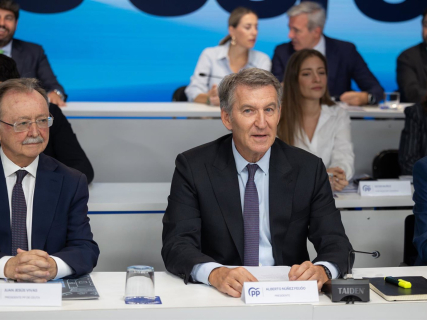
General elections survey: PP and Vox would add up to 203 seats compared to the 110 of PSOE, according to Data10

The survey places the PP at 139 seats, the PSOE at 110, and Vox at 64, while the territorial map would also shift the parliamentary distribution.

2 minutes

fotonoticia 20261005171827 1920

fotonoticia 20261005171827 1920

Add DEMÓCRATA to Google

Ask FREN

Published

Last updated

2 minutes

Most read

The Data10 survey for OKDIARIO places the PP as the leading force in a general election, with 139 seats. The PSOE would obtain 110 deputies and Vox would reach 64, while Sumar and Podemos would remain at five and four representatives, respectively. The sum of PP and Vox would reach 203 deputies in this estimate. Meanwhile, among the left-wing state-level parties, PSOE, Sumar, and Podemos would gather 119 seats.

PP leads the estimate with 139 deputies

The Popular Party obtains 139 seats in the Data10 projection. The figure represents six deputies less than the 145 that the same survey attributed to the party in August. In the vote estimate included in the study, the PP appears with 34% of the votes.

The PSOE is positioned at 110 deputies in the estimate. Compared to the previous measurement from Data10 cited in the study, the party goes from 100 to 110 seats. The percentage of votes that the survey collects for the socialists is 26.1%, compared to the 31.7% obtained in the 2023 general elections.

Vox obtains 64 seats in the Data10 projection and 18.6% of the votes. In the 2023 general elections, it achieved 33 deputies and 12.4% of the votes.

The current estimate therefore represents 31 deputies more than those obtained by the party in those elections.

Party Vote Estimate Seats
PP 34% 139
PSOE 26.1% 110
Vox 18.6% 64
Sumar 5.2% 5
Podemos 4.3% 4

PP and Vox would total 203 deputies

The 139 seats of the PP and the 64 of Vox add up to 203 representatives in Congress. The figure exceeds by 27 deputies the 176 that constitute the absolute majority of the Chamber.

Combination Seats
PP + Vox 203
Absolute majority 176
Difference +27

To the left of the PSOE

The Data10 estimate attributes five deputies to Sumar, compared to the 31 that the Sumar candidacy obtained in the 2023 general elections. The percentage of votes that the study collects is 5.2%.

Podemos appears with four seats and 4.3% of the votes. The two formations would total nine deputies and 9.5% of the estimated votes.

In 2023, the Sumar candidacy, which then included Podemos, obtained 12.3% of the votes and 31 seats. The comparison is made between different electoral configurations.

Among the Catalan parties, ERC obtains seven seats in the projection, while Junts reaches six. The survey indicates that ERC maintains the seven deputies and that Junts loses one compared to the seven it obtained in the 2023 general elections.

The estimate also includes the entry of Aliança Catalana, although the text of the survey does not provide a figure of seats for this party in the data provided.

In the Basque Country, EH Bildu reaches eight deputies in the estimate from Data10 and the PNV obtains four. The projection implies for Bildu two more seats than the six obtained in the general elections of 2023, while the PNV stands at four compared to the five from those elections.

Comparison with the previous survey

Party Previous survey New estimate Variation
PP 145 139 -6
PSOE 100 110 +10
Sumar 31 5 -26
Podemos Not indicated 4 Not indicated

Data10 for OkDiario, published on 05/10/2026

More key points, information and questions with FREN

AI-GENERATED CONTENT

What is the process for an electoral poll to be considered in parliamentary debate in Spain?

In Spain, there is no “special procedure” for an electoral poll to be admitted or validated before it can be used in parliamentary debate. Polls enter the debate through ordinary parliamentary instruments (questions, interpellations, motions, etc.), provided they comply with the general regulations on polls and the rules of procedure of the Chambers.

1. Basic regulatory framework on electoral polls

The public use of electoral polls is mainly governed by the Organic Law of the General Electoral Regime (LOREG), particularly by its provisions on electoral polls and surveys. Although its articles are not detailed here, in summary it requires:

  • That publicly disseminated polls indicate a minimum technical sheet: entity conducting it, who commissions it, universe and sample size, sampling method, fieldwork dates, margin of error, etc.
  • That publication prohibition periods immediately before elections are respected (the so-called “last days” during which new surveys cannot be disseminated).
  • That the information is not misleading nor presented in a way that could deliberately confuse the electorate.

These rules are aimed at media, polling companies, parties, and generally any actor disseminating polls. Deputies, when citing polls in parliamentary sessions, operate within this same general framework of truthfulness and transparency, although there is no specific prior authorization from Parliament for each mentioned survey.

2. Rules of the Congress and Senate Regulations

The Regulations of the Congress and the Senate do not contain, in practice, a specific chapter on “use of polls” in debate. What they do is:

  • Regulate the admissible content of initiatives (questions, interpellations, motions, non-legislative proposals, etc.), which must concern matters within the competence of the Government or the Chamber itself.
  • Provide for the rejection by the Board of manifestly inadmissible initiatives (insults, unrelated matters, abusive repetition, etc.), but they usually do not veto an initiative based on a poll, as long as the approach is serious and relevant.
  • Impose duties of politeness and political truthfulness (no insults, no attributing criminal acts without basis), which act as an indirect limit to manipulative use of polling data.

Therefore, the Regulation acts as a general framework of order and discipline; it does not certify or “approve” specific polls.

3. How a poll is introduced into parliamentary debate

A poll can be brought into debate through several ordinary channels:

  • Questions to the Government (oral in Plenary or committee, or written): a deputy can ask, for example, “in view of the poll published by X showing concern about housing, what measures does the Government intend to adopt…”. The Board qualifies the question; if admitted, it is debated or answered in writing.
  • Interpellations and motions: a group can base a political interpellation on the evolution of public opinion reflected in polls and then present a motion urging the Government to act in a certain way.
  • Motions and non-legislative proposals in committee or Plenary: the arguments in the statement of reasons can be supported by polling data to justify the need for a public policy.
  • Appearances: in committee, groups can request the appearance of Government members or heads of bodies such as the CIS to explain official poll results. Likewise, academic experts or polling company representatives can be called to appear in special reports.
  • Spontaneous debate: in any intervention (defense of an amendment, budget debate, etc.), a deputy can cite polls as part of their political argument.

4. Difference between official and private polls

It is advisable to distinguish:

  • Official polls (CIS and regional public opinion bodies): The Sociological Research Center has its own regulations, obligation of methodological transparency, and accountability before the Cortes, usually through a specific control commission. Its barometers and studies are formally submitted to Parliament, published with a complete technical sheet, and are usually subject to appearances by its Presidency.
  • Private polls (polling companies, media, university institutes): can be freely cited in parliamentary sessions, provided they are already public and comply with LOREG during the electoral period. Parliament does not validate or certify them; it treats them as information available in the public space.

5. Practical limits on the use of polls in debate

In practice, the limits are three:

  • Respect for electoral rules: during the days when publication of new polls is prohibited, parties and media must respect this restriction; in the parliamentary sphere, the electoral calendar usually overlaps with the dissolution of the Chambers, so ordinary debate is reduced.
  • Parliamentary correctness: the Presidency can call to order if polls are used to launch unfounded accusations or insulting expressions.
  • Political responsibility: the reputational cost of citing manifestly biased or poorly described polls acts as an informal brake, rather than a direct legal sanction.

In summary, there is no prior technical filter by Parliament on polls: the validity of those complying with LOREG and transparency rules is assumed, and it is the ordinary parliamentary control and debate instruments that allow these polls to be incorporated into political discussion.

What are the main competencies and functions of the president of the Partido Popular?

According to the current national Statutes of the Partido Popular (PP), approved at the XXI National Congress in 2025, the national president is the highest political and organizational authority of the party at the state level. Their competencies combine three major dimensions: external representation, political direction, and internal leadership of the organization.

1. Representation of the party

First, the president of the PP exercises the political and legal representation of the party. This means that:

  • They represent the Partido Popular before institutions, other parties, social organizations, and public opinion.
  • They act on behalf of the PP in legal dealings, being able to enter into agreements and assume commitments under the terms provided in the Statutes.
  • They are the main reference of the PP brand at the national level, embodying its political project and its position in the country’s major debates.

2. General political direction

The Statutes assign the president the direction and coordination of the political action of the PP. Among their functions are:

  • Setting the major lines of the party’s political strategy at the state level, in coherence with the resolutions of the National Congress.
  • Promoting the PP’s position in various institutional spheres (Congress, Senate, European Parliament, regional governments where the party governs, etc.).
  • Ensuring unity of criteria and coherence of the message between the national leadership and territorial structures.

In practice, this means the president sets the political framework for electoral campaigns, defines discourse priorities, and coordinates the party’s response to major Government decisions and current events.

3. Presidency of governing bodies

The president of the PP presides over the central bodies of the party’s internal government:

  • National Board of Directors, the highest body between congresses.
  • National Executive Committee, the body for the organization’s daily management.

By presiding over these bodies:

  • They convene meetings, set the agenda, and direct debates.
  • They ensure the execution of agreements adopted by the National Congress and these collegiate bodies.
  • In case of a tie in votes, they have a , which strengthens their internal arbitration capacity.

4. Appointments and team configuration

Another key part of their competencies is the capacity to propose and appoint internal positions. According to the Statutes and the party’s organizational documentation:

  • They propose to the National Executive Committee the appointment of the General Secretariat, the General Coordination (if it exists), the vice-secretariats, and other secretariats and area coordinations.
  • They propose the person responsible for the party’s finances and organization.
  • They participate in the appointment of members of the National Electoral Committee and the Committee of Rights and Guarantees, as provided in the Statutes.

With these powers, they configure the core of the national leadership, selecting the political and organizational team with which they intend to develop their project.

5. Execution of agreements and message control

The Statutes also entrust them with executive and control functions:

  • Execution of agreements: they take necessary measures to comply with and develop the resolutions of the National Congress and the agreements of the party’s superior bodies.
  • Control of official statements: they must authorize statements made expressly on behalf of the Partido Popular or those that could politically commit the party as a whole.

This last competence reinforces their role as guarantor of the PP’s official line and the coherence of the public discourse of its main spokespersons.

6. Disciplinary power and internal cohesion

Within the guarantees framework set by the Statutes and the Committee of Rights and Guarantees, the president has certain disciplinary powers:

  • They can initiate or promote the opening of disciplinary proceedings against members or officials when they consider internal rules or the ethical code have been violated.
  • They are empowered to promote the adoption of precautionary or sanctioning measures, always within statutory procedures and guarantees.

This underlines their ultimate responsibility in preserving exemplary conduct, discipline, and internal unity of the party.

7. Summary

Overall, the president of the Partido Popular concentrates the responsibility to:

  • Represent the PP politically and legally.
  • Direct and coordinate its political action at the state level.
  • Preside over and articulate the functioning of the highest internal bodies.
  • Configure the leadership team through appointment proposals.
  • Ensure the execution of agreements and coherence of the public message.
  • Contribute to maintaining discipline and internal ethics.

All this, always subject to the limits and checks established by the Statutes themselves and the party’s collegiate bodies, which retain relevant decision-making powers over the internal life and political orientation of the PP.

Could you detail how the PP president is elected according to the Statutes and what role the delegates have in that process? What differences are there between the functions of the president of the Partido Popular and those of the party’s secretary general? How are the competencies of the national PP president coordinated with those of the party’s regional presidents?

What requirements does Spanish electoral legislation establish for the formation of parliamentary groups in the Congress?

In the Spanish system, the specific requirements to form parliamentary groups in the Congress of Deputies are not set in the Organic Law of the General Electoral Regime (LOREG), but in the Regulations of the Congress. LOREG organizes the electoral process and the allocation of seats, but it is the Regulations that determine how the elected deputies are grouped afterwards.

The core regulation is found in articles 23 to 26 of the Regulations of the Congress (approved by the Plenary and of sub-legal rank but with internal normative value of the Chamber).

1. Threshold of seats and votes

Article 23.1 establishes two alternative ways to constitute a group:

  • General rule of seats: deputies who gather a number not less than fifteen may constitute a parliamentary group. That is, a party or coalition that obtains at least 15 seats can form a group regardless of its vote percentage.
  • Exceptional route of significant representation: those who integrate one or more political formations that, although they do not reach 15 seats, simultaneously meet:
    • having obtained a number of seats not less than five, and
    • also, reaching at least 15% of the votes in the constituencies where they presented candidacy or 5% of the votes cast nationwide.

This design seeks to prevent pure territorial dispersion or the allocation system from preventing groups for forces with relevant representation but that do not reach the 15-seat threshold.

2. Prohibition of splitting parties or coalitions

Article 23.2 introduces guarantees to prevent artificial use of groups:

  • Party unity: “under no circumstances may those belonging to the same party constitute a separate Parliamentary Group.” That is, a specific party cannot divide its deputies into two or more different parliamentary groups in the Congress.
  • Coalitions without electoral confrontation: those who, “at the time of the elections, belonged to political formations that did not face each other before the electorate” may not form separate groups. This affects, for example, formations running in a stable coalition: if they did not present differentiated and alternative lists to voters, they cannot later split into several groups.

These restrictions aim to ensure that groups reflect political options truly differentiated at the polls, avoiding purely instrumental constructions to obtain more resources, speaking times, or other parliamentary rights.

3. Constitution procedure and the mixed group figure

Article 24 regulates the procedure:

  • The constitution of groups must be done within five days following the constitutive session of the Congress, by written communication to the Board.
  • The written communication, signed by those wishing to constitute the group, must include its name, the nominal list of members, the person who exercises the spokesmanship, and those who may substitute them.
  • Those who are not members of any group may associate with an already constituted group if they so request and the group’s spokesmanship accepts. These associated persons count towards the minimums of article 23 and for determining representation quotas in committees.

When a deputy does not integrate into any group within the deadline nor associates with another, article 25 comes into play:

  • Those not integrated into a group automatically join the Mixed Group.
  • No member of the Chamber may belong to more than one group simultaneously; affiliation is unique.

Article 26 extends this logic to those who acquire the status of deputy later (by substitution, etc.): they must join a group within five days from acquiring the status; if the group’s spokesmanship does not accept, they join the Mixed Group.

4. Fit within “electoral legislation”

From a systematic point of view, the Constitution guarantees the right to political participation (article 23 CE) and grants the Congress the power to approve its Regulations; the LOREG regulates the electoral procedure up to the proclamation of elected deputies and seat distribution; and it is the Regulations of the Congress — especially articles 23 to 26 — that set the requirements and legal regime of parliamentary groups (seat and vote thresholds, prohibition of splitting, deadlines, mixed group, and unique affiliation).

Play

Test your knowledge with FREN!

How much do you know about this topic? Answer the following 3 questions.

How many seats would the Popular Party obtain according to the Data10 survey for OKDIARIO?

Question 1 of 3

Which party would gain the most seats compared to the previous Data10 survey according to the estimate published on October 5, 2026?

Question 2 of 3

What percentage of votes would Vox reach according to the Data10 estimate for OKDIARIO?

Question 3 of 3