
His bet hinges on an electoral mobilization that he compares with the left’s victories in other countries.
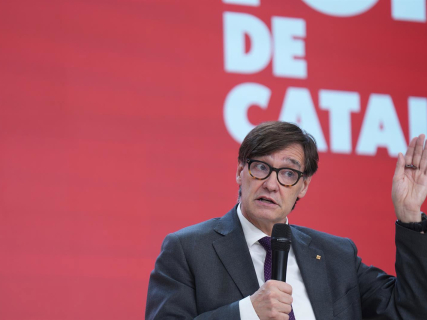
Salvador Illa believes there are grounds for a general strike over housing and rejects the use of the Urda rail tragedy as an argument against his call. The president of the Generalitat states it in an interview with Ignacio Escolar and Neus Tomàs in elDiario.es, in which he combines his support for the protest with a defense of the continuity of Pedro Sánchez in La Moncloa.
"It seems to me a moral low point to use the 69 victims of Urda to ask that it not be called, as Feijóo has done," he declares. Illa argues that the unions and the organizations calling the strike exercise a legitimate right and that it is up to the officials to listen to their demands.
His argument places housing at the center of the campaign. For the socialist leader, the protest expresses a problem that the institutions must respond to, even if its solution cannot be immediate.
Illa defends the strike and calls for rent regulation
In the interview with elDiario.es, Illa rejects that increasing supply is a sufficient response for those who need housing now. He defends speeding up construction, but also maintaining regulation while the new properties arrive.
The president assures that, during the two years of the application of the Housing Law, rent has increased by 0.7% in tense areas and has fallen by 4.4% in Barcelona, compared with inflation of 6.9%. He also maintains that there are nearly 24,000 more contracts during that period.
These are the figures he uses to defend the actions of his Govern and to question the criticisms of market intervention. "The law is working and it needs more time," he says to the newspaper.
Illa attributes the blocking of housing measures to PP, Vox and Junts, and supports Sánchez’s decision to call elections so that citizens can have their say.
His forecast for 29N: Sánchez will win and be able to govern
The Catalan leader does not limit himself to anticipating a Socialist victory. He also predicts that the PSOE will gather the necessary support to continue in government.
"My forecast is that the Partido Socialista is going to win and that the Partido Socialista will govern in a government that represents a plural and diverse Spain," he says in elDiario.es.
Illa bases that expectation on the mobilization of the electorate. He cites Lula in Brazil and the Democrats’ result in the United States as references to argue that a campaign can activate decisive voters.
This is his political reading, not a new polling estimate. The president presents the elections as a choice between “democracy or authoritarianism” and trusts that this framing will mobilize citizens.
Puente’s resignation: the collective project ahead of the leader
Óscar Puente’s departure occupies another of the interview’s main themes. Illa, who considers himself a friend of the former minister, respects his decision and argues that he attended to the first consequences of the accident, offered explanations, and adopted measures before resigning.
From his farewell, the idea stands out especially that no individual figure should place themselves above the political project to which they belong or the mood of the country.
The president argues that regaining trust in the railway requires transparency, resources, and support for technical decisions. When speaking about the causes of the accident, he refers to the independent investigation and the explanations offered by the then minister; he does not present his own conclusion about what happened.
He also calls for strengthening or reviewing public oversight of the rail system, even if different companies operate within it.
“Feijóo doesn’t understand Catalonia and doesn’t want it as it is”
In his responses to elDiario.es, Illa links Sánchez’s continuation to the possibility of resuming pending matters such as regional funding.
The president expresses his confidence that those negotiations can be resumed after the elections. To those who question Catalonia’s fit, he reproaches their positions on co-official languages in Congress, amnesty, or the use of Catalan in European institutions.
“Feijóo doesn’t understand Catalonia and doesn’t want it as it is. That’s why he won’t be president of Spain,” he says.
The interview also addresses uncomfortable issues for the Government. Asked about the resignation of his chief of staff, Eduard Rivas, Illa denies having been wrong to maintain his confidence in him beforehand and defends his honesty. Regarding the overall reshuffling in the Generalitat, he argues that they respond to different circumstances and places them within the normality of an administration subject to high political intensity.