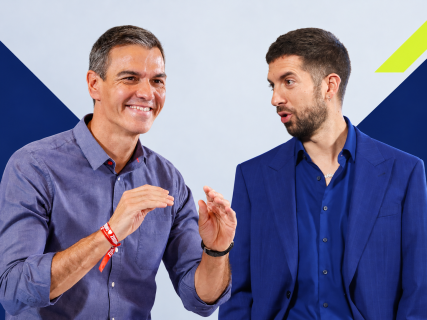
Sánchez visits La Revuelta tonight

Pedro Sánchez visits La Revuelta this Thursday, October 22, to be interviewed by David Broncano on La 1 and RTVE Play. The president of the Government will be the first of the main candidates of 29N to attend the program, which has also invited his electoral rivals.

montaje sanchez broncano.jpg

montaje sanchez broncano.jpg

Add DEMÓCRATA to Google

Ask FREN

Published

Last updated

1 minute

Most read

Elecciones 29N · Encuestas

La media de las encuestas

Media a 21 de octubre de 2026 · 15 institutos

  • PP31,6 %
  • PSOE26,9 %
  • Vox18,7 %
  • Sumar6,3 %
  • Podemos3,1 %
  • ERC2,2 %
010203040ene 2024jul 2024ene 2025jul 2025ene 2026jul 2026

Media del último estudio de cada instituto en 30 días y su evolución semanal desde el 23J. Partidos con al menos un 2 %.

Todas las encuestas

Elecciones generales del 29 de noviembre · Demócrata

Pedro Sánchez will attend La Revuelta, the program of David Broncano on TVE, just over a month before the general elections on November 29. The President of the Government has accepted the invitation from the entertainment space and will be the first of the main candidates to sit down with the presenter. 

The visit was announced by Broncano during Wednesday's program. The invitation is part of the invitations that the team has sent to the candidates for the Presidency of the Government before the 29N. 

What time is Pedro Sánchez's interview on La Revuelta

The agenda of the Presidency of the Government places the interview at 21:45, peninsular time, this Thursday, October 22. 

The interview will be broadcast live on La 1 de TVE and through RTVE Play, the digital platform of the public corporation.  Sánchez will be received by Broncano and his team at the UMusic Hotel Teatro Albéniz in Madrid, where the program is being held this season. 

Which other candidates are invited to the program

The invitation from La Revuelta has been directed to the main candidates of PSOE, PP, Vox, and Frente Amplio. As Broncano explained on Wednesday, Alberto Núñez Feijóo and Santiago Abascal had not yet responded at the time of the announcement of Sánchez's visit. 

The presenter revealed that another person will attend the following week. Frente Amplio has also accepted to participate, although it does not specify the date of that interview.

Sánchez's visit before the elections on 29N

The interview will take place during the pre-campaign for the general elections on November 29. The format allows candidates to participate in a conversation different from the interviews in the news spaces.

Sánchez had already appeared on La Revuelta through a video related to a request from one of Jorge Ponce's daughters. This Thursday's appointment will be his first personal interview and in front of the cameras with Broncano.

More key points, information and questions with FREN

AI-GENERATED CONTENT

What are the powers and functions of the President of the Government according to the Spanish Constitution?

The Spanish Constitution regulates the figure of the President of the Government mainly in articles 97 to 100, along with other scattered mentions. Their powers and functions can be grouped into several major blocks: government leadership, coordination of governmental action, relationship with the Cortes Generales, role in the Head of State, and political responsibilities.

1. Head of Government and direction of domestic and foreign policy

The President of the Government is the highest authority of the executive power. According to article 97 of the Constitution:

  • Directs the action of the Government, that is, sets priorities, the general political line, and coordinates the actions of the different ministers.
  • Assumes the direction of domestic policy, which implies setting the major guidelines in areas such as economy, public services, public order, territorial organization, etc., within the framework of the laws.
  • Directs foreign policy, in coordination with the competent minister, but being the decision center of the Executive in international relations, treaties, and Spain's position abroad (always with constitutional controls, for example, authorization from the Cortes for certain treaties).
  • Holds the direction of the civil and military Administration, which means that the State's administrative structure acts under their political directives, and that they exercise the highest governmental authority over the Armed Forces through the Government as a whole.
  • Exercises the defense of the State, which translates into leading defense policy, proposing exceptional measures (state of alarm, exception, and siege, which require parliamentary authorization), and the general planning of national security.
2. Appointment, dismissal, and coordination of ministers

As head of the Government, the president has essential powers over the composition and functioning of the Council of Ministers:

  • Proposes to the King the appointment and dismissal of ministers (art. 100 CE). The King formalizes these acts, but the political decision is the president's.
  • Determines the structure of the Government (which ministries exist, how functions are distributed among them, what vice presidencies there are), within the framework of the law.
  • Convenes, presides over, and sets the agenda of the Council of Ministers, directing its deliberations and ensuring the coherence of the Executive's decisions.
  • Can give political directives to ministers and demand responsibility for their management, being able to request their resignation when deemed necessary.
3. Relationship with the Cortes Generales and political responsibility

The President of the Government is the main political responsible before the Congress of Deputies:

  • Is invested by the Congress after an investiture debate (art. 99 CE). Without that initial confidence, they cannot be appointed president.
  • Responds continuously before the Congress, which can demand responsibility through a motion of censure. If approved, the president ceases and is replaced by the alternative candidate.
  • Can request a vote of confidence from the Congress. If lost, they are obliged to resign or dissolve the Cortes and call elections, according to constitutional possibilities.
  • Must account through interventions, debates, answers to questions, and appearances, maintaining a permanent relationship with the lower chamber.
4. Political and legislative initiative

Although the Government acts collegially, the president's leadership grants them a decisive role in normative production and legislative orientation:

  • Leads the Government's legislative initiative, promoting the presentation of bills in matters considered priorities.
  • Can promote the approval of royal decree-laws in cases of extraordinary and urgent need, which the Government adopts and the Congress must subsequently validate or repeal.
  • Guides the approval of regulations and general provisions that develop laws, thus setting the practical application of the normative framework.
5. Relationship with the Head of State

The president has a key position in the relationship between the Government and the King:

  • Is the main political interlocutor of the King and the one who, in practice, proposes decisions that the King formalizes (appointments, dissolution of Cortes, calling elections, etc.).
  • All acts of the King in the Government and political sphere are carried out at the proposal, countersignature, or agreement of the president or ministers, who assume political responsibility.
6. Summary

Overall, the President of the Government is the central figure of the executive power in Spain: directs domestic and foreign policy, coordinates ministers, sets the Government's legislative initiative, and is politically accountable before the Congress, on which their tenure depends. The Constitution thus combines strong leadership in the head of Government with a system of parliamentary responsibility that allows controlling and, if necessary, replacing the president through the provided mechanisms.

How is the President of the Government elected and invested according to the Spanish Constitution? What differences exist between the functions of the President of the Government and those of the King in the Spanish constitutional system? What parliamentary control mechanisms specifically exist over the President of the Government?

What results did the PSOE obtain in the last general elections in Spain?

In the last general elections held in Spain, on July 23, 2023, the PSOE obtained 121 seats in the Congress of Deputies and 31.68% of the votes. The definitive result, including the PSC and candidacies associated with the total socialist vote, was 7,821,718 votes. It came in second place, behind the PP, which obtained 137 deputies (Demócrata, Sánchez results; Demócrata, reference to 23J).

How to interpret the result

The three main figures describe different aspects: votes count the support received; the percentage expresses their weight over valid votes; and the seats indicate how many deputies the candidacy obtained. In 2023, the PSOE improved its support compared to the previous call but did not regain the first electoral position (Demócrata, electoral evolution).

  • Votes: the 7,821,718 supports were the highest total obtained by the PSOE in the five general elections in which Pedro Sánchez was a candidate, from 2015 to 2023 (Demócrata, historical series).
  • Percentage: 31.68% was also its highest percentage in those five calls. Expressed with one decimal, it equals 31.7% which usually appears in electoral comparisons (Demócrata, votes and percentage).
  • Representation: the 121 deputies meant one more than in November 2019, although two fewer than in April of that same year (Demócrata, evolution of seats).

Comparison with previous elections

The immediate comparison is with the general elections of November 10, 2019. On that occasion, the PSOE had obtained 6,792,199 votes, 28.00%, and 120 seats. In July 2023, it thus added 1,029,519 votes, increased its percentage by 3.68 points, and gained one deputy. However, it went from first to second position: improving its own result did not mean finishing ahead of the other candidacies (Demócrata, comparison with 2019).

The comparison with April 28, 2019 shows another relevant difference. Then it had obtained 7,513,142 votes, 28.67%, and 123 deputies. In 2023 it gathered 308,576 more votes and increased its percentage by 3.01 points but obtained two fewer seats. Therefore, Sánchez's record number of votes as a candidate corresponds to 2023, while his best result in deputies remains that of April 2019 (Demócrata, comparison between calls).

Why more votes did not mean more deputies

The distribution of deputies is done by constituencies, not through a direct conversion of the national percentage into seats. Both the territorial distribution of support and the results of competitors and the quotients that determine the last deputies of each province matter. This explains why the PSOE could surpass its votes from April 2019 without reaching the 123 seats of that call (Demócrata, explanation of distribution).

In short, the PSOE's balance in the last general elections was more votes and one additional deputy compared to November 2019, but second position. These figures correspond to the definitive result of the July 2023 elections; they are not survey estimates or forecasts about a subsequent call (Demócrata, definitive results).

What legal requirements must a public broadcaster's television program meet to organize interviews with candidates during the pre-campaign period?

Yes, a public television can interview candidates during the pre-campaign, but it must do so respecting pluralism, equality, proportionality, and informational neutrality. The key is to distinguish whether the elections have already been called: specific electoral guarantees apply from the publication of the call, not only from the start of the official campaign.

1. Determine which period applies

The Instruction 4/2011 of the JEC defines the electoral period as that between the publication of the call and the voting day. Therefore, the pre-campaign after that publication is already subject to its requirements. Before the call, the general public service obligations remain in force; in RTVE, Law 17/2006 requires objective, truthful, plural, and independent information and a perceptible separation between information and opinion.

2. The decision corresponds to the broadcaster

The Instruction assigns the decision to organize or broadcast electoral interviews to the media's management bodies. It does not impose automatically interviewing all candidates, but neither does it allow arbitrarily selecting guests, favoring one candidacy. The selection and treatment must be justifiable according to electoral principles.

Moreover, these obligations affect all programming. Presenting the interview as entertainment, personal conversation, or a program unrelated to news does not exclude electoral control when its content has electoral impact.

3. Select guests and times with proportionality

When organizing interviews, particular attention must be paid to the results of each party in the last equivalent elections. This means equality does not necessarily equate to identical minutes for all. Nor should the proportional duration rule specifically provided for campaign information be mechanically applied to each interview.

For a series of interviews, it is advisable to document the criteria for invitation, duration, order, schedule, and editorial treatment, so that the whole does not generate an unjustified advantage. This is a practical recommendation to prove compliance, not a closed legal list.

Coverage plans must also include significant political groups: parties without representation in the previous equivalent elections that have subsequently obtained, in recent processes and within the broadcaster's territorial scope, at least 5% of valid votes. Their coverage cannot equal or exceed that of candidacies that obtained representation.

4. Submit planning to electoral control

Management bodies must present their campaign coverage plans to the competent Electoral Board, including interviews, debates, and specifically electoral programs. Subsequent modifications must be communicated immediately. For interviews before the campaign start, respect for principles throughout the electoral period remains mandatory; this general obligation should not be confused with the specific content of the campaign plan.

5. Do not confuse interview and electoral advertising

A journalistic interview is not a contracted advertising space. Article 60 of the LOREG prohibits contracting electoral advertising in public media and reserves legally regulated free propaganda spaces for the campaign. The interview must maintain its editorial nature and not become promotional treatment incompatible with neutrality.

6. Provide for complaints

Accredited representatives can challenge programs with electoral impact within 48 hours following their broadcast. The Board can order measures to restore violated principles. In RTVE, article 26 of its law places communication with the Electoral Administration in the Board of Directors, through its presidency.

Play

Test your knowledge with FREN!

How much do you know about this topic? Answer the following 3 questions.

Who will be the first main candidate to be personally interviewed by David Broncano on La Revuelta?

Question 1 of 3

Where is the program La Revuelta being held this season?

Question 2 of 3

Which main candidates had not yet responded to La Revuelta's invitation at the time of Sánchez's visit announcement?

Question 3 of 3