PP and Vox ministers: who sounds like they might govern after the 29N and what the media’s betting pools are

Sixteen names in the front row and a Government that Feijóo wants to reduce to fourteen ministries. Carmen Obregón identified in DEMÓCRATA the leaders who feed the PP’s betting sheets. A photograph that now also adds possible economic hires, Vox contenders, and a dispute that is still to be resolved: which portfolios the popular ones would keep if they need Santiago Abascal to govern after the 29N

feijoo semper

feijoo semper

Add DEMÓCRATA to Google

Ask FREN

Published

Last updated

4 minutes

Most read

Elecciones 29N · Encuestas

La media de las encuestas

Media a 8 de noviembre de 2026 · 11 institutos

  • PP30,8 %
  • PSOE26,2 %
  • Vox19,5 %
  • Frente Amplio6,8 %
  • ERC2,6 %
  • Podemos2,0 %
01020304050ene 2024jul 2024ene 2025jul 2025ene 2026jul 2026

Media del último estudio de cada instituto en 30 días y su evolución semanal desde el 23J. Partidos con al menos un 2 %.

Todas las encuestas

Elecciones generales del 29 de noviembre · Demócrata

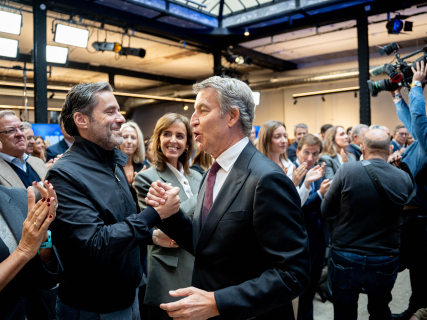
The ministers’ betting pool of PP and Vox has a reference photograph: the first row that Carmen Obregón identified in DEMÓCRATA during the presentation of the "Contract with Spain" by Alberto Núñez Feijóo. There, sixteen popular leaders appeared, several of them indicated by the political sources consulted as possible members of a future Government.

The journalist from DEMÓCRATA was at the Espacio Larra, where Feijóo brought together around 550 leaders, and she collected the conversations that accompanied the staging. While the candidate presented his commitments, other calculations circulated in the bystanders’ talk: who could end up in the Council of Ministers and who would be left out.

That information included a detail that remains decisive. Not all the members of the first row would end up being ministers. There were also aspirants in more discreet positions and names absent that were included in the bets.

The 16 names that Carmen Obregón identified in DEMÓCRATA

The first row brought together Ignacio Dancausa, Ildefonso Castro, Cayetana Álvarez de Toledo, Alfonso Serrano, Pedro Rollán, Alberto Nadal, Elías Bendodo, and Alma Ezcurra.

They were completed by Ester Muñoz, Cuca Gamarra, Carmen Fúnez, Borja Sémper, Alicia García, Javier de Andrés, Sergio Sayas, and Alejandro Fernández.

Carmen Obregón’s information makes it possible to identify part of the group of leaders on which expectations of government are projected. It does not assign a specific portfolio to each one nor does it present their presence at the event as a guarantee of appointment.

The fact introduces an alignment problem. Feijóo has committed to putting together an Executive of fourteen ministries. If he finally shares a Government with Vox, part of those seats would have to be reserved for his partner. And, in that case, external professionals outside the party would still have to be incorporated.

Economy and Finance: Hernández de Cos, Bravo, Conde, and Pablo Isla

The economic area concentrates some of the most specific bets. El País placed Pablo Hernández de Cos and Francisco Conde among the names being considered for a possible economic vice presidency. It also indicated Juan Bravo for Finance and Alberto Nadal for economic responsibilities that could extend to Industry or Trade. These are possibilities attributed to sources from the PP, not appointments announced.

Digital Closure incorporates Pablo Isla into conversations about a possible economical hiring. His information also places Bravo among the favorites for the Treasury and contemplates for Nadal different destinations, including the Economic Office of Moncloa. This latter option would be a post in the Presidency, not necessarily a ministry.

Nadal thus connects the photograph collected by DEMÓCRATA with information about the economic team. The coincidence of his name in different lineups shows that he is one of the recurring profiles; it does not allow his destination to be considered settled.

Tellado, Gamarra, Sémper and the Cayetana enigma

Away from the economic bloc, Artículo14 includes Miguel Tellado, Cuca Gamarra and Esteban González Pons among the possible members of the Executive. It also collects bets on José Luis Martínez-Almeida as the government’s spokesperson.

ElPlural, for its part, highlights expectations about Borja Sémper and divergent versions surrounding Cayetana Álvarez de Toledo. When reviewing other publications, it collects both the possibility that she will reach a ministry and that she will hold the parliamentary spokesperson position.

The difference matters. The distribution after the elections would also include responsibilities in Congress and in the party. That a leader gains weight in the lists or in the campaign does not determine that he will sit on the Council of Ministers.

Vox names that enter the lineups

The list of possible Government members for Vox goes beyond Santiago Abascal. Pablo Montesinos in Artículo14 pointed to Ignacio Garriga and Montse Lluis, whom he identifies as a central figure in negotiating the autonomous coalitions.

The same information includes the names of Jorge Buxadé, José María Figaredo, Carlos Hernández Quero, Samuel Vázquez and Rocío de Meer. It does not assign them specific ministries nor does it substantiate that there exists a cabinet proposal agreed with the PP.

In Abascal’s case, El Independiente proposes a vice presidency as a scenario for a possible agreement. This is a provision from its analysis about the coalition, not a position announced by the leader.

The ministries that the PP wants to keep versus Vox

The information from Cristina de la Hoz in El Independiente shifts the focus from names to competencies. According to the popular sources it consults, the PP intends to keep Economy and Treasury, Home Affairs, Foreign Affairs, Defense and Justice.

To that group add the energy and environmental policies and Education. Transport also gains relevance: Feijóo has defended that its person in charge must have proven experience and training.

The same article uses the regional agreements as a reference to anticipate possible Vox interests in Agriculture, social and family policies, Tourism, the Environment, and Deregulation.

There is a possible friction there: some competences that the analysis places among Vox’s aspirations also appear among those the PP wants to keep. Before assigning names, both parties would have to resolve what each one controls.

The information outlines three groups that would compete for space: PP leaders, possible external additions, and Vox representatives. The final composition would depend on the results, on support for the investiture, and on the agreement the parties reached.

Meanwhile, Feijóo publicly maintains caution. In the event described by DEMÓCRATA he left this instruction for his leaders: "Nothing is celebrated here until the last electoral college closes."

More key points, information and questions with FREN

AI-GENERATED CONTENT

What is the parliamentary process for forming a coalition government between PP and Vox after a general election in Spain?

A coalition government between PP and Vox would be formed through the same investiture procedure as any other Government: the Congress must grant its confidence to a candidate for president. There is no specific vote to approve the coalition or to jointly choose its ministers. It is necessary to distinguish the political pact between both parties from the constitutional acts that allow the Executive to be formed.

1. Constitution of the Congress and political negotiation

After the elections, the new Congress is constituted and its Presidency and Board are elected. While the next Executive is formed, the outgoing Government continues in office until the new one takes office, in accordance with article 101 of the Constitution.

PP and Vox could negotiate a common program, the distribution of ministerial responsibilities, and coordination mechanisms. That agreement would serve to organize their collaboration, but it would not replace the investiture. Signing it would also not be enough to assume the Government: it would be necessary to gather the required parliamentary support.

2. Consultations by the King and proposal of candidate

Article 99 of the Constitution establishes that the King consults the representatives designated by the political groups with parliamentary representation and proposes a candidate through the Presidency of the Congress. The proposal opens the investiture procedure; it does not equate to the appointment as president.

Upon receiving the proposal, the Presidency of the Congress convenes the Plenary, according to article 170 of the Congress Regulations. The Senate does not participate in the investiture vote: the confidence necessary to form Government corresponds exclusively to the Congress.

3. Investiture debate

The session begins with the reading of the proposal. Then, the candidate presents, without time limit, the program of the Government they intend to form and requests the confidence of the Chamber.

After a break, the parliamentary groups that request it intervene for thirty minutes. The candidate may respond as many times as requested and there are ten-minute reply turns. These rules are set out in article 171 of the Regulations. The vote is public by roll call: each deputy answers "yes," "no," or "abstention."

4. Majorities and second vote
  • First vote: the candidate needs an absolute majority of the members of Congress.
  • Second vote: if not achieved, another is held forty-eight hours later. A simple majority suffices: more favorable votes than opposing.

Therefore, the viability of a candidacy supported by PP and Vox would depend on their votes and the support, rejection, or abstentions of the other deputies. Before the second vote, the candidate may intervene for ten minutes and each group for five.

5. Appointment and formation of the coalition

If confidence is obtained, the Presidency of the Congress communicates the result to the King for his appointment. Then, the president chooses the members of the Government, who are appointed by the King at his proposal, in accordance with article 100 of the Constitution. The Congress does not subject them to individual investitures.

The distinction between choosing the president and appointing the ministers is recorded in the Ruling 124/2018. In a coalition, people agreed upon by both parties would participate in the Executive; with external support, one could back the investiture without joining the Government.

6. If no candidate obtains confidence

New proposals could be processed by the same procedure. If two months pass from the first investiture vote without any candidacy obtaining confidence, both Chambers are dissolved and new elections are called. The period does not start on election day nor restart with each candidate.

What powers and functions does a vice president have in the Government of Spain according to current legislation?

A vice president of the Government of Spain primarily exercises the functions entrusted to them by the president. They do not have, by virtue of holding that position alone, a general competence to direct all ministers nor a specific material scope. Their powers depend on presidential assignments, competencies received by delegation, and, if they are also a minister, those corresponding to their department.

1. Legal framework and institutional position

The basic norms are the Spanish Constitution, especially its article 98, and the Law 50/1997, of the Government. The Constitution includes vice presidents among the members of the Government but adds "if applicable": therefore, their existence is not mandatory. There may be one, several, or none.

Article 98.2 assigns the president the direction of government action and coordination of its members, respecting their direct competence and responsibility. Consequently, a vice presidency does not automatically displace that presidential direction nor absorb the ministers' powers.

2. Functions entrusted by the president

The decisive rule is in article 3.1 of the Government Law: "The Vice President or Vice Presidents, when they exist, shall exercise the functions entrusted to them by the President."

This allows each vice presidency to be configured differently. It may receive tasks of political coordination or promotion of certain actions, but there is no uniform material catalog applicable to all vice presidencies. To know the specific powers of one, one must attend to the organizational provisions and corresponding assignments.

Additionally, article 20.1 allows the president to delegate the exercise of their own competencies to vice presidents and ministers. It is important to distinguish that delegation from the general assignment of tasks: the first aims at exercising a specific competence; the second defines the functions the president entrusts to the vice presidency.

3. Participation in Government bodies

As a member of the Executive, the vice president participates in the Council of Ministers. The decisions legally attributed to this body — for example, approving bills, royal decree-laws, or regulations — are competencies of the Council, not individual faculties of the vice president.

They may also be part of or preside over a Delegated Government Commission. According to article 6, the royal decree of creation must identify who presides it, its members, and its functions. These commissions examine matters affecting several ministries, prepare joint proposals, and may resolve issues that should not be elevated to the Council of Ministers.

4. When also heading a ministry

Article 3.2 establishes that whoever assumes the leadership of a ministerial department shall also hold the status of minister. These are, therefore, two cumulative conditions, but not inseparable: one can be vice president without directing a ministry.

When both are combined, they exercise the ministerial functions of article 4: developing Government action in their department, exercising regulatory power in their matters, performing competencies attributed by norms, and countersigning, when appropriate, the acts of the King within their competence. These faculties derive from their ministerial status, not simply from being vice president.

5. Appointment, dismissal, and limits

According to article 12.2, vice presidents are appointed and dismissed by the King, at the proposal of the president of the Government. If a minister is appointed vice president, they may keep their department.

They are also subject to the incompatibilities of article 98.3 of the Constitution: they cannot exercise other representative functions except parliamentary mandate, nor public functions unrelated to the office, nor professional or commercial activities.

In short, the vice presidency is a position of flexible configuration: its legal scope is determined by the functions entrusted, delegations received, and ministerial competencies that, if applicable, it accumulates.

How many seats did Vox obtain in the last general elections held in Spain?

Vox obtained 33 seats in the Congress of Deputies in the last general elections held in Spain, which took place on July 23, 2023. That is the figure appearing in the results published by Europa Press and in the electoral information of RTVE, prepared with data from the Ministry of the Interior.

The result you are asking about

The answer refers to the deputies elected for the Congress, not to a vote estimate nor a projection of future elections. In this context, saying that Vox obtained 33 seats means that it secured 33 representation positions in that Chamber as a result of that electoral call.

  • Party: Vox.
  • Elections: general elections of July 23, 2023.
  • Chamber: Congress of Deputies.
  • Representation obtained: 33 seats.

The precision about the Chamber is important: the figure of 33 corresponds to the Congress. It should not be presented as a sum of representatives in the Congress and the Senate, nor as a result of regional, municipal, or European elections. To answer your question about the seats obtained in the last general elections, the specific reference is, therefore, that representation in the Congress.

Where you can verify it

The results page of Europa Press on 23J records for Vox the 33 seats. The electoral information of RTVE on the Congress confirms the same figure. Both references allow verifying the result associated with the July 23, 2023 call, rather than confusing it with news about electoral expectations.

You can also consult the official electoral publication of the BOE, which constitutes the official reference among the sources consulted. If you need to cite the result in a text, it is advisable to always accompany the number of seats with the date of the elections and the name of the Chamber. This makes clear what is being counted and to which vote it corresponds.

How to cite the data unambiguously

A brief and precise formulation would be: Vox obtained 33 seats in the Congress in the general elections of July 23, 2023. That sentence includes the three necessary elements to identify the result: the party, the number of deputies, and the electoral call. There is no need to add a political assessment to answer how many seats it obtained.

Likewise, it is useful to distinguish between the result of an election and any subsequent information about a party's activity. Your question refers to how many positions it obtained at the polls, so the figure to use is the electoral result. No forecast or assessment about what may happen in another call is offered here.

In short, the number you are looking for is 33 deputies. The date that should accompany it is July 23, 2023, and the Chamber to which it corresponds is the Congress of Deputies. The two cited result sources agree on that figure.

Play

Test your knowledge with FREN!

How much do you know about this topic? Answer the following 3 questions.

How many ministries does Alberto Núñez Feijóo foresee for a hypothetical Executive?

Question 1 of 3

Which area of government concentrates some of the most concrete bets on possible future ministers according to media predictions?

Question 2 of 3

What condition has Feijóo set for his leaders regarding celebrating possible results before the elections?

Question 3 of 3