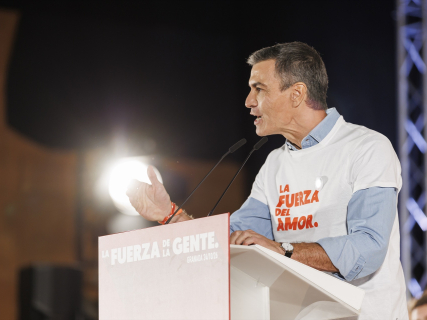
Sánchez seeks an international narrative to fuel the comeback of 29N: he clings to Lula and looks at Trump

The president turns the Brazilian's victory into a campaign argument for the 29N, while the midterm elections in the United States will test support for Trump and the reach of the conservative wave.

EuropaPress 7866121 imagen secretario general psoe presidente gobierno pedro sanchez acto

EuropaPress 7866121 imagen secretario general psoe presidente gobierno pedro sanchez acto

Add DEMÓCRATA to Google

Ask FREN

Published

6 minutes

Most read

Elecciones 29N · Encuestas

La media de las encuestas

Media a 27 de octubre de 2026 · 15 institutos

  • PP31,0 %
  • PSOE27,3 %
  • Vox18,9 %
  • Sumar6,3 %
  • Podemos2,9 %
  • ERC2,3 %
010203040ene 2024jul 2024ene 2025jul 2025ene 2026jul 2026

Media del último estudio de cada instituto en 30 días y su evolución semanal desde el 23J. Partidos con al menos un 2 %.

Todas las encuestas

Elecciones generales del 29 de noviembre · Demócrata

Pedro Sánchez has found in the victory of Luiz Inácio Lula da Silva in Brazil a new argument to feed the electoral expectations of the PSOE. Just over a month before the general elections of November 29, the president of the Government has immediately transferred the Brazilian result to the Spanish scenario and has presented it as a sign that the radical right can be defeated at the polls, even when the polls point in another direction.

"Great victory for Lula! What has happened in Brazil will happen in Spain. The comeback of global progressivism has just begun", he wrote this Monday on his X account. The congratulation to the Brazilian leader has come accompanied by an explicitly national reading: Sánchez not only celebrates Lula's continuity at the head of the Government, but uses his victory to reinforce the message with which the PSOE faces the final stretch of the campaign.

Lula has achieved a fourth term after winning in the second round against Senator Flávio Bolsonaro, son of former president Jair Bolsonaro. The leader of the Workers' Party has obtained 51.79% of the votes, compared to 48.21% of his rival, after the first round, held on October 4, left Bolsonaro ahead. The result offers socialists an image of comeback that fits with the narrative that Sánchez wants to convey to Spanish voters.

The result of Lula offers socialists an image of comeback that fits with the narrative that Sánchez wants to convey to Spanish voters

The political operation has a clear logic: to transform an international victory into a signal of electoral possibility at home. Against polls that place the PP ahead of the PSOE, the president insists that the forecasts are not definitive and that progressive mobilization can change the outcome. The comparison with Brazil allows him to present the appointment of 29N not only as a dispute between Spanish parties but as part of a broader struggle between two political models.

Trump, the next test for the international narrative

Lula's victory comes, moreover, eight days before the midterm elections in the United States, scheduled for November 3. Americans will renew all 435 seats in the House of Representatives and one-third of the Senate. The result will not decide the presidency, but it will determine the margin of maneuver for Donald Trump during the second half of his term and will serve to measure electoral support for his agenda.

The available projections as of October 26 indicate that the Democrats have a chance to regain the House of Representatives, while the contest for the Senate presents a tighter scenario. One of the estimates published by Polling Forecast places the probability of a Democratic majority in the House at 77% and at 57% for the Democrats to control the Senate. These are projections subject to the uncertainty of the polls, not anticipated results.

For Sánchez, the interest of the U.S. election lies in its value as a political thermometer. If the Republican Party loses control of one or both chambers, Trump's opponents could interpret it as a sign of weariness of his project. If the Republicans maintain their majorities, the result would provide a different argument to those who defend the resilience of the conservative movement. In either case, the scrutiny will be read beyond the United States, although the reasons for the vote will also depend on internal issues, such as the economy, the cost of living, and the assessment of presidential management.

The comparison with Brazil, however, has limits. Lula has just won a direct presidential election; in the United States, Congress will be renewed, with different contests in each state and district. The midterms are not a perfect plebiscite on Trump, just as the Brazilian victory does not allow for anticipating the outcome of the Spanish elections. Its relevance for Sánchez's narrative is different: both events feed the debate on whether the advance of conservative forces is a consolidated trend or if there is space for an electoral response from their opponents.

The PSOE turns Lula's victory into a collective message

Sánchez has not been the only member of the Government who has turned to the Brazilian result to defend the possibility of a comeback. The Minister of Foreign Affairs, José Manuel Albares, has congratulated Lula on a victory that he has described as "brilliant and democratic" and has emphasized the strategic relationship between both countries. He has also taken advantage of the result to insist that "the only poll that matters is the one on election day", an idea that connects directly with the Spanish campaign.

The Minister of Territorial Policy, Ángel Víctor Torres, has also predicted a socialist comeback, while the spokesperson minister, Elma Saiz, has presented the Brazilian outcome as a victory of democracy against hatred, disinformation, and denialism. The PSOE thus tries to turn Lula's result into a shared argument by the entire Government and its political space.

The strategy is not limited to celebrating an ideological ally. The Brazilian result allows the socialists to counterbalance the weight of the polls with a recent example where the outcome deviated from previous expectations. The message seeks to mobilize progressive voters and question the idea that a victory for the right is inevitable. But the translation of the Brazilian case to the Spanish context has a primarily political and symbolic dimension: the electoral dynamics, candidates, and issues that condition the vote are different in each country.

Milei, the counterpoint to the campaign against PP and Vox

The other international reference that Sánchez has incorporated into his speech is Javier Milei. The visit of the Argentine president to Madrid served the head of the Executive to intensify his warnings against a possible alternation led by PP and Vox. In fact, as soon as he landed, Ferraz welcomed him with a banner.

At a rally in Burgos, Sánchez stated that both formations do not simply offer a change of Government, but rather a "regression," and linked Alberto Núñez Feijóo and Santiago Abascal with the political and economic model of Milei.

The president contrasted the labor and economic situation of Argentina with the data he claims from Spain, and used the visit to warn of the consequences that, in his opinion, would arise from applying similar policies in the country. "What you do not want for the world, do not want for your country," he defended at that event, where he also advocated for increases in the minimum wage and pensions.

Lula and Milei thus fulfill opposing functions within the socialist campaign. The former represents the example of a progressive victory against a rival from the radical right; the latter, the warning about the model that Sánchez attributes to his Spanish adversaries. Trump adds a third piece: the reference to a central power whose electoral date may fuel international interpretations about the strength or wear of the American right.

The common thread is the president's attempt to place the elections of 29-N within a global political dispute. But that narrative also has its limits. Neither the Brazilian result guarantees a socialist comeback in Spain nor will the outcome of the midterms determine the Spanish vote. What Sánchez's messages do show is that the PSOE wants to use international events to contest the framework of the campaign: against the idea of a conservative cycle that is difficult to stop, the president claims that the polls are still open and that progressivism can win again.


More key points, information and questions with FREN

AI-GENERATED CONTENT

What stage is the PSOE's electoral campaign process at for the general elections on November 29?

As of October 27, 2026, the PSOE is in an advanced pre-campaign phase for the general elections on November 29: it has internally approved its candidacies and organized the electoral leadership, but the official campaign has not yet started. This will begin on November 13 and end on the 27th. It is important to distinguish the party's political preparation from the administrative procedures of its candidacies.

1. Campaign organization: launch

The Federal Executive Committee approved the October 5 the Electoral Committee and its internal calendar. Rebeca Torró took on general coordination; María Jesús Montero, strategic coordination; and Cristina Narbona, program development. Therefore, this organizational stage is already completed and the team is working on the electoral deployment. (Demócrata, October 5)

2. Candidate and lists: internal approval completed

The Federal Committee unanimously proclaimed Pedro Sánchez as the candidate for the Presidency of the Government on October 17, in Fuenlabrada, and ratified the lists for the Congress and Senate. The Federal List Commission had previously approved the proposals on the 16th. This closed the organic procedure for preparing candidacies; this internal ratification should not be confused with their proclamation by the electoral administration. (Demócrata, October 17)

An agreement has also been reached to present joint candidacies to the Senate with the Broad Front under the name "Senate of Progress." The pact does not generally extend to the candidacies for the Congress, which remain differentiated. It is, therefore, an electoral decision already made, not a negotiation pending closure under the published terms. (Demócrata, October 17)

3. Electoral procedures: publication and proclamation

According to the calendar included in the consulted electoral coverage, the deadline for submitting candidacies ended on October 26 and their publication is scheduled for October 28. After that come possible corrections and the definitive proclamation. Thus, the administrative phase is situated between the closing of submissions and the publication of the lists; it should not be considered completed solely because the party has approved its names. (Electoral calendar coverage)

4. Political and media deployment: in execution

The pre-campaign activity is already underway. Sánchez began his major events in Dos Hermanas on October 10, under the slogan "The strength of the people," and continued his territorial tour. Therefore, this is not an exclusively internal preparation: the party is already holding public mobilization events. (Demócrata, October 10)

On the television front, the PSOE has expressed its willingness to participate in a four-way debate on RTVE on November 26 and has proposed a face-to-face debate for the 16th. These positions alone do not confirm the agreement of all participants and organizers. (Demócrata, October 22)

5. Next milestone: official campaign

The Ministry of the Interior sets the fifteen days of the campaign between 00:00 on November 13 and 24:00 on the 27th. The conclusion is clear: the organic preparation is resolved in its main elements, the candidacy procedures follow their calendar, and the political deployment is already functioning, but we are still in pre-campaign. (Interior Calendar)

What are the powers and functions of the Prime Minister of Spain according to the Constitution?

The Prime Minister of Spain is the highest authority of the executive power and their position is mainly defined by the 1978 Constitution, especially in articles 97, 98, 99, 100, and 112 to 115, as well as some references in article 62. From these, their powers and functions can be systematized as follows:

1. Direction of the Government and domestic and foreign policy
  • According to article 97, the Government directs domestic and foreign policy, the civil and military administration, and the defense of the State. The Prime Minister, as head of the Government, embodies this political direction.
  • In practice, this means setting the major orientations of the Government's action (legislative, economic, social, foreign policy, defense priorities, etc.) and coordinating the different ministers to act coherently with that program.
  • They are the main political responsible before the Congress of Deputies, which can demand accountability through a motion of censure or deny confidence.
2. Representation of the Government
  • The Prime Minister holds the representation of the Government as a collegiate body, both within Spain and abroad.
  • Internally, they preside over the meetings of the Council of Ministers, set the agenda for its sessions, and act as the main political spokesperson of the Executive.
  • Internationally, they lead the Government's position in summits, bilateral meetings, and international forums, although the Head of State is the King.
3. Appointment and dismissal of ministers
  • According to article 100, the other members of the Government (vice presidents and ministers) are appointed and dismissed by the King, but exclusively at the proposal of the Prime Minister.
  • This implies that the configuration, structure, and composition of the Government depend politically on the Prime Minister: they decide which portfolios exist, who occupies them, and when reshuffles occur.
  • They also coordinate the work of the ministers and can issue general political directives or guidelines to the entire cabinet.
4. Relationship of confidence with the Cortes Generales
  • The confidence link is established from the start: article 99 provides that the King proposes a candidate for Prime Minister who must obtain the confidence of the Congress of Deputies through the investiture debate.
  • Once invested, the Prime Minister can:
    • Raise before the Congress a question of confidence (art. 112) to reaffirm parliamentary support for a political program or general policy declaration.
    • Face a motion of censure (art. 113), through which the Congress can withdraw confidence and replace them with another candidate.
  • If confidence is denied in a question of confidence, or if a motion of censure succeeds, the Prime Minister must resign.
5. Dissolution of the Chambers and calling elections
  • Article 115 establishes that the Prime Minister can propose to the King the dissolution of the Congress, the Senate, or the Cortes Generales as a whole, leading to the calling of general elections.
  • This power is subject to certain limits:
    • It cannot be proposed while a motion of censure is in process.
    • A minimum period between dissolutions must be respected.
  • The decision to dissolve is formally the King's, but it can only be exercised at the proposal of the Prime Minister, who assumes the political responsibility for this initiative.
6. Legislative initiative and relationship with the King
  • The Government, under the Prime Minister's direction, exercises legislative initiative (art. 87) by presenting bills to the Congress or Senate.
  • According to article 88, bills are approved in the Council of Ministers and sent to the Cortes with a statement of reasons and necessary background, a process politically led by the Prime Minister.
  • The Prime Minister also intervenes in all relevant decisions in which the King acts upon prior proposal or countersignature of the Government, such as:
    • The calling of a consultative referendum (art. 92), proposed by the Prime Minister and authorized by the Congress.
    • Other acts of the King requiring countersignature by the Prime Minister or ministers, according to article 64.
7. Direction of defense and states of crisis
  • As head of the Government, they direct defense policy and the organization of the Armed Forces through the Ministry of Defense, within the framework set by the Constitution (art. 97).
  • In exceptional situations (states of alarm, exception, and siege), regulated by article 116 and the corresponding organic legislation, the Prime Minister leads the proposal to the Congress and the political direction of the measures adopted by the Government.

In summary, the Constitution configures the Prime Minister as the center of political direction of the Executive, ultimately responsible for Government action, cabinet coordination, and the confidence relationship with the Congress, with broad powers for political impetus but always subject to parliamentary control and the constitutional framework.

How is the Prime Minister chosen and invested according to the Spanish Constitution? What constitutional differences exist between the functions of the King and those of the Prime Minister? What control mechanisms can the Congress exercise over the Prime Minister?

What has been Luiz Inácio Lula da Silva's political trajectory before obtaining his fourth term?

Luiz Inácio Lula da Silva reached his fourth presidential victory after a trajectory of more than half a century: he was a metalworker, union leader against the dictatorship, founder of the Workers' Party (PT), constituent deputy, and president on three previous occasions. His career combines electoral defeats, social inclusion policies, and a judicial crisis that led him to prison before regaining his political rights and returning to power.

From the labor movement to national politics

Born in Pernambuco in 1945, Lula emigrated as a child with his family to the state of São Paulo. He trained as a mechanical turner and worked in the metalworking industry. That work experience was the basis for his entry into unionism and his later political identity.

In 1975 he was elected president of the Metalworkers' Union of São Bernardo do Campo and Diadema. At the end of that decade, he led major strikes in the São Paulo industrial belt, demanding wage improvements and democratic opening. In 1980 he was detained for 31 days under the military dictatorship, according to the Demócrata profile.

That same year he participated in the founding of the PT, along with unionists, intellectuals, social movements, and grassroots Christian sectors. In 1982 he unsuccessfully tried to become governor of São Paulo. In 1986 he was elected federal deputy and participated in the National Constituent Assembly, transferring his union leadership to institutions.

Three defeats before the Presidency

His first presidential candidacy came in 1989, in the first direct elections after the dictatorship. He reached the second round but lost to Fernando Collor de Mello. He ran again in 1994 and 1998, and on both occasions was defeated by Fernando Henrique Cardoso.

Victory came in 2002, after moderating part of the PT's economic discourse and broadening alliances toward business and centrist sectors. He defeated José Serra and took office on January 1, 2003. In 2006 he was re-elected against Geraldo Alckmin.

Two terms and a deep judicial crisis

Between 2003 and 2010, his governments were associated with Bolsa Família, the expansion of social aid, and poverty reduction. These advances coincided with economic growth, job creation, and a favorable international context for Brazilian exports; they were not exclusively the result of government policies.

Lula left the Presidency with high popularity and was succeeded by Dilma Rousseff. Subsequently, the Lava Jato investigations placed him at the center of corruption and money laundering cases. He entered prison in April 2018 and remained incarcerated for 580 days. His situation prevented him from competing in that year's elections.

In 2021, the Supreme Federal Court annulled his convictions due to lack of jurisdiction of the Curitiba court. In a separate decision, it declared Judge Sergio Moro partial in the triplex case. He thus regained his political rights: the annulments responded to jurisdictional and procedural guarantee issues, not a general acquittal on the merits of the accusations.

The return and the fourth victory

In 2022 he defeated Jair Bolsonaro with 50.90% of valid votes. He assumed his third term on January 1, 2023, with Alckmin as vice president, in a more polarized Brazil with less parliamentary margin.

Finally, on October 25, 2026, he won against Flávio Bolsonaro with 51.79%, according to Demócrata. That fourth electoral victory culminated a trajectory marked by the construction of the PT, three initial defeats, two consecutive terms, imprisonment, and presidential return.

Play

Test your knowledge with FREN!

How much do you know about this topic? Answer the following 3 questions.

What result did Lula da Silva achieve against Flávio Bolsonaro in the second round of Brazil's presidential elections?

Question 1 of 3

What message has Pedro Sánchez conveyed using Lula's victory in Brazil?

Question 2 of 3

Which other international figure does Sánchez use as a warning in his campaign against PP and Vox?

Question 3 of 3