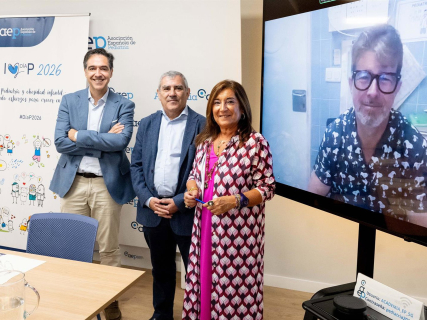

The president of the Spanish Association of Pediatrics (AEP), Dr. Luis Carlos Blesa, has defended that GLP-1 receptor agonists "should be funded" as "one more tool" and "for equity" in the treatment of obesity in childhood and adolescence.
He has recalled that "they are drugs that have an indication for obesity from six and 12 years old," respectively, and that "they should be available" and "within the range of the therapeutic arsenal," as they have demonstrated "evidence and favorable effects." "They can give us another tool in cases where preventive measures are not effective," he added.
During the presentation of the manifesto "Child and Adolescent Obesity: Facing a Complex Disease, an Integral Response," coinciding this Thursday, October 8, with Pediatric Day, Blesa highlighted that these are therapies that "fortunately" have been developed and "have filled a worrying gap."
The coordinator of the Health Promotion Committee of the AEP, Dr. Julio Álvarez Pitti, has warned that these medications "are very costly," as they represent "350 euros a month" per patient. He emphasized that "the doctor wants to cure" and expressed his concern: "It terrifies me that this ends up in the hands of a drug that only those who can afford that cost can benefit from and the gap continues to grow." In his opinion, it is key to accompany pharmacological treatment, when indicated, with a structured care intervention.
Blesa has insisted on avoiding "the mistaken idea" that the mere existence of these drugs, even without funding, allows for dispensing "with a change of habits." He has insisted that medications "should not be, by any means, the objective of obesity treatment," a stance shared by the coordinator of the Nutrition and Maternal Breastfeeding Committee of the AEP, Dr. Rosaura Leis Trabazo, who has focused on prevention.
Inequality and obesogenic environment
According to Leis Trabazo, in the coming years "there will surely be new drugs and changes in prescription, but what is always at the base is the obesogenic environment." She pointed out that this environment is more intense in homes with lower socioeconomic and cultural levels, where a higher proportion of children with overweight or obesity is observed.
In this framework, the AEP has made public the manifesto in order to recognize childhood obesity as a chronic and complex disease that requires a comprehensive response and the identification of the social determinants that make certain children more vulnerable. Experts demand to start prevention from the beginning of life, reinforcing preventive strategies already in the preconception period and paying special attention to the first 1,000 days.
The document urges the creation of environments that favor healthy growth and reduce social gaps, through coordinated policies in health, education, urban planning, and social protection. It also advocates for ensuring global and coordinated care, led by the pediatrician, with multidisciplinary teams both in Primary Care and in the hospital setting, and with well-defined care pathways. Furthermore, it proposes to combat stigma and blame and ensure continuity of care in the transition to adulthood.
Blesa has emphasized that obesity is "very transversal," so it "can affect many specialties" and requires coordination with other health professionals. He has called for "changes" and "involvement of public administrations" and has highlighted the "luxury" of having pediatricians both in Primary Care and in hospitals.
16% of minors with obesity in Spain
The president of the AEP has recalled that obesity affects 16 percent of minors, to which is added "an extra 20 percent" of children with overweight, which, in his words, evidences "an alarming problem." The vice president of Primary Care of the AEP, Dr. Guillermo Martín Carballo, has emphasized "the importance of preserving and reinforcing the model of Pediatrics in Spain" and has announced various activities during Pediatric Week to raise awareness about childhood obesity, "one of the main health challenges."
In this line, Álvarez Pitti has explained that all the factors involved in the development of obesity "are related to each other," which makes it "very difficult to treat." He has pointed out that the pathology has "an impact on practically all organs and systems" and is associated with other diseases, "such as diabetes and hypertension," in addition to affecting mental health.
He emphasized that the effect "is not homogeneous across all social layers," since "it is clearly seen in the most disadvantaged," where the difference with the most favored "reaches 12 percentage points," with rates of 11 percent and 23 percent, respectively. Although "genetics is important," he has granted a key role to habits, mentioning the use of screens, sleep, and sedentary behavior, among other factors, and has called for "structural changes: in regulation, urban planning, and access to resources."
In his opinion, "many more resources" are needed and the implementation of multidisciplinary teams, a necessity that Leis Trabazo has also emphasized by highlighting the role of professionals such as "the pediatric nurse, nutritionists, and specialists in physical activity."
Finally, Álvarez Pitti has reminded that obesity "is stigmatized," and that in these patients "generic recommendations are not enough." Therefore, he has insisted on the importance of detecting "earlier" the situation and the obesogenic environment surrounding each person.