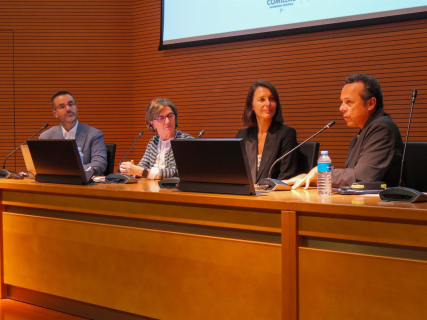

The president of the General Council of Colleges of Physiotherapists of Spain and of the Official College of Physiotherapists of Galicia, Gustavo Paseiro Ares, has called for access to physiotherapy services within the public healthcare system to be promoted and, in parallel, for progress to be made in the effective recognition of the competencies of these professionals.
These ideas were defended by him during the 1st Physiotherapy Forum, promoted by the San Juan de Dios - Comillas University School of Nursing and Physiotherapy (EUEF), a meeting that brought together representatives from the university, scientific and professional spheres with the aim of reviewing the trajectory of physiotherapy and debating its medium- and long-term challenges.
In this forum, Paseiro has pointed out that, although the profession has undergone a profound transformation in recent years, major challenges in healthcare still persist. In this regard, he highlighted the value of spaces like this one, which make it easier to bring together the perspectives of academia, research and clinical practice.
Throughout the day, the milestones that have marked the evolution of physiotherapy were analyzed, from its entry into the university to the consolidation of the Bachelor's, Master's and Doctorate degrees. Likewise, it was discussed how to transfer that academic and scientific progress into daily practice and into a response more suited to patients' needs.
Regarding training, the dean of the Faculty of Health Sciences of the University of Málaga and president of the National Conference of Deans of Faculties of Physiotherapy of Spanish Universities, Noelia Moreno Morales, has highlighted the high academic, scientific and professional maturity achieved by the discipline.
In her paper, focused on the current challenges of the Bachelor's degree, she stressed the need to consolidate the achievements obtained and, at the same time, adapt teaching to scientific, technological and social changes, preserving the quality of face-to-face and clinical training and strengthening research activity.
On the other hand, the president of the Spanish Association of Physiotherapists, Fernando Ramos, has analyzed the role of scientific societies in the transfer of scientific knowledge to clinical practice, in the preparation of evidence-based recommendations and in improving the quality of care.
International dimension and scientific production
The meeting has also reserved a block for the international projection of physiotherapy. The tenured professor at the University of Sevilla, general secretary of the Spanish Association of Physiotherapists and first vice president of the European Region of World Physiotherapy, Carmen Suárez Serrano, has presented the work that is being carried out in the European environment in matters of education and research.
At the same time, the professor of the EUEF and treasurer of the European Network of Physiotherapy in Higher Education (ENPHE), Pedro Chana Valero, has detailed the possibilities for cooperation between universities and professionals opened up by European higher education networks.
The closing of the day was carried out by the professor of the EUEF José Ríos Díaz, with a lecture on Spanish scientific production in physiotherapy. In this framework, he has presented a study that analyzes more than 4,000 scientific articles indexed in "Web of Science", signed by a group of 86 authors.
The work makes it possible to follow the evolution of the volume of publications since the mid-2000s, coinciding with the boost in university training in physiotherapy, as well as to identify the main lines of research and the distribution of that scientific production.
This analysis has served as a basis to open a debate on the criteria with which research is evaluated and on the need to value its contribution responsibly, both in the academic environment and in professional practice.