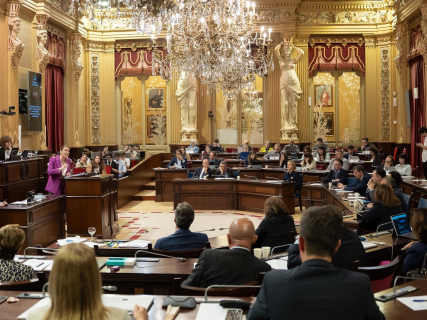

The Parliament of the Balearic Islands will hold this Tuesday an intense parliamentary day with a double plenary in which, on one hand, the approval of the capital law of Palma and the reform of the own civil law to allow inheritances in life between spouses will be addressed and, on the other hand, the proposals for resolutions arising from the recent General Policy Debate will be voted on.
In practice, there will be two plenaries that will take place continuously. The ordinary session will start at 09:00 hours and is expected to last, at least, until 14:30 hours. Next, without interruption, an extraordinary plenary will begin which, if the forecasts are met, could extend for about two hours.
One of the central points of the ordinary plenary will be the debate on the capital law, approved by the City Council of Palma at the end of last year and which months later was admitted for processing by the Parliament with the support of the PP, the PSIB, and Vox.
Only the formation of Santiago Abascal has advanced that it will change its voting position --by showing its rejection of the incorporation of amendments on other issues during the processing-- although the support of 'popular' and socialists would be enough to push the norm forward.
In the same session, the plenary will decide whether to process by single reading the bill that modifies the matrimonial economic regime, approved two weeks ago unanimously. If this accelerated procedure is chosen, the deputies will immediately vote on the reform of the Balearic civil law which, in general terms, allows inheritances in life between spouses.
In addition to these two regulatory projects, the agenda includes the debate of two motions, one related to climate policies and another on agricultural law, as well as an interpellation on public housing policies, all presented by the socialist group.
As is customary, the session will begin with the control turn to the Govern. The councilors must respond to questions about housing, health, environmental protection, and tourism, among other matters.
Questions will also be raised about current issues, such as the irregularities reported in two large poultry farms in Manacor, the controversy over the possible removal of the statue of Christ the King of Sant Salvador de Felanitx, or the leak of personal data of a woman evicted by a vulture fund in Palma.
The president of the Govern, Marga Prohens, will have to answer questions related to the defense of tenants (Unidas Podemos), measures for those who cannot rent or buy housing (MÉS per Mallorca), the priorities of the spending ceiling for 2027 (Vox), and the "given word" (PSIB).
162 proposals after the General Policy Debate
Once the first part of the plenary session is concluded, the Chamber will focus on the debate of the 162 resolution proposals derived from the General Policy Debate held last week.
The PP, as the majority group, is the one that has presented the most initiatives, 60, followed by the PSIB (46), Vox (20), MÉS per Mallorca (18), Més per Menorca (9), Unidas Podemos (5), and the deputy from Formentera, Llorenç Córdoba (4).
The proposals from the PP, in line with the rest of the legislature, seek to endorse the management of the Govern and its president, the 'popular' Marga Prohens. Among other aspects, they emphasize the response to emergencies due to extreme weather phenomena, their fiscal policy "aimed at reducing the tax burden on families and middle and low incomes," aid to the sectors most affected by the war in the Middle East, and measures in education, health, dependency, and housing.
Likewise, they support several of the measures announced by Prohens in the General Policy Debate, such as allocating part of the sustainable tourism tax (ITS) to housing policies, increasing train frequencies and schedules, or expanding tax deductions for young people buying their first home.
Among the initiatives of the PSIB, the one that urges the plenary to admit the popular legislative initiative (ILP) that proposes a supplement for pensioners earning below the minimum interprofessional wage (SMI) stands out.
In the field of housing, the socialists will again defend the declaration of the Balearic Islands as a tense residential market area so that municipalities can set limits on rental prices. They will also demand the "immediate" construction of social housing, the use of the right of first refusal and retraction, and the temporary expropriation of the use of apartments from large holders to "quickly expand" the public housing stock.
Among the 20 proposals from Vox are the 100% bonus on the tax on property transfers and documented legal acts in the purchase of the first habitual residence or the elimination of VAT for new housing. The party also proposes extending the regional deduction for rent to all tenants with at least five years of legal residence in the Balearic Islands and specifically limiting and taxing the acquisition of housing that will not be a habitual residence by non-residents in the European Union, measures that fit into their idea of 'national priority'.
MÉS per Mallorca, with a proposal drafted by Mallorca Nova, insists on restricting the purchase of housing to non-residents in the Islands and on the temporary expropriation of the use of properties from large owners. In tourism matters, the ecosovereignists demand a ten-year plan to reduce annual visitors to 13 million and allocate 120 million euros a year from the ITS to diversify the economy, in addition to opposing the expansion of capacity at the airports of the archipelago planned by Aena.
These contributions are joined by those from Més per Menorca, such as implementing a system that prioritizes residents in access to housing; those from Unidas Podemos, who propose distributing the unaccompanied minor migrants under guardianship evenly among the four islands; and those from deputy Llorenç Córdoba, who demands compensation for the extra costs arising from the triple insularity of Formentera.