
The Balearic Parliament, backed by the majority formed by PP and Vox, has rejected the full amendment registered by the PSIB against the coastal planning, protection and management bill that is currently being processed.
The socialist proposal sought for the text to return to the Govern, considering that "it does not respond to the needs that the social reality of the Balearic Islands demands of a law that should be a cornerstone for ecological development" and instead "to particular interests".
According to the PSIB, the structure of the rule "favors the commercialization of the coastline, normalizes commercial services, consolidates occupations, speeds up the removal of posidonia without justification, reduces prior controls, and allows partial plans or those promoted by private parties to displace the insular territorial plans" and, in addition, "excludes ports, postpones without deadlines the transfers to the consells, fragments the protection easement according to land classification, assigns powers to municipalities without checking their capacity, and creates instruments for purchase, restoration and renaturalization without ensuring funding".
For the socialists, the "major environmental statements" included in the law "ultimately serve only as window dressing and remain as statements without operational or executive force," while introducing "open concepts that produce exceptional regimes and procedures that favor private exploitation and the continuation of uses on the coast, including those contrary to state law".
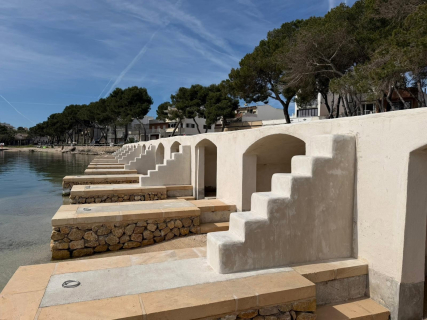
The bill was approved by the Consell de Govern on June 25 and, as detailed by the president, Marga Prohens, and the Minister of the Sea and the Water Cycle, Juan Manuel Lafuente, it incorporates as its main pillars the preservation of traditional seafaring constructions --the 'escars' and the 'casetes de vorera'--, the limitation of vessel speed, and the simplification of certain administrative procedures.
The left's opposition to the rule
PSIB deputy Mercedes Garrido, who has defended the full amendment, has begun her intervention by asserting that the Balearic Islands "deserves" to have its own coastal law, although she has stressed that "but we cannot allow this law" before going on to outline a "list of absurdities" that, she has warned, is not "exhaustive".
Garrido has censured the fact that the rule “invents an instrument to legalize constructions and prohibited or inappropriate uses on the coast under the excuse of registering with the coastal heritage registry,” a formula that, he has recalled, the Constitutional Court has already rejected in the Valencian Community. He has also warned about the creation of “uses that do not exist until now,” such as the installation of “beach bars, hammocks or umbrellas” on beaches of special protection, the expansion of concessions up to 10%, or the “threat” regarding es Trenc.
Along these lines, he has accused the PP of deceiving the public: “It’s a new lie and deception by the PP, which promises protection and limits on overcrowding but does everything the opposite. When you read the small print you see that it has been exceeded; we are dealing with a Prohens of predation and lack of protection of the territory. The groundwork is laid to have more pressure and more business.”
From MÉS per Mallorca, the deputy Ferran Rosa has regretted that the text “does not guarantee that the use of the coast responds to the general interests” nor does it address what he considers the main challenges facing the coast. “Regarding the erosion of the coast and the rise in sea level, you don’t foresee anything. And to regulate economic activities and guarantee residents’ access to the sea, also nothing. It’s a law that completely overlooks these two major challenges; I suppose because it has other purposes,” he said.
The eco-sovereigntist has reproached the councillor Juan Manuel Lafuente that, in the initial drafting phase, he did not heed his request to agree on measures to ensure the continued existence of the coastline. “Beyond the fact that they are completely shortsighted about the problems we have as a society, it seems to me that they are laughing at all of us. They are dismantling the land-use planning,” he denounced.
The spokesperson for Més per Menorca, Josep Castells, has warned that, if the law goes through, the Balearic Islands "lose the opportunity to exercise their power to regulate the coast and decide for the first time what coastal model it wants." In his view, there is "a fundamental reason" that explains his rejection: "the tension between uses and limits, between what can be done and with what intensity it can be done." "What do we do when there are more people, more boats and more business on the beaches? How do we manage it? That is the situation you would have to solve. But in the face of these questions, the law is silent. And we are not talking about a future risk, because pressure on the coast is bread and butter," he warned.
PP and Vox close ranks with the coastal law
From Vox, deputy Patricia de las Heras has defended the advisability for the Community to have its own regulations in order not to be "at the mercy" of the decisions of the Executive of Pedro Sánchez, whom she has accused of expropriating properties on the frontline of the sea. "Against that model, Vox is very clear. The coasts and beaches form part of Spain's natural wealth and their protection must be compatible with economic activities. Protect the coast, yes, but with people inside," she said.
De las Heras insisted on defending traditional constructions and on the importance that boundaries are determined with technical criteria rather than "at the whim of La Moncloa."
The PP deputy Sebastià Mesquida reproached the PSIB for proposing a total amendment against a law that, he said, "responds to the need for Balearic Islands to have its own coastal law" and "is shaped by the opportunity to exercise our powers." He stressed that the text was born "with the firm will to comply with what the president promised before starting her term" and with "a clear will to give prominence to the local entities affected in matters of coast management."
In response to the PSIB's warnings about a possible unconstitutionality, Mesquida has issued a "message of reassurance" by understanding that the project is more similar to that of Galicia, where the Constitutional Court dismissed all the appeals, than to that of the Valencian Community.