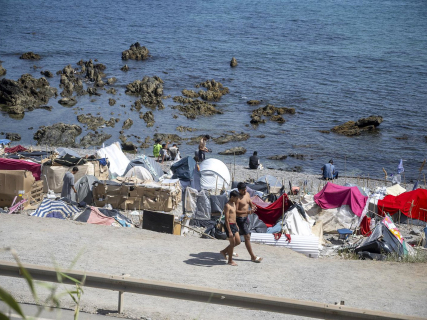

Two testimonies collected after the eviction of Benítez beach, in Ceuta, have raised questions about how some of the returns that the Government counts as voluntary are taking place. Two Moroccan citizens, identified by the fictitious names of Youssef and Samir to preserve their identity, claim that last Tuesday they were taken by the Police to the vicinity of Tarajal and subsequently sent to Morocco without having expressed their willingness to return. The Interior denies that a forced return took place and maintains that those affected had the option to continue with the police procedure or return voluntarily.
The episode occurs amid the management of the migratory crisis triggered by the massive entries at the end of July. According to the latest official balance available, by September 29, 8,243 people had returned to Morocco since August 10: 7,794 through returns considered voluntary and 449 through expulsions. On that same day, the Government also counted 3,220 triages conducted on adults and stated that between 25% and 30% of those who go through that procedure decide not to apply for international protection.
"They didn't ask me if I wanted to go back"
Youssef, 22 years old, recounts that on Tuesday he was awakened around 7:30 a.m. during the police operation to dismantle the Benítez beach settlement. According to his account, an interpreter initially explained to them that they would be taken to a camp for their registration, so he believed he was going to be transferred to one of the resources set up by the Government. Later, he claims, they were put into police buses and taken to the border area.
The young man asserts that they did not ask for his name, did not take his fingerprints, and he also did not sign any documentation before the Spanish authorities. His testimony states that an interpreter informed them that there was a decision to remove from Ceuta those who remained in that area and that they were subsequently handed over to the Moroccan authorities. "They didn't ask me if I wanted to go back to Morocco," he states in his account.
Samir, 25 years old, offers a similar version. He explains that before the transfer he had spoken with Youssef about the possibility of requesting international protection and seeking legal assistance, but he assures that upon arriving at the border crossing environment he did not receive detailed questions about his circumstances nor did he go through the identification procedure he expected. According to his account, it was then that an interpreter informed them that they were going to be returned to Morocco. The two young men offer their testimonies already from Moroccan territory.
What happened next in Morocco
Both also describe a second episode once they crossed the border, although these claims correspond exclusively to their testimonies and have not been independently verified. Youssef claims that the Moroccan authorities took their belongings and made them put their fingerprint on a document whose content they initially did not know. He states that they were then transported for hours by bus to Fquih Ben Salah, in the center of the country, hundreds of kilometers from Ceuta.
Samir also claims that he lost some of his belongings before being taken far from the border and that he had to return to his home later by his own means. The accounts coincide with complaints made by other Moroccan citizens about the treatment received once they return to their country, although those accusations refer to the actions of the Moroccan authorities and must be distinguished from the procedure followed previously by Spain.
Interior: "By own will"
The Ministry of the Interior offers a different version. Sources from the department maintain that during the operation on Tuesday "no one was taken from the beach directly to the border" and that the people who returned to Morocco did so "by their own will." The objective of the operation, according to this explanation, was to transfer those who remained on Benítez beach to the Temporary Attention Center for Foreigners (CATE), carry out the corresponding police actions there, and subsequently take them to the resource enabled in Loma Colmenar.
The buses stopped before entering the premises, in an area of the Tarajal industrial estate located very close to the border crossing. There, people were getting off in small groups and receiving information about the next steps. According to the version gathered by El País from different sources, they were presented with the option to continue with the registration and administrative procedure or to voluntarily return to Morocco, an option chosen by numerous migrants. More than 400 people left Ceuta by that route that Tuesday, one of the highest daily figures recorded since August.
The official version of the procedure coincides with the explanation that the Government had publicly given days before. The Minister of Territorial Policy and responsible for coordinating the crisis, Ángel Víctor Torres, stated that the triage includes fingerprinting, the assistance of a translator, identification, and a final question about whether the person wants to apply for international protection. "That is mandatory," he explained after the Council of Ministers on September 22.
Morocco is a "safe country," but that does not eliminate the right to seek asylum
One of the elements that the Interior communicates to Moroccan citizens is that their chances of receiving international protection are low. Since June, Morocco is on the common list of safe countries of origin of the European Union, along with Bangladesh, Colombia, Egypt, India, Kosovo, and Tunisia. This designation allows applications submitted by citizens of those countries to be examined through expedited procedures.
However, being on that list does not imply an automatic denial of asylum. Authorities still have to examine the individual circumstances of the applicant and determine if there are specific grounds for persecution or serious risk. The EU Asylum Agency itself emphasizes that the designation of a safe country allows for expedited processing but maintains the individual assessment of each application.
For that reason, the discrepancy between the testimonies and the Government's version is relevant. If the young people really had the option to initiate the procedure and decided to return, their departure would fit the category of voluntary return used by the Executive. If, as they claim, they were not identified or informed of the possibility of requesting protection and were simply told that they would be returned, the procedure described would be different from the protocol that the Government itself claims to be applying.
An eviction that had already raised doubts about "voluntariness"
The doubts do not begin solely with these two testimonies. During the dismantling of the beach settlements of Benítez, several media witnessed how migrants were forcibly transported by bus from the beach and, once near the CATE, they were offered to return to Morocco or enter the affiliation procedure. An agent cited by El País then described one of those returns as voluntary in formal terms, although he considered that the circumstances exerted strong pressure on the decision.
The Unified Police Union (SUP) has also separately questioned the overall figures of voluntary returns provided by the Government and claims that the agents count fewer departures than those officially announced. Interior and the Executive maintain their statistics, and the Council of Ministers placed the last consolidated count at 7,794 voluntary returns until September 29.
Two opposing versions and without a judicial conclusion
The testimonies of Youssef and Samir do not in themselves constitute judicial evidence that forced returns are being carried out under the label of voluntary returns, but they do raise a concrete contradiction with the official version. Both assert that they never chose to return; Interior maintains that all the people who crossed the border during that operation did so voluntarily after knowing their alternatives.
For now, there is no judicial resolution that has determined what happened in these two specific cases. The central issue will be to clarify whether before crossing the Tarajal both young people really had access to the identification procedure and the effective possibility of requesting international protection. It is there that the difference between the two versions lies: for Interior there was a choice; for those affected, the decision had already been made.