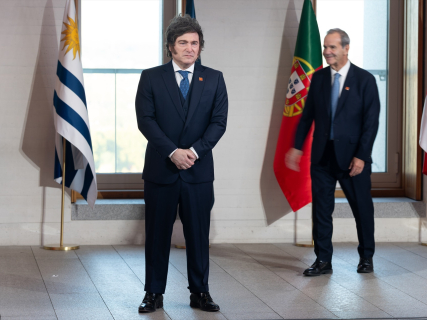
Argentine press sees Milei's trip to Spain as a failure for not achieving his goal: a photo with Felipe VI

The head of Argentina’s Executive branch ended up without his longed-for bilateral meeting with the King, an encounter he has been asking for for some time and which the Royal Household denies him, which the media interpret as a diplomatic setback

EuropaPress 7892576 presidente republica argentina javier milei xxx cumbre iberoamericana jefes

EuropaPress 7892576 presidente republica argentina javier milei xxx cumbre iberoamericana jefes

Add DEMÓCRATA to Google

Ask FREN

Published

3 minutes

Most read

Elecciones 29N · Encuestas

La media de las encuestas

Media a 6 de noviembre de 2026 · 13 institutos

  • PP30,9 %
  • PSOE26,2 %
  • Vox19,5 %
  • Frente Amplio6,6 %
  • ERC2,5 %
  • SALF2,3 %
  • Podemos2,2 %
01020304050ene 2024jul 2024ene 2025jul 2025ene 2026jul 2026

Media del último estudio de cada instituto en 30 días y su evolución semanal desde el 23J. Partidos con al menos un 2 %.

Todas las encuestas

Elecciones generales del 29 de noviembre · Demócrata

The journey of Javier Milei to Spain ended without the image that the Argentine president had been seeking for some time: a bilateral meeting with Felipe VI at the Palacio de la Zarzuela. The absence of that meeting has shaped the assessment of his visit to Madrid and has led several Argentine media outlets to interpret his trip through the Spanish capital as a diplomatic setback, despite his participation in the XXX Ibero-American Summit of Heads of State and Government.

The Argentine press has focused on the impossibility of Milei being received alone by the monarch. The newspaper Clarín emphasized that the Argentine president had been looking for that photograph for some time. For its part, La Nación explained that the Casa Real had conveyed a condition in order to make the meeting possible: he also had to meet with Pedro Sánchez, a possibility that the Argentine leader had publicly ruled out.

The issue was not minor for Milei. This was his eighth visit to Spain and the first one linked to an institutional appointment of a multilateral nature. In his previous trips, the president had mainly attended political events, conferences, and meetings with representatives of Vox, without an official meeting taking place with the head of the Spanish State.

The condition of the Casa Real and Sánchez’s role

The explanation for the breakdown in relations lies in Spanish institutional protocol. According to what La Nación published on October 21, the Casa Real reminded the Argentine government that the usual practice in visits by heads of State to Spain is that the meeting with Felipe VI is accompanied by a meeting with the president of the Government. The information suggested that Milei had informally expressed his interest in meeting the monarch, but was not willing to hold a meeting with Sánchez.

Milei had informally expressed his interest in meeting the monarch, but was not willing to hold a meeting with Sánchez

The relationship between the two presidents is going through one of its most tense moments since 2024, when Milei accused Begoña Gómez of corruption, the executive leader’s wife, during a Vox event in Madrid. The diplomatic crisis then led Spain to temporarily withdraw its ambassador in Buenos Aires. Since then, the Argentine leader’s verbal attacks against Sánchez have been repeated in different settings.

Milei himself again took aim at the Spanish president during his speech at the Nueva Economía Fórum, held in Madrid on October 21. There he described him as "impresentable dictator" and of "corrupt", while also calling for the socialists to be removed from power in the general elections. Statements that highlighted the political distance between the two and made any gesture of institutional rapprochement difficult.

Clarín, however, introduces a nuance about the role of the Spanish Government in the absence of the meeting. The newspaper asked sources from Moncloa whether Sánchez had vetoed the meeting between Milei and Felipe VI. The answer was that it was not known that the Executive had intervened to prevent it, although they acknowledged that the agenda of the Royal House with foreign leaders is usually agreed with the Government and that meetings not initially scheduled may arise.

Therefore, there is no confirmation that Sánchez personally blocked the audience. What the information does reflect is that the usual protocol placed the meeting with the head of Government as a condition to facilitate the meeting with the king—something that Milei was not willing to accept.

A cold greeting with Sánchez and a lackluster showing

The absence of the photograph with Felipe VI was not the only element that marked the visit. Milei's participation in the Ibero-American Summit was also surrounded by gestures of distance. The Argentine president finally coincided with Sánchez and both greeted each other in the sight of the monarch, in a scene that Página/12 described as a cold encounter, in which he presented the Argentine leader as isolated.

The Argentine newspaper titled its chronicle of November 6 Milei showed himself isolated and could not avoid Sánchez and described his participation in the summit as "lackluster". According to its reading, the president returned without managing to meet the king and with limited support among the leaders present: the newspaper highlighted that only the far-right leaders approached him to greet him, although without any great signs of closeness.

Felipe VI’s agenda during the summit did include meetings with other heads of state. The monarch received at the Royal Palace the presidents of Chile, José Antonio Kast; Honduras, Nasry Asfura; Guatemala, Bernardo Arévalo, and the president of Costa Rica, Laura Fernández Delgado. He also held a meeting with the Ukrainian president, Volodímir Zelenski, after his participation in the plenary session.

For his part, Milei did not attend the opening act of the summit at the Teatro Real nor the gala dinner offered by the kings to the participating heads of government and representatives. The Argentine foreign minister, Pablo Quirno, denied that those absences were a retaliation for the meeting with Felipe VI not having been carried out.

More key points, information and questions with FREN

AI-GENERATED CONTENT

What are the next steps in the diplomatic process between Argentina and Spain following this disagreement between Milei and Felipe VI?

The next step is not an automatic audience with Felipe VI, but rather to restore dialogue between the two governments. As of November 6, the sources consulted do not announce a schedule of meetings or a normalization agreement following the summit. It is important to distinguish between confirmed facts and possible diplomatic channels: there is political distancing, but no record of a rupture in relations.

What really happened

The disagreement should not be understood as a personal confrontation between Milei and the king. According to Demócrata's information, which gathers explanations from the Argentine press, the Royal House conveyed that the usual practice was to accompany a meeting with Felipe VI with another with Pedro Sánchez. Milei was not willing to accept that second meeting. It is not confirmed, however, that Sánchez personally vetoed the audience.

Milei also did not attend the inauguration or the gala dinner. The Argentine foreign minister, Pablo Quirno, denied that these absences were retaliation for not securing the meeting. Furthermore, on November 5 there was indeed a handshake with Sánchez, in front of Felipe VI. It was a protocol greeting, not a bilateral meeting or a reconciliation announcement.

Open channels
  • Contacts between Foreign Ministries and embassies. A call, a ministerial meeting, or conversations between delegations could address the disagreement without immediately requiring a presidential photo opportunity. This is a possible de-escalation path, not an already announced appointment. Its usefulness would be to agree on stable dialogue and avoid each visit turning into a conflict again.
  • Negotiating a future comprehensive institutional agenda. Argentina can request an audience with the king again. The identified obstacle is political and protocol-related: according to published information, Madrid links that meeting to dialogue also with the President of the Government. A greeting during a summit does not equate to accepting that agenda.
  • Preserving practical cooperation. Economic, consular, cultural, and technical contacts offer areas to maintain the relationship while political differences persist. The summit concluded with agreements on artificial intelligence, disaster prevention, and academic mobility, according to the report published by Demócrata. This maintains a multilateral framework, although it does not demonstrate bilateral normalization.
What could hinder rapprochement

The continuation of personal attacks would hinder any progress. There is a specific precedent: on May 19, 2024, Albares announced the calling back of the ambassador and demanded public apologies. Afterwards, the Spanish representative was withdrawn, but Spain appointed a new ambassador in October of that year without a public apology from Milei, as recalled by this reconstruction of the background. Therefore, that withdrawal does not describe the current situation.

A new formal protest or a call to consultations would be escalation options, but none are announced for this episode. There is also no basis to present diplomatic expulsions, sanctions, or a general suspension of cooperation as decided steps.

In short, relevant signals will be a confirmed meeting between Foreign Affairs officials, a joint statement, or a new visit with an agreed agenda. Until these appear, prudence suggests speaking of managing distancing, not of an already agreed reconciliation process. The central question remains whether both governments accept maintaining an institutional relationship despite their differences.

What powers does the Spanish Prime Minister have in organizing official meetings with foreign heads of state?

The Spanish Prime Minister can promote, arrange, and lead official meetings with foreign heads of state as part of the governmental direction of foreign policy. This capacity does not displace the institutional representation of the King nor does it turn each encounter into an act requiring parliamentary authorization. The fundamental distinction is between holding a meeting, organizing a visit involving various institutions, and adopting international legal commitments.

Political direction of meetings

The competence to promote these meetings falls within the direction of foreign policy that corresponds to the Government. The Constitutional Court has explained that it includes a function of direction and execution: defining the strategy, positioning, and international action of the State. Therefore, it is not limited to managing already established diplomatic relations but allows promoting political contacts to defend Spain's interests (STC 135/2020).

Within this framework, the Prime Minister can initiate a meeting, set its political objectives, and guide the issues he wishes to address. However, arranging a meeting requires agreement with the foreign interlocutor: the Spanish authority to propose it does not allow unilaterally imposing its holding, date, or conditions.

Institutional organization and coordination

It is important to distinguish the political decision to meet from its diplomatic and material preparation. The former responds to foreign policy objectives; the latter must serve those objectives through coordinated action. The principle of unity of external action requires avoiding fragmented or contradictory actions and allows the Government to order activities with international projection (STC 85/2016).

This offers room to propose the agenda, format, and conditions of the meeting but does not constitute unlimited power over all acts of a visit. If other institutions participate, their actions must be coordinated respecting their respective functions. A political meeting of the Prime Minister should also not be confused with the entire ceremonial of a state visit.

The Ministry of Foreign Affairs plays a role in this diplomatic coherence. Jurisprudence highlights its guidelines as a reference to maintain unity of action, even regarding the international activity of the Chambers (STC 137/2021).

Relationship with the King and the Cortes

The governmental direction of foreign policy and the institutional representation of the Head of State are distinct levels. Therefore, meeting with a foreign president or monarch does not, by itself, mean assuming the King's functions. Nor does it allow deducing that the Prime Minister can unilaterally decide the Crown's participation in any official program.

The Cortes do not ordinarily organize these meetings nor is there a specific authorization in the Congress Rules for each meeting. Their relevant function is political control: requesting information and documentation, posing questions and interpellations, and promoting appearances. These instruments are included in the Congress Rules.

Limits and effects of what is agreed

A meeting does not replace the necessary procedures to legally bind Spain. When its results are embodied in treaties requiring authorization from the Cortes, that procedure must be followed: the meeting does not avoid it.

Moreover, foreign action is subject to parliamentary responsibility and control, even when the Government is acting in a caretaker capacity, as recalled by STC 124/2018. In sum, the Prime Minister has political initiative to organize meetings but must respect institutional competences and applicable requirements for their results.

What has been Javier Milei's political trajectory before becoming president of Argentina?

Javier Milei's political trajectory before becoming President was brief in public office but preceded by intense media exposure. He went from working as an economist and television commentator to joining party activity in 2019, becoming a national deputy in 2021, and winning the 2023 presidential elections. Before his presidential election, he had not held government responsibilities.

From economist to public figure

His starting point was not militancy in Argentina's major parties but economics. He worked in the private sector and as an advisor, with activities at HSBC Argentina, Máxima AFJP, Corporación América, and Estudio Broda. He was also a university professor and directed the Fundación Acordar. This stage provided him with the professional profile with which he later entered public debate, according to Britannica and Infobae.

His notoriety increased from the mid-2010s thanks to television. His appearances on Animales Sueltos, since 2016, helped popularize his confrontational style, his criticisms of public spending, and his rejection of what he called the "political caste." Television and social media allowed him to gather followers, especially young people, before having his own electoral structure. This is reconstructed by La Voz and BBC Mundo.

Entry into party politics

In 2019 he announced his adhesion to the Libertarian Party, a step that marked his formal incorporation into party activity. His discourse identified with libertarian and anarcho-capitalist positions: he deeply questioned state intervention and advocated reducing the size of the State.

During 2020 he intensified his opposition to Alberto Fernández's Government, especially regarding measures adopted during the pandemic. That year he communicated his intention to compete for a national deputy seat for the Autonomous City of Buenos Aires. The transition from commentator to candidate thus occurred before the 2021 legislative elections, as reported by CNN en Español.

La Libertad Avanza and his first office

For the 2021 legislative elections, he formed the coalition La Libertad Avanza. His list obtained approximately 17% of the votes in Buenos Aires City and secured two seats: one for Milei and another for Victoria Villarruel, who later became his presidential running mate.

Milei assumed office as national deputy on December 10, 2021. It was his first public office, which he held until 2023, according to Perfil. In Congress, he maintained an opposition profile and reinforced his denunciation of political privileges through the public lottery of his parliamentary remuneration, a practice analyzed in this academic study.

The leap to the presidential candidacy

Since 2022 he expressed his intention to run for the Presidency and formalized his candidacy in 2023. His campaign combined drastic public spending cuts, elimination of fiscal deficit, dollarization, and privatization or reform of state companies and agencies. He also directed his criticisms at both Peronism and Juntos por el Cambio.

In the primaries on August 13, 2023, he obtained nearly 30% and was the most voted individual candidate. He came second, behind Sergio Massa, in the first round on October 22 and won the runoff on November 19. His rise thus combined media exposure, electoral organization, and barely two years of parliamentary experience.

Play

Test your knowledge with FREN!

How much do you know about this topic? Answer the following 3 questions.

What was the main reason why the bilateral meeting between Javier Milei and King Felipe VI did not take place?

Question 1 of 3

How did the Argentine press describe Milei's participation in the XXX Ibero-American Summit?

Question 2 of 3

What did the usual protocol require for a foreign head of state to meet with King Felipe VI in Spain?

Question 3 of 3