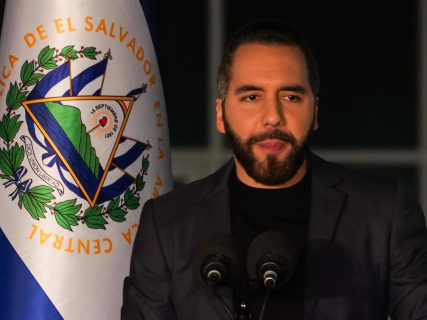

The president of El Salvador, Nayib Bukele, has rejected that the human remains delivered by a non-governmental organization (NGO) correspond to the four Salvadoran soldiers missing and kidnapped by criminal gangs in Haiti last Sunday.
"They are not our men," Bukele has pointed out on his social media, explaining that an NGO brought them human remains at the airport that do not correspond with the four Salvadoran aerotechnicians captured in Haitian territory.
The head of the Salvadoran State has detailed that the "remains correspond to a child, to a man of a considerably greater height than that of our military, and to a person wearing a uniform of an army from another country," thus denying the information from various media that suggested they could be the mentioned military personnel.
In this way, he has insisted that they are not "his soldiers," since among the remains "identification cards and military uniforms from other countries were also found."
Bukele ordered on Thursday a "military operation to rescue them," emphasizing that the four hostages are aviation technicians responsible for medical evacuation tasks within the international mission. He has reiterated that his purpose is for the "four compatriots to return home alive, without any harm."
In this line, on Friday a detachment of the Army of El Salvador landed in Haiti to reinforce the search efforts for the four military personnel. Although the authorities have not disclosed the official number of troops, several local media have reported that it would be about 450 military personnel deployed in the Caribbean country.
The kidnapping took place in the context of an ambush recorded last Sunday against a vehicle of the Gang Suppression Force (GSF, for its acronym in English) in the Santo area, in the metropolitan area of Croix-des-Bouquets, near the capital, Port-au-Prince. Since then, the GSF has carried out tracking operations with air support that have so far left "several" alleged gang members dead and four international personnel injured.
The case highlights the increase in violence in Haiti. The highest representative of the United Nations in the country, Carlos Ruiz Massieu, recently warned before the UN Security Council about the "ability of gangs to adapt their tactics as security operations intensify," increasingly resorting to kidnappings and hostage-taking.
Currently, the GSF has just over 1,500 members deployed, a figure much lower than the 5,550 agents authorized by the United Nations.