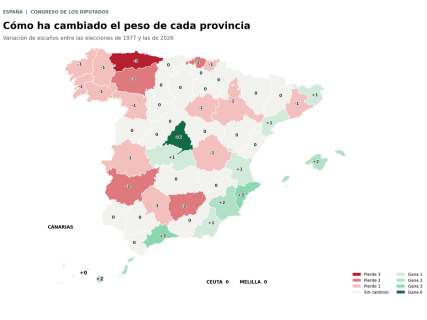
The Spain that will go to the polls on November 29 is demographically very different from the one that voted in the first democratic elections of 1977. Back then, Barcelona was the province with the most deputies, ahead of Madrid, and the northwestern peninsula —Galicia, Asturias, or Castilla y León— had a parliamentary weight much higher than the current one. Almost half a century later, the concentration of population in large urban areas and in certain coastal zones has modified the distribution of the 350 seats in Congress.
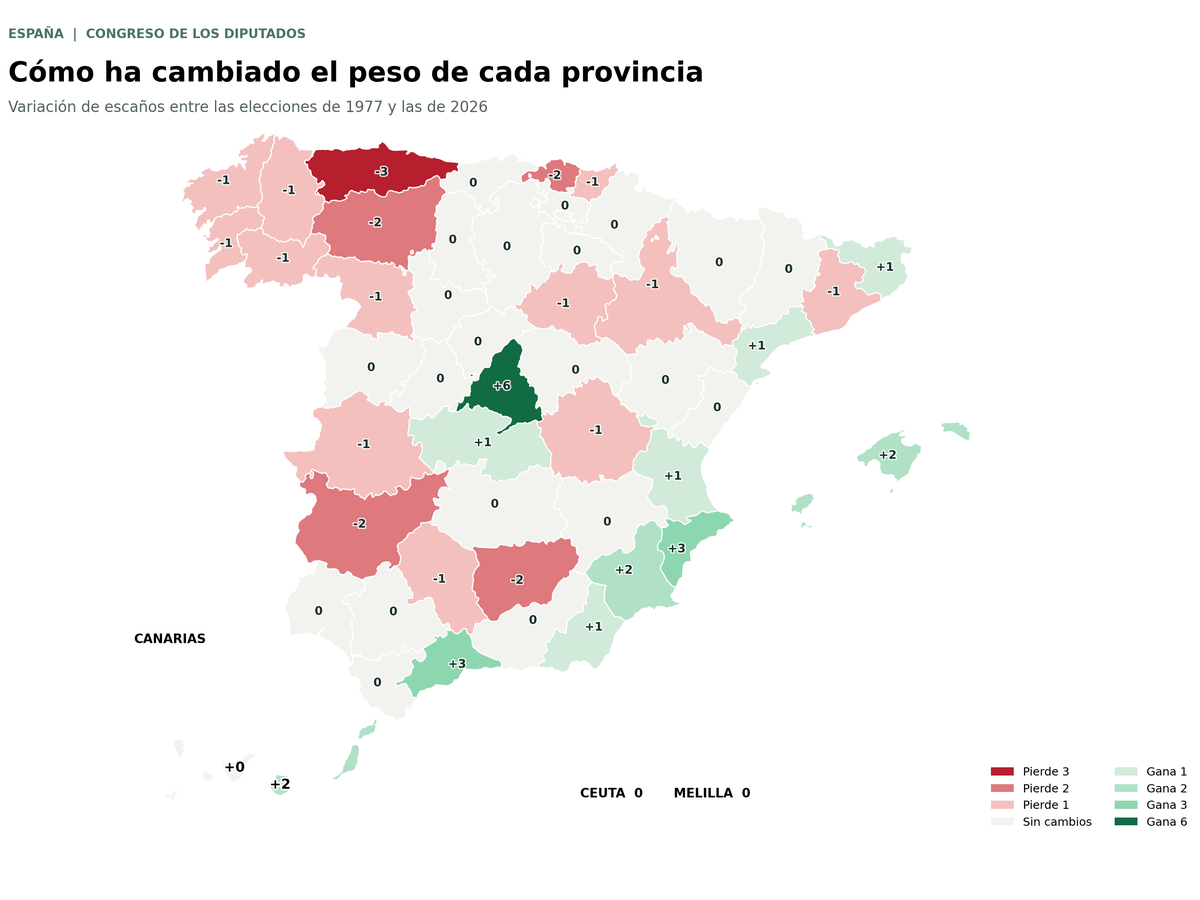
If there is one province that accounts for this profound demographic transformation, it is Madrid, which has gone from the 32 deputies it elected in 1977 to the 38 that will correspond to it in 2026, while Barcelona, which then led the provincial representation in Congress, has lost one, from 33 to 32. The inversion of the balance between both constituencies, which reflects their different growth rates compared to the rest of Spain, is part of a deeper demographic shift, also noticeable in the Mediterranean façade and the archipelagos, which have gained parliamentary weight against much of the northwest and the interior of the peninsula.
A Congress of 350 deputies for a different population
In Spain, although deputies represent the entire citizenry, their election is organized by provinces, with a minimum allocation of seats designed during the Transition to benefit less populated constituencies. This principle of minimum representation was introduced for the first time in the Law for Political Reform, the 50th anniversary of which will soon be celebrated, and was subsequently incorporated into the Constitution of 1978, although the specific procedure for distributing the remaining representatives changed with the approval of the Organic Law of the General Electoral Regime (LOREG).
The current legal and constitutional framework reserves two deputies for each of the 50 provinces and one for Ceuta and Melilla, so that 102 of the 350 seats are assigned regardless of the population of each constituency. The other 248 are distributed proportionally among the provinces according to their legal inhabitants, using the official population figures applicable to each electoral call.
To calculate that distribution, the joint population of the 50 provinces is divided by 248, which allows obtaining a quota of inhabitants per seat. Each constituency is first assigned the whole number of representatives that results from dividing its population by that quota and, if there are still deputies to be allocated, these are assigned to the provinces with the largest decimal remainders.
This explains why the growth of a province does not necessarily imply that it gains representation, nor does a reduction of seats necessarily mean that it has lost inhabitants. What is decisive is how its population evolves in comparison to that of the rest of the provinces, as all compete for a limited number of additional deputies, while the territorial minimum remains protected.
In 1977, the distribution was carried out according to the rules of Royal Decree-Law 20/1977, which also established an initial allocation of two deputies per province, but used a fixed quota of inhabitants and a rounding rule to allocate the remaining ones. Therefore, the comparison between the distribution of seats in both years allows observing the evolution of the relative population weight of each territory in the whole country.
Madrid and the Mediterranean concentrate the gains
The demographic expansion of Madrid has been linked to the growth of its metropolitan area, which over the last few decades has extended its influence far beyond the capital. The population movements from other autonomous communities have been joined by international immigration, which has contributed to consolidating its position as one of the main demographic attraction poles in the country.
The transformation has also been particularly intense on the Mediterranean coast, where Alicante has gone from nine to twelve deputies and Málaga from eight to eleven, as a consequence of the expansion of its urban areas and the development of tourist and residential municipalities that have attracted new inhabitants. This growth is joined by Murcia and the Balearic Islands, with two additional representatives each, while Valencia, Almería, Girona, and Tarragona have also increased their presence in Congress.
In the archipelagos, Canarias has gained two seats since 1977, both corresponding to Las Palmas, while Santa Cruz de Tenerife retains the seven deputies it had then, a distribution that allows us to appreciate how population growth can modify territorial balance even within the same community.
The northwest loses weight in Congress
On the other hand, the aging of the population, emigration, and the lower capacity to attract new residents have marked the demographic evolution of a good part of the northwestern peninsula, whose representation has decreased compared to the first democratic elections.
Galicia has gone from 27 to 23 deputies, with a loss of one representative in each of its four provinces, although the intensity and characteristics of the population changes have been different between the interior territories and those of the Atlantic axis.
Castilla y León has also ceded four seats, going from 35 to 31, in a community where the depopulation of numerous rural municipalities has coexisted with the concentration of inhabitants in the provincial capitals and their surroundings. The reduction has been especially significant in León, which has lost two deputies, while Zamora and Soria have each ceded one, an evolution that is a faithful reflection of the emptying of interior Spain.
The loss of representation extends to other territories in the northern half, such as Asturias, which has gone from ten to seven deputies, and the Basque Country, which has gone from 21 to 18, while Extremadura has also reduced its parliamentary delegation by three representatives.
Overall, the regions of the western and northwestern peninsula lose 13 seats, a symptom of the decline that this area of the peninsula has experienced after industrial reconversion. This is exactly the same number of seats that the provinces of the Mediterranean coast have gained, reflecting the change in demographic balances that Spain has experienced in these fifty years.
The minimum representation cushions the effect of depopulation
Throughout this time, the minimum of two deputies per constituency has acted as a territorial protection mechanism that has allowed the preservation of seats even when the proportion of inhabitants that a province represents within the whole of Spain has decreased.
The most evident case is that of Soria, which has gone from three deputies in 1977 to the two that will be elected on November 29. Although its relative demographic weight may continue to decrease, the province cannot lose more representation while the current electoral system remains in force, since it has already reached the minimum guaranteed by legislation.
This protection also means that constituencies with smaller populations have a proportion of representatives higher than what they would correspond to in a strictly proportional distribution, while the more populated provinces need to gather many more inhabitants to obtain each seat.
Half a century of changes in the autonomous map
Although the seats are assigned individually to each province, comparing their distribution by autonomous communities allows us to appreciate the magnitude of the demographic transformations experienced since the beginning of democracy. To carry this out, it is necessary to group the constituencies of 1977 according to the current autonomous boundaries, since that territorial organization did not yet exist when the first elections were held.
| Autonomous community | 1977 | 2026 | Variation |
|---|---|---|---|
| Community of Madrid | 32 | 38 | +6 |
| Valencian Community | 29 | 33 | +4 |
| Balearic Islands | 6 | 8 | +2 |
| Canary Islands | 13 | 15 | +2 |
| Region of Murcia | 8 | 10 | +2 |
| Andalusia | 59 | 60 | +1 |
| Catalonia | 47 | 48 | +1 |
| Castilla-La Mancha | 21 | 21 | 0 |
| Cantabria | 5 | 5 | 0 |
| Navarre | 5 | 5 | 0 |
| La Rioja | 4 | 4 | 0 |
| Aragon | 14 | 13 | -1 |
| Principality of Asturias | 10 | 7 | -3 |
| Extremadura | 12 | 9 | -3 |
| Basque Country | 21 | 18 | -3 |
| Galicia | 27 | 23 | -4 |
| Castilla y León | 35 | 31 | -4 |
| Ceuta | 1 | 1 | 0 |
| Melilla | 1 | 1 | 0 |
| TOTAL | 350 | 350 | 0 |
Almost half a century after the first democratic elections, the 350 seats in Congress continue to be distributed among the same constituencies, but represent a Spain whose territorial distribution of the population has changed considerably.