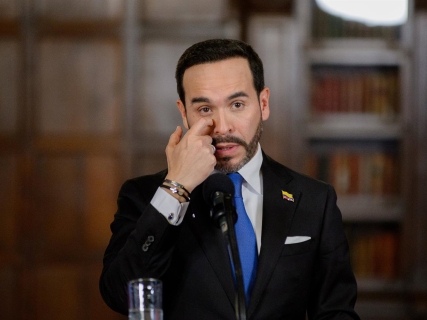

The president of Colombia, Abelardo de la Espriella, has presented this Sunday his public apologies to the people who felt aggrieved by the religious event held on the day of his inauguration, last August 7. He does so after a judge expressly ordered him to ask for forgiveness considering that this act violated "religious neutrality".
"If this act caused discomfort or if it offended anyone, in my capacity as head of State, I offer apologies for it," the far-right leader has stated in a message to the nation, an intervention that concluded with the expressions "long live Christ the King" and "God bless Colombia".
The questioned ceremony took place in the city of Cali and included a religious act in which several spiritual leaders participated, who carried out a manifestation of faith and a joint prayer. However, De la Espriella has defended that "the ceremony of the transmission of command corresponded to a point on the agenda of the joint session of the honorable Congress of the Republic approved on August 7" and that "the preparation of the agenda corresponds to one of the powers of the directive tables of that honorable corporation and included a point called invocation".
The president has also emphasized that, despite his personal faith, he respects the separation between Church and State. "Although I identify as a believer, I am Catholic. I respect the separation between the Church and the State and I will guarantee within the framework of my functions the freedoms and rights of all Colombians without any distinction, including the freedom to profess any religion or to not profess any," he has reiterated, also emphasizing that the Colombian Constitution "protects" his "right to freely profess" his religion and "to do so publicly and privately".
The judicial resolution that obliges him to apologize was known just a week ago. In it, the judge ordered the head of the Colombian Executive to apologize to the country for "violating religious neutrality" during the inauguration ceremony, thus estimating the claim of a citizen who went to the courts considering that there was a "violation of fundamental rights to freedom of conscience and worship".
According to the details in the sentence, the ceremony included a segment called "invocation and praise," in which representatives of three different confessions participated, in addition to displaying an image of the Virgin of Fatima at the place where the official event took place.