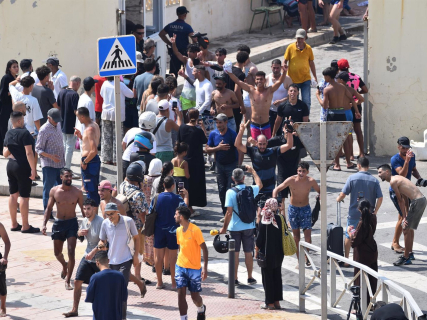

The so-called Armada of Solidarity with Ceuta gathered this weekend dozens of private boats mainly from the Costa del Sol and the Campo de Gibraltar to convey a message of support to the autonomous city after the massive entry of migrants recorded on July 30 and 31.
Despite its name, it is not an initiative of the Spanish Navy nor a military device. It is a civilian flotilla promoted by entrepreneurs, sailors, and other people linked to civil society that has counted on the logistical collaboration of Marina de Ceuta and with a reception organized in the city.
The call was presented under slogans such as "United for Ceuta, united for Spain", "The sea unites us. Ceuta calls us" and "We are all Ceuta, Spain responds united". Its promoters defined it from the beginning as a "civic and peaceful" action aimed at expressing solidarity, closeness, and support to the people of Ceuta.
However, in recent hours the meeting has also acquired a political dimension. Some organizers have used their presence in Ceuta to demand changes in the management of the crisis, hold the Government accountable, and advocate for the return of migrants who do not have the right to remain in Spain.
What is the Armada of Solidarity and who is behind it
The initiative began to be organized during the second half of August and was initially scheduled for the 23rd, but weather conditions in the Strait forced its postponement until this weekend.
Among its promoters are Marcos de Quinto, businessman and former deputy of Ciudadanos; Amalio de Marichalar; Francisco Mier del Castillo; África León; Juan Núñez; Fernando Oltra and businessman Pedro Rodríguez, who has acted as one of its main spokespersons.
The initial idea, as Rodríguez explained to media in Ceuta, was born among a group of boat owners who were looking for a visible way to convey their support to the city. From there, the call extended to marinas, nautical clubs, brotherhoods, schools, and other sailors.
The organizers initially proposed a maximum of 60 boats, partly conditioned by the available moorings in Ceuta. During Saturday, several dozen boats arrived and different reports placed participation around 50 boats and about 120 participants.
The main event, this Sunday in the waters of Ceuta
The vessels did not cross the Strait forming a single fleet. Each captain left from their port of origin and arrived staggered in Ceuta during Saturday to avoid concentrations at the marina.
The program reserved for this Sunday the main visual act of the initiative: a joint navigation along the coast of Ceuta and a concentration in the South Bay.
The organizers' forecast is that boats arriving from the Peninsula will be joined by Ceuta vessels until approaching a hundred. Canal Sur also reported that the participation of three helicopters was expected and that the vessels would sound their sirens during the concentration. The final number of participants will be known once the event is concluded.
Free moorings and a reception in Ceuta
The initiative has had logistical support in the city.
Marina de Ceuta, led by Mehdi Amin, made its facilities available to the participants and offered free mooring to the registered vessels. The program also included a visit to the city and a reception with the sailors.
The information disseminated before the arrival also indicated that there would be a welcome or courtesy dinner offered by the City. The subsequent programming placed the nighttime meeting in the vicinity of the Nautical Club.
This institutional component is relevant to understand the controversy that later arose between Marcos de Quinto and a member of the Ceuta Government.
From an act of solidarity to a platform with political demands
Although the call was initially presented as a show of support for the citizens of Ceuta, some of its promoters have been incorporating specific political demands.
Pedro Rodríguez stated during the arrival that the objective was, on one hand, "to show solidarity and support" for Ceuta and, on the other, to demand a more forceful response from the Government regarding the border crisis.
The promoter defended the expulsion of those who remain in the city after the massive entry and used the term "invaders" to refer to them. He also called for a permanent reinforcement of the border of Ceuta and Melilla and questioned the response of the central Government before and after July 30.
These statements correspond to the political position of one of the organizers. The possibility of returning a person does not depend on a collective claim: returns, asylum requests, and the situation of minors are subject to individualized legal procedures and guarantees.
The existence of this type of message explains that the initiative, although it was formally born as a call for solidarity, has also ended up entering the political debate on the management of Ceuta.
What really happened between De Quinto and Cecchi
In his publication, De Quinto also criticized the gestures and the "non-verbal language" of Cecchi while he spoke and considered that the behavior of the counselor reflected differences with the position maintained by the PP.
It is important to separate at this point verifiable facts from personal interpretations.
There is a public intervention by De Quinto and he states that Cecchi responded to him that his electoral appeal was not appropriate. The assessment of the counselor's facial expressions or the reasons for which he intervened corresponds exclusively to the interpretation of the former deputy.
As of the information available this Sunday, there is no equivalent public explanation from Cecchi regarding the episode. Therefore, it cannot be concluded that he intended to limit De Quinto's freedom of expression nor what exactly his motives for intervening were.
The PP of Ceuta, in a different institutional position
The incident also reflects the difference between the position of certain promoters of the flotilla and the one that the Government of Ceuta headed by Juan Jesús Vivas must maintain.
The local Executive, governed by the PP, has been very critical of various aspects of the central government's response and has demanded for weeks more resources, a single command, and an acceleration of returns.
At the same time, it occupies an institutional position that forces it to coordinate with the central Executive, the Security Forces and Corps, emergency services, and the authorities responsible for immigration.
The request for general elections made by De Quinto is therefore outside the initial institutional objective of a reception organized as a gesture of solidarity with Ceuta, although the former deputy maintains that as an organizer he had full freedom to introduce that claim.
A civil initiative at a time of high tension
The arrival of the Armada of Solidarity occurs in a particularly delicate context.
Ceuta has been registering citizen protests, violent incidents, and tensions around some reception spaces for several weeks. Some calls planned for this weekend were even suspended for fear that they would be used by radical groups.
The flotilla, on the contrary, has maintained in its official call the peaceful nature with which it was presented. There are no relevant incidents associated with the crossing of the vessels during their arrival on Saturday.
The debate has fundamentally shifted to the political content of the messages expressed by some of its promoters, especially after the episode between De Quinto and Cecchi.
Solidarity, claim, and politics: the three dimensions of the flotilla
The Armada of Solidarity thus brings together three distinct elements that should be differentiated.
First, there is a citizen and nautical initiative whose declared objective is to show support for the population of Ceuta. Second, several promoters have used the meeting to demand border reinforcement and changes in migration policy. And finally, some interventions have directly entered the partisan terrain, as happened with Marcos de Quinto's call for general elections.
The controversy does not alter the civil nature of the flotilla, but it has modified the initial image of a call conceived exclusively as an act of brotherhood.
The planned joint route this Sunday in the South Bay will serve to close the maritime program. The main unknown is no longer solely how many boats will participate, but whether the initiative remains a show of solidarity with Ceuta or also consolidates a political dimension of its own after the statements of some of its organizers.